
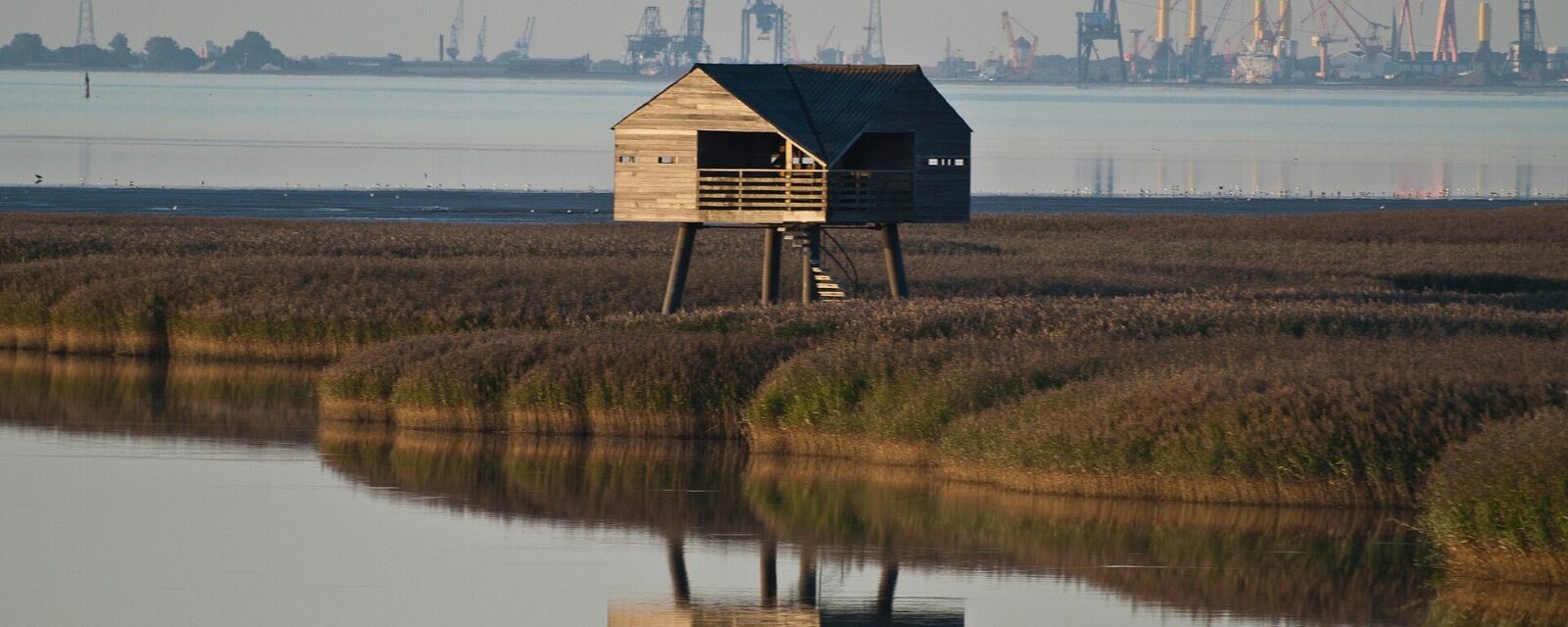
 📷 Foto: Uberprutser / CC BY-SA 3.0 via Wikimedia Commons.
De Dollard: where to see wildlife
August for the waders, when Het Groninger Landschap says tens of thousands of birds drop in to sit out the high tide. Seals: late May or early June to August. Late summer for the lilac fields of sea aster on the salt marsh. Note a contradiction within the site manager’s own pages: the seal-watching screen page says it is open from spring to autumn, the visitor centre page says from late April to mid-September. Estuary and salt marsh
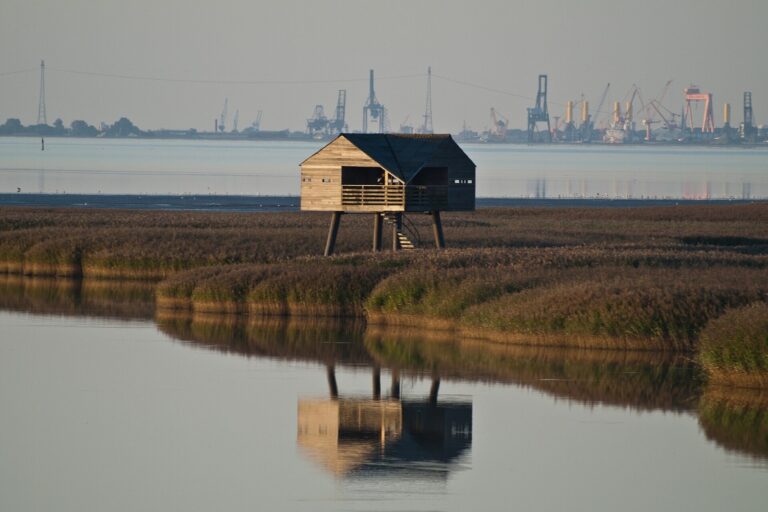
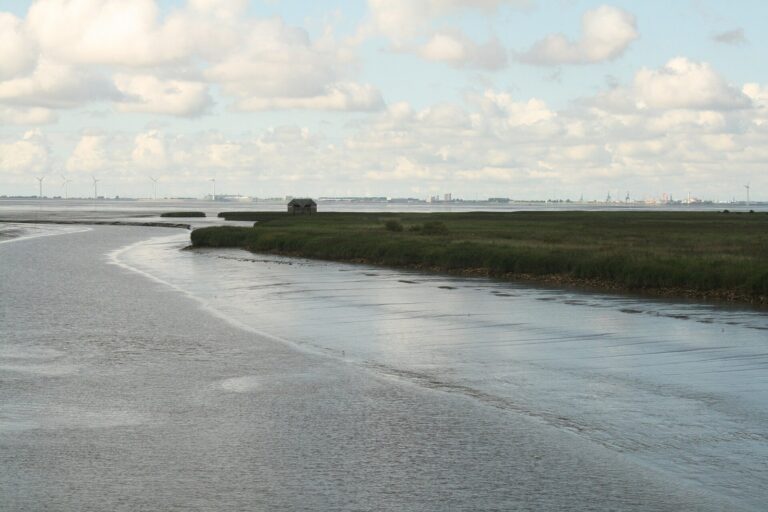
De Dollard — The Kiekkaaste is the only hide in the Netherlands that stands outside the sea dyke. Two strong alternatives, from the site manager’s own sources: the Beheerplan Dollard 2016 calls the Punt van Reide the only example in the Netherlands of a headland outside the dyke, and Polder Breebaart is the first tidal area inside a Dutch sea dyke, with the largest avocet colony in Europe. Mainly here: Marine mammals, from the Beheerplan Dollard 2016: harbour seals are the ones you mostly see in the Eems estuary, grey seals have been turning up more often in the mouth of late, and the harbour porpoise is recorded regularly. The neighbouring mudflat is a nursery for seals. Birds at the Punt van Reide: Arctic Tern, Common Tern, Common Redshank, Pied Avocet, Black-headed Gull and Common Ringed Plover as breeding birds; the management plan singles out the large numbers of ringed plovers, colony nesters and redshanks, plus Barnacle Goose and Dunlin. At Polder Breebaart: Black-headed Gull, Common Tern and Arctic Tern as breeding birds, with the largest avocet colony in Europe; also waders, geese, ducks and spoonbills. From the Polder Breebaart hide, Broad-billed Sandpiper, Pectoral Sandpiper, Red-breasted Goose, White-winged Tern, Black Stork and White-tailed Eagle have been seen. At the Kiekkaaste, birdingplaces.eu (a user-contributed source) lists White-tailed Eagle, Dunlin, Bearded Reedling, Common Greenshank, Spotted Redshank, Whimbrel, Pied Avocet, Black Tern and Twite; Het Groninger Landschap names no species on its own Kiekkaaste page. Insect: the sea-aster mining bee, which lives on sea aster outside the dyke. Flatfish in the estuary: flounder, sole, dab and plaice. For amphibians, reptiles, dragonflies and butterflies we found no source linking a species to the Dollard. Best period: August for the waders, when Het Groninger Landschap says tens of thousands of birds drop in to sit out the high tide. Seals: late May or early June to August. Late summer for the lilac fields of sea aster on the salt marsh. Note a contradiction within the site manager’s own pages: the seal-watching screen page says it is open from spring to autumn, the visitor centre page says from late April to mid-September.
Which animals will you see here?
Also reported present in this area (150 species) presence reported
These species are known to occur here (NDFF), but nothing has been recorded yet about your chance of seeing them.
Amphibian (1)
Grasshopper (3)
Fish (2)
Butterfly (7)
Bird (122)
Marine mammal (3)
Mammal (land) (9)
Mammal (land/water) (2)
Mammal (bat) (1)
Walking routes
Wandelroute Dollard
Wandelroute Dollardkwelder
Vlonderpad naar de Kiekkaaste
Hides and viewpoints
🔭 Bird hide De Kiekkaaste
🔭 Bird hide Polder Breebaart
🔭 Seal viewing wall
🔭 Viewpoint in the visitor centre
🔭 Photo hide Han Bouwmeester
Practical information
- Access: Polder Breebaart is free to enter as long as you stay on the paths. The viewing facilities are open from sunrise to sunset. The Punt van Reide is closed: Het Groninger Landschap states plainly that it is shut to the public, the only exception being a handful of guided excursions each year outside the breeding season. Drones are not allowed, because this is a Natura 2000 site. The site manager publishes little about tides and safety for the area outside the dyke: the only concrete advice concerns the seal-watching screen, for which you follow the Delfzijl tide table plus twenty minutes for the Punt van Reide, and arrive an hour and a half before high water. Those twenty minutes do not simply apply to the Kiekkaaste as well. For the Kiekkaaste what does apply: the ground is flat and wet and can be under water at high tide, and in a strong wind you are better off doing something else. Bring boots.
- Parking: At the Bezoekerscentrum Dollard, Dallingeweersterweg 30 in Termunten: reachable by car with enough spaces, and a separate parking instruction for coaches. At Nieuwe Statenzijl there is a car park for the Kiekkaaste; capacity and cost are not stated. We found no source anywhere on parking charges, so do not assume it is free.
- Dogs: Not allowed, and all the sources agree on that. The general Het Groninger Landschap policy is that in most of their reserves you may walk your dog on a lead. But with explicit exceptions: dogs are not allowed on the Dollard, Bourtange and Reitdiep walking routes, nor on the salt marshes of Westpolder and Noordpolderzijl. The Dollard walking route page gives the reason: dogs are not allowed on this route because it is a sensitive bird area. Dogs are also banned at Polder Breebaart, the Polder Breebaart hide, the Kiekkaaste and the seal-watching screen. No contradiction found.
- Facilities: Bezoekerscentrum Dollard, Dallingeweersterweg 30, 9947 TB Termunten, 0596-601880. Entry is free according to visitgroningen; the site manager quotes no price. Upstairs in the building there is a viewpoint looking out over the birds in Polder Breebaart. The Han Bouwmeester photography hide can be hired, and there are teaching programmes for school groups. Nearby: Batterij Fiemel and the Dollardfestival, held in September every other year. We found no source on toilets or refreshments. Watch the opening hours: in summer Het Groninger Landschap names only Friday as an extra day, visitgroningen names Wednesday and Friday. We found no reliable source on public transport to Termunten or Nieuwe Statenzijl; plan ahead via 9292.
🌿 Rules in this area
Split. Het Groninger Landschap. Within the Dollard they manage the Punt van Reide, Polder Breebaart and the brackish reed bed with the Kiekkaaste hide near Nieuwe Statenzijl. Natuurmonumenten is the legal owner of a large part of the open mudflat (3,740 ha), which Het Groninger Landschap manages. We could not find an exact division of management with Rijkswaterstaat, which manages the Eems-Dollard as state water. sets its own rules here. Stay on the paths, respect refuges and closures, keep dogs on a lead where that applies, and do not fly a drone — they are banned in almost every Dutch nature reserve.
Status: Verified · Last checked: 2026-10-29
Photo: Foto: Uberprutser / CC BY-SA 3.0 via Wikimedia Commons.