
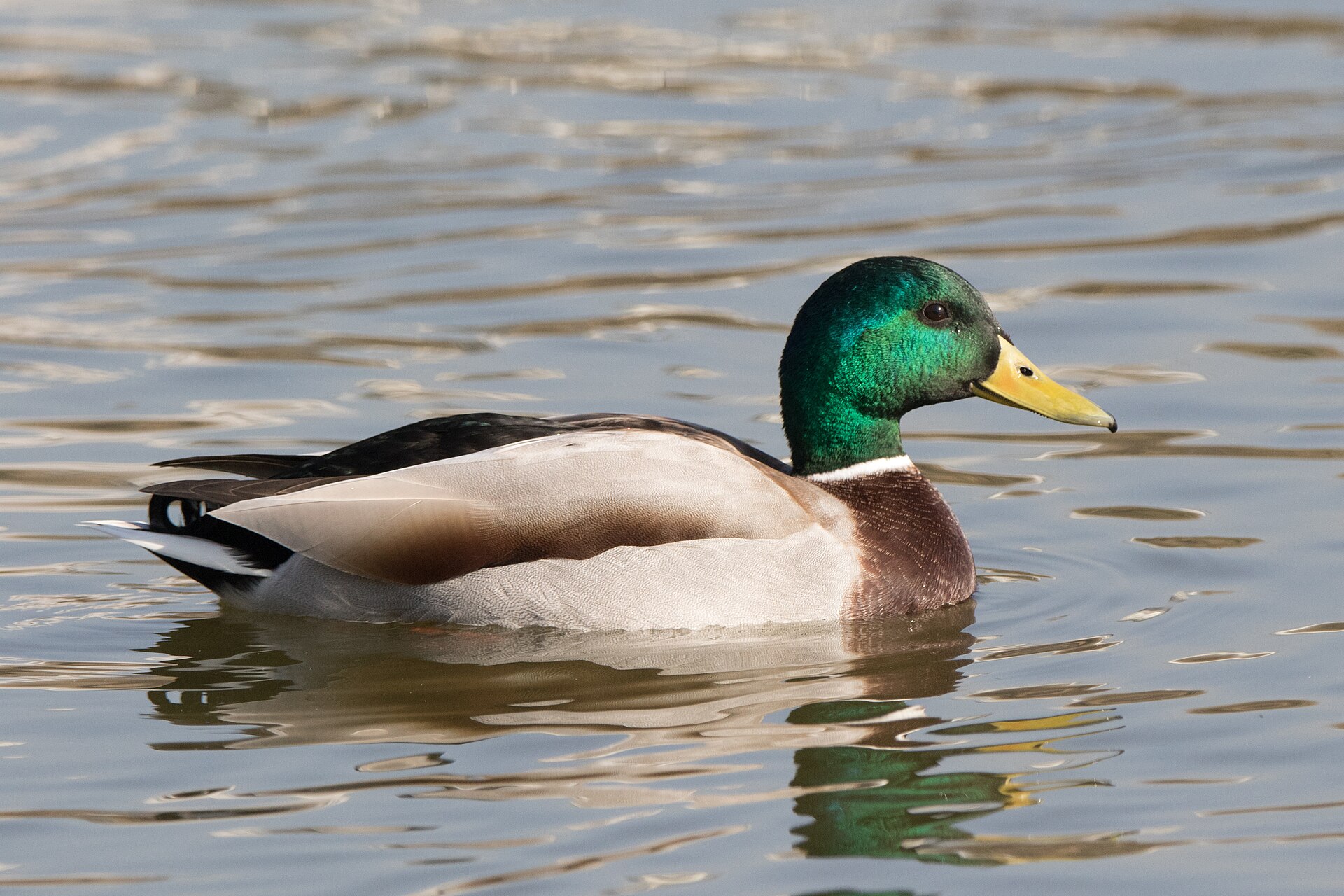
Mallard
📷 Nrik kiran, CC BY-SA 4.0 (Wikimedia Commons)

Where to see the Mallard in the Netherlands

Anas platyrhynchos · Mallard

Easy 🦅 Bird

Where and when do you see a Mallard? This species is easy to see, from October to April.

How do you recognise a Mallard?

Length 50 to 65 cm, wingspan 75 to 100 cm. The male has a glossy green head, a yellow bill and a narrow white neck ring above a brown breast; the female is mottled brown and far more inconspicuous. Both have a blue-purple wing speculum with white edges, the feature by which you always recognise a mallard, even in eclipse plumage.

What can you confuse a Mallard with?

Looks like: Gadwall, Northern Shoveler, Northern Pintail, Eurasian Teal, Eurasian Wigeon

  • Gadwall: The female closely resembles a female mallard, but has a white speculum instead of a blue-purple one, plus an orange bill edge and a white belly.
  • Northern Shoveler: The female is almost as mottled brown, but the broad, flat spatula bill is almost as long as the head, which you see at once.
  • Northern Pintail: The female is slimmer, with a longer neck and a plain dark grey bill; the male has two long pointed tail feathers.
  • Eurasian Teal: At 34 to 38 centimetres the teal is well over a third smaller and the male has a green, yellow-rimmed eye patch.
  • Eurasian Wigeon: The wigeon is smaller and more compact, with a high forehead, a short blue-grey bill and a large white wing panel in flight.

What does a Mallard sound like?

Recording: Jonathon Jongsma, CC BY-SA 3.0, via Wikimedia Commons

Where do you see this species in the Netherlands?

Almost the whole of the Netherlands, from polder ditch to town pond. It is the commonest duck in the country.

Habitat: Almost any fresh water: ditches, lakes, canals, ponds and river floodplains, with bankside vegetation to nest in.

This is a common, widespread species: you can come across it in far more places than the areas listed below. Treat that list as a starting point rather than a full survey.

How certain is this? verified chance per source presence reported Links that do not clear the bottom threshold are not published. How we decide that.

📍 Gelderse Poort & Millingerwaard

Good chance chance per source
Vogelwerkgroep Nijmegen · area description
Nationwide period: Present all year. From October to April the males wear their finest plumage; in the summer months they moult and temporarily resemble females, the so-called eclipse plumage.

📍 Amsterdamse Waterleidingduinen

Good chance chance per source
Birdingplaces · most recorded species
Nationwide period: Present all year. From October to April the males wear their finest plumage; in the summer months they moult and temporarily resemble females, the so-called eclipse plumage.

📍 Nationaal Park Zuid-Kennemerland

Good chance chance per source
Kennemerduinen.com
Nationwide period: Present all year. From October to April the males wear their finest plumage; in the summer months they moult and temporarily resemble females, the so-called eclipse plumage.

📍 Blauwe Kamer

presence reported
NDFF open data
Nationwide period: Present all year. From October to April the males wear their finest plumage; in the summer months they moult and temporarily resemble females, the so-called eclipse plumage.

📍 Zouweboezem

presence reported
NDFF open data
Nationwide period: Present all year. From October to April the males wear their finest plumage; in the summer months they moult and temporarily resemble females, the so-called eclipse plumage.

📍 Oostelijke Vechtplassen

presence reported
NDFF open data
Nationwide period: Present all year. From October to April the males wear their finest plumage; in the summer months they moult and temporarily resemble females, the so-called eclipse plumage.
NDFF open data
Nationwide period: Present all year. From October to April the males wear their finest plumage; in the summer months they moult and temporarily resemble females, the so-called eclipse plumage.

📍 Wormer- en Jisperveld

presence reported
NDFF open data
Nationwide period: Present all year. From October to April the males wear their finest plumage; in the summer months they moult and temporarily resemble females, the so-called eclipse plumage.

📍 Ilperveld

presence reported
NDFF open data
Nationwide period: Present all year. From October to April the males wear their finest plumage; in the summer months they moult and temporarily resemble females, the so-called eclipse plumage.

📍 De Dollard

presence reported
NDFF open data
Nationwide period: Present all year. From October to April the males wear their finest plumage; in the summer months they moult and temporarily resemble females, the so-called eclipse plumage.
NDFF open data
Nationwide period: Present all year. From October to April the males wear their finest plumage; in the summer months they moult and temporarily resemble females, the so-called eclipse plumage.

📍 Meijendel & Berkheide

presence reported
NDFF open data, 8.637 records 2016-2026
Nationwide period: Present all year. From October to April the males wear their finest plumage; in the summer months they moult and temporarily resemble females, the so-called eclipse plumage.

📍 Voornes Duin

presence reported
NDFF open data, 2.046 records 2016-2026
Nationwide period: Present all year. From October to April the males wear their finest plumage; in the summer months they moult and temporarily resemble females, the so-called eclipse plumage.
NDFF open data, 4.064 records 2016-2026
Nationwide period: Present all year. From October to April the males wear their finest plumage; in the summer months they moult and temporarily resemble females, the so-called eclipse plumage.

📍 De Maashorst

presence reported
NDFF open data, 2.547 records 2016-2026
Nationwide period: Present all year. From October to April the males wear their finest plumage; in the summer months they moult and temporarily resemble females, the so-called eclipse plumage.
NDFF open data, 1.886 records 2016-2026
Nationwide period: Present all year. From October to April the males wear their finest plumage; in the summer months they moult and temporarily resemble females, the so-called eclipse plumage.

📍 Loonse en Drunense Duinen

presence reported
NDFF open data, 4.195 records 2016-2026
Nationwide period: Present all year. From October to April the males wear their finest plumage; in the summer months they moult and temporarily resemble females, the so-called eclipse plumage.

📍 Schoorlse Duinen

presence reported
NDFF open data, 11.476 records 2016-2026
Nationwide period: Present all year. From October to April the males wear their finest plumage; in the summer months they moult and temporarily resemble females, the so-called eclipse plumage.

📍 Haringvlietsluizen

presence reported
NDFF open data, 1.598 records 2016-2026
Nationwide period: Present all year. From October to April the males wear their finest plumage; in the summer months they moult and temporarily resemble females, the so-called eclipse plumage.
NDFF open data, 341 records 2016-2026
Nationwide period: Present all year. From October to April the males wear their finest plumage; in the summer months they moult and temporarily resemble females, the so-called eclipse plumage.

📍 De Putten bij Camperduin

presence reported
NDFF open data, 2.826 records 2016-2026
Nationwide period: Present all year. From October to April the males wear their finest plumage; in the summer months they moult and temporarily resemble females, the so-called eclipse plumage.

These links come straight from our database, with the chance, the source and the evidence level for each area.

When is the best time?

Green = present · orange = peak period. The bar is generated from our database.

Best period: Present all year. From October to April the males wear their finest plumage; in the summer months they moult and temporarily resemble females, the so-called eclipse plumage.

Best time of day: Morning and evening, though mallards are visible all day on open water.

Recent sightings

👁️ Where has this species been seen recently?

Check the current sightings on Waarneming.nl. A useful addition to our own verified information.

Current sightings on Waarneming.nl →

How to improve your chances

  • Learn the calls first. You will hear most birds before you see them.
  • Go in the first hour after sunrise, when the song is at its peak and the wind is still down.
  • Use a hide or natural cover. Sitting still gets you more than walking closer.
  • Keep the sun behind you. Against the light you see a silhouette and no colour.

Photography

Green only becomes green in low side light; photograph at water level

🌿 Watching responsibly

Keep your distance, stay on the paths, and never lure animals with food or sound. Leave as soon as an animal becomes uneasy.

Sources: Sovon / Vogelbescherming / Zodion / Vlinderstichting; Vogelbescherming Nederland (vogelgids), geraadpleegd 02-11-2026
Status: Verified · Last checked: 2026-08-08

More photos
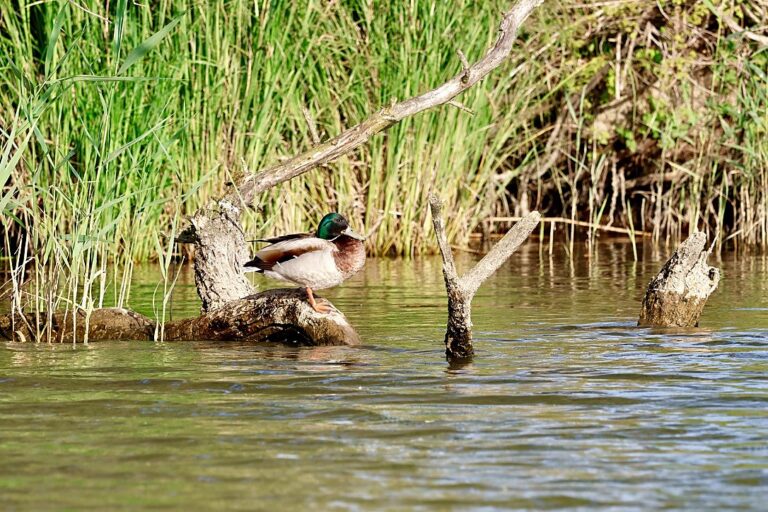
Mannetje wilde eend rustend op een half ondergelopen boomstam
Photo: Bas de Bruin — Biesbosch