
Where to see the Dunlin in the Netherlands
Easy 🦅 Bird
Where and when do you see a Dunlin? This species is easy to see, from August to May.
How do you recognise a Dunlin?
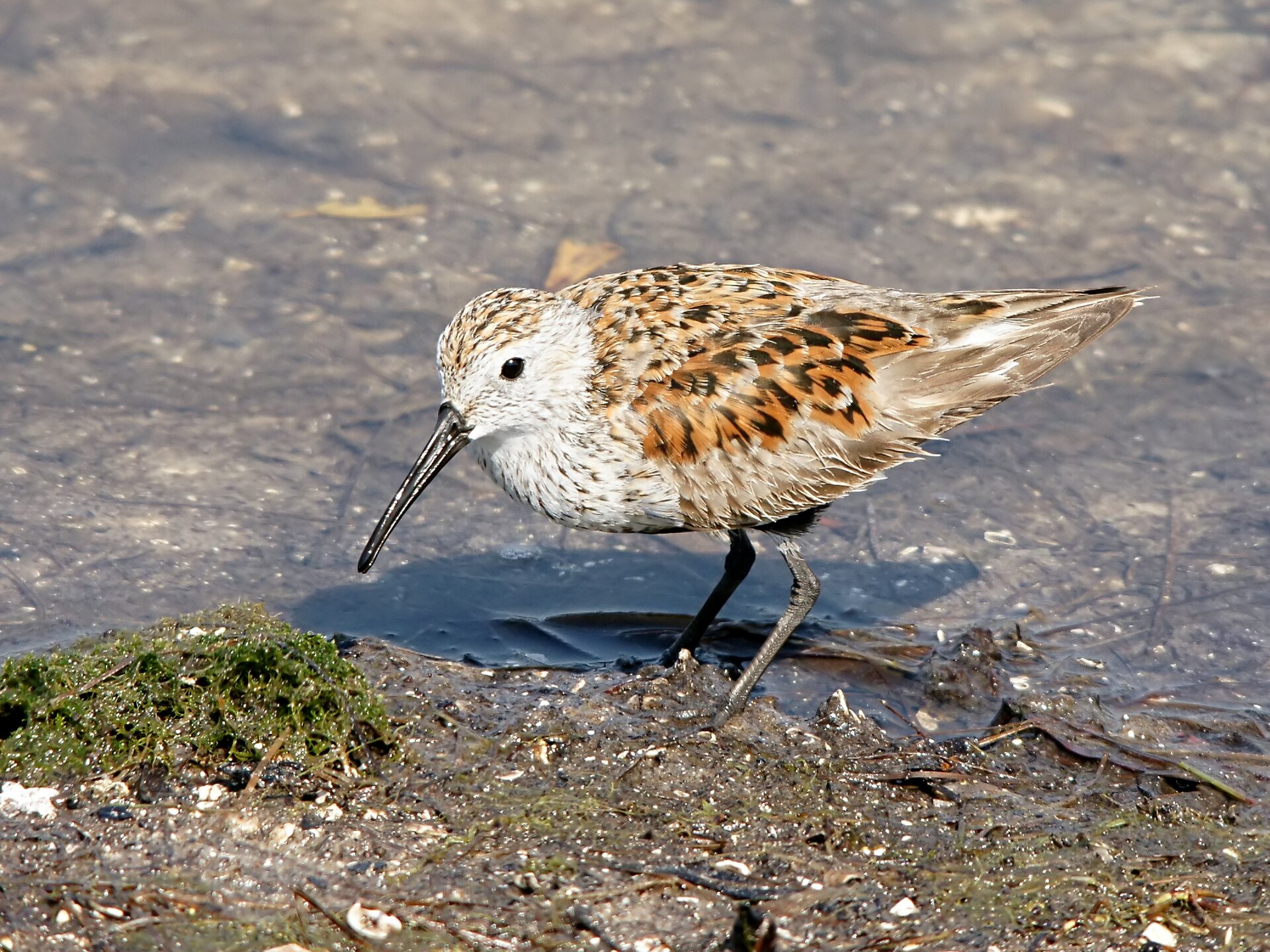
It depends entirely on the season, and one of the two plumages is unmistakable. In summer there is nothing else like it: a black belly patch below an orange-brown marked upperside, and no other wader here has that black belly. In winter it turns plain grey and you have to go by shape: 16 to 22 centimetres with a wingspan of 33 to 40, noticeably smaller and slighter than a Red Knot, with black legs and a fairly long bill that kinks clearly downwards towards the tip. That bill is what separates it from the knot, whose bill is short and straight. In flight it shows narrow white wing bars, and the call is a hoarse, strained little trill, usually heard as a flock lifts rather than from a settled bird.
What does a Dunlin sound like?
Recording: British Library, CC BY 4.0, via Wikimedia Commons
Where do you see this species in the Netherlands?
The tidal flats of the Wadden Sea and the Delta hold the bulk of them. Two things surprise people. First, you will rarely find Dunlin on an open sandy beach, which is Sanderling habitat; the Dunlin wants mud. Second, it is increasingly turning up in wet grassland inside nature reserves, well away from the coast, which makes it a species you can now look for inland.
📍 Nationaal Park Lauwersmeer
presence reported📍 Nationaal Park De Biesbosch
With luck chance per source📍 Oostvaardersplassen
presence reported📍 Nationaal Park Oosterschelde
Good chance in season chance per source📍 Zwin & Zeeuws-Vlaanderen
presence reported📍 Gelderse Poort & Millingerwaard
presence reported📍 Amsterdamse Waterleidingduinen
presence reported📍 Nationaal Park Duinen van Texel
presence reported📍 Sint-Pietersberg & Zuid-Limburg
presence reported📍 Marker Wadden
Good chance in season chance per source📍 Wadden Sea
Good chance chance per source📍 Noordhollands Duinreservaat
presence reported📍 Wormer- en Jisperveld
presence reported📍 Ilperveld
presence reported📍 De Dollard
presence reported📍 Zuidlaardermeergebied en Hunzedal
presence reported📍 Meijendel & Berkheide
presence reported📍 Voornes Duin
presence reported📍 De Maashorst
presence reported📍 Strabrechtse Heide & Beuven
presence reported📍 Loonse en Drunense Duinen
presence reported📍 Schoorlse Duinen
presence reported📍 Haringvlietsluizen
presence reported📍 Vismigratierivier Afsluitdijk
presence reported📍 De Putten bij Camperduin
presence reportedThese links come straight from our database, with the chance, the source and the evidence level for each area.
When is the best time?
Green = present · orange = peak period. The bar is generated from our database.
Best period: August to May, with October the clear peak; in that month something like half a million birds move through.
Best time of day: Around high water. As the flats flood the birds gather at high-tide roosts and stand packed together in their thousands, and a rising flock turns as a single cloud, switching from dark to silver-white as the birds bank. It lasts an hour or two, and then the tide gives the mud back and they scatter. Keep your distance while it lasts: the roost is their rest between tides, not a spare moment.
Recent sightings
👁️ Where has this species been seen recently?
Check the current sightings on Waarneming.nl. A useful addition to our own verified information.
How to improve your chances
- Learn the calls first. You will hear most birds before you see them.
- Go in the first hour after sunrise, when the song is at its peak and the wind is still down.
- Use a hide or natural cover. Sitting still gets you more than walking closer.
- Keep the sun behind you. Against the light you see a silhouette and no colour.
🎒 What you need for this
A telescope
🌿 Watching responsibly
Keep your distance, stay on the paths, and never lure animals with food or sound. Leave as soon as an animal becomes uneasy.
Status: Verified · Last checked: 2026-08-08
Our most numerous wader
The Dunlin (Calidris alpina) is by a wide margin the most numerous wader in the Netherlands. In October, when passage peaks, something like half a million birds move through. It is also the one most people walk past without registering, because for eight months of the year it is a small grey bird among tens of thousands of other small grey birds.
Numbers
- 250,000 to 290,000 birds here in winter.
- 440,000 to 530,000 passing through in October.
As a passage migrant and winter visitor the Dunlin has been doing well since roughly 1985.
As a Dutch breeding bird it has effectively gone. It used to nest sporadically along our coast; now it is at most one pair in a year, and the Dutch Red List classes it as extinct as a breeding bird. The birds you see are from northern Scandinavia, Russia, Greenland and Canada. Both of those statements are true at the same time, which is worth holding on to: abundance on the flats tells you nothing about whether a species still breeds here.
How it feeds
By touch, with fast repeated probing — the usual comparison is a sewing machine, and it is a good one. It does not see its prey, it feels it. On the menu: bristle worms, small molluscs, crustaceans and insects.
One habit is oddly specific and easy to watch if you have a scope on a feeding bird: worms are often rinsed in water before being swallowed.
Like the Red Knot it feeds day and night, because the tide sets the rhythm rather than the light.
Sources
Our sources for this species are in Dutch.
- Vogelbescherming Nederland (bird guide), consulted 2 November 2026 (in Dutch): identification, measurements, feeding behaviour and call.
- Sovon Vogelonderzoek Nederland (in Dutch): the winter and passage totals, the trend since 1985, and the breeding-bird status.
- Area-level occurrence on our Dutch pages is based on NDFF Flora & Fauna Verkenner open data alongside statements from the site managers. NDFF counts say something about presence, not about density or your chance of seeing a bird.
- Red Knot — the larger, stockier wader in the same flocks, and the full explanation of the high-tide roost.
- Sanderling — the one you actually do find on sandy beaches.
- The Wadden Sea — the area page.
- How we work — where our facts come from and what we leave out.
Frequently asked questions
Where and when do you see dunlin?
From August to May, with a peak in October, and mainly on the tidal flats of the Wadden Sea and in the Delta. This is by far our most numerous wader: 250,000 to 290,000 birds in winter, and 440,000 to 530,000 passing through in October. On open sandy beaches you will rarely see one; in wet grassland in nature reserves, increasingly often.
How do you recognise one?
In summer plumage it is unmistakable: a black belly patch under an orange-brown marked upperside, which no other wader here has. In winter plumage it turns inconspicuously grey and you go by shape — 16 to 22 centimetres, black legs, and a fairly long bill with a clear downward kink at the tip. In flight, narrow white wing bars.
What is the best moment to look?
Around high water. As the flats go under, the birds gather at high-tide roosts and stand in their thousands, packed tight. A rising flock turns as one cloud and shifts from dark to silver-white as the birds bank. Keep your distance: this is their rest period.
How does it find food?
By touch, with rapid probing movements like a sewing machine — it feels its prey rather than seeing it. Bristle worms, small molluscs, crustaceans and insects. Notably, worms are often rinsed in water before being eaten. It feeds by day and by night, because its rhythm follows the tide and not the light.
Does it breed in the Netherlands?
Barely any more. It used to nest sporadically along our coast; today it is at most one pair a year, and the Red List classes it as extinct as a breeding bird here. The birds you see come from northern Scandinavia, Russia, Greenland and Canada. As a passage migrant and winter visitor it has been thriving since about 1985.
What does a dunlin sound like?
A hoarse, strained little trill, usually heard as a flock takes off.