
Where to see the Red Knot in the Netherlands
Easy 🦅 Bird
Where and when do you see a Red Knot? This species is easy to see, from August to May.
How do you recognise a Red Knot?
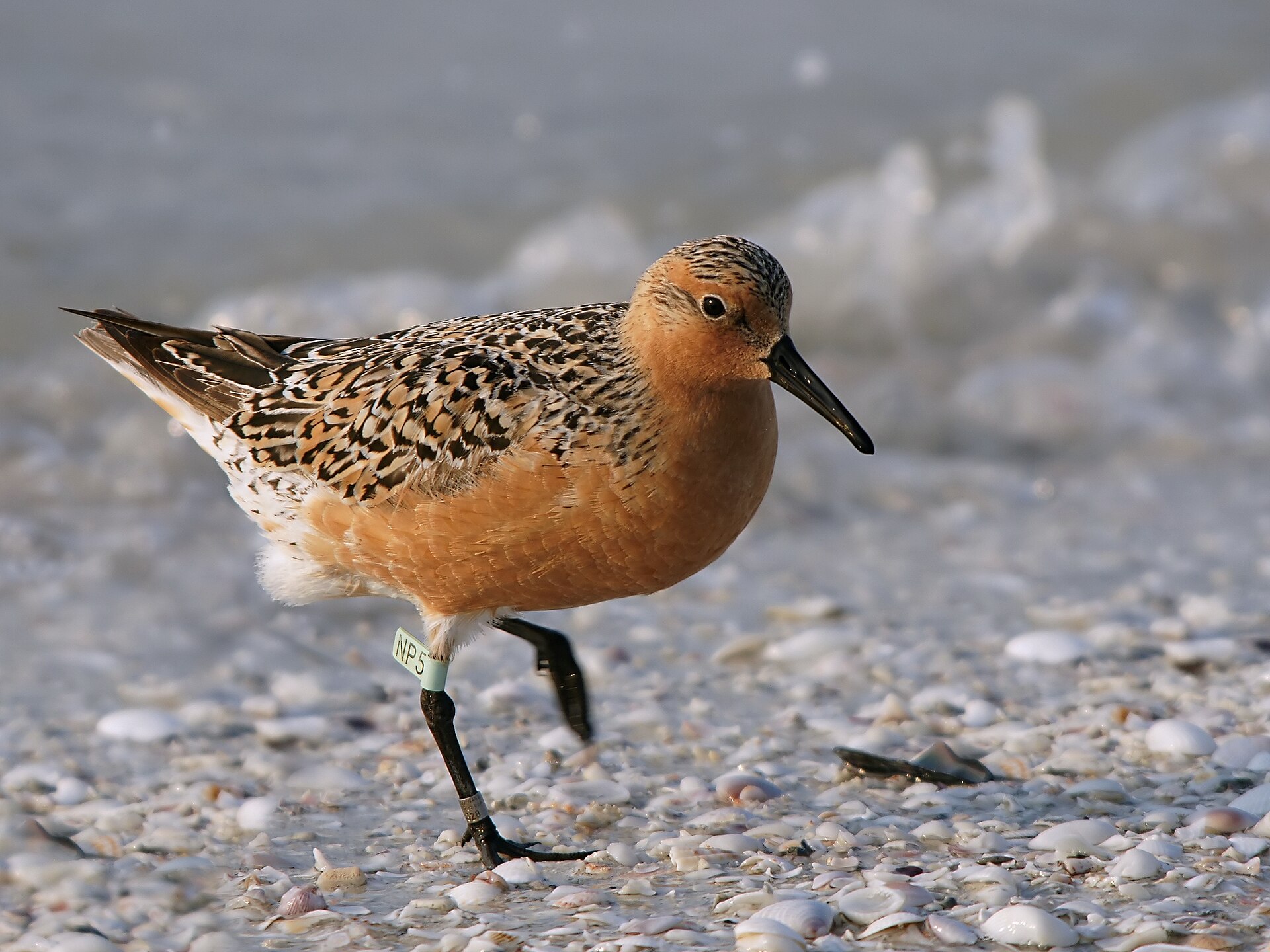
By its build, because the plumage changes completely between seasons. This is our largest Calidris, 23 to 25 centimetres with a wingspan of 45 to 54 centimetres, and it looks heavy-bodied next to a Dunlin. The bill is short and straight and the legs greenish; that bill is the quickest separation from the Dunlin, whose bill is longer and curves down at the tip. In winter the bird is plain grey-white and genuinely unremarkable; in spring the underparts are deep rust-red. A flock in May looks like a different species from the same flock in January.
Where do you see this species in the Netherlands?
Essentially only on the flats. The Wadden Sea is the stronghold; the Zeeland Delta holds good numbers too, and the Oosterschelde is the most accessible place to try. The birds feed on sandy flats and banks, and gather at high water on beaches, salt marshes and higher sandbanks.
📍 Nationaal Park Lauwersmeer
presence reported📍 Nationaal Park De Biesbosch
Rare chance per source📍 Nationaal Park Oosterschelde
Good chance in season chance per source📍 Wadden Sea
Good chance in season chance per source📍 Noordhollands Duinreservaat
presence reported📍 Ilperveld
presence reported📍 De Dollard
presence reported📍 Zuidlaardermeergebied en Hunzedal
presence reported📍 Meijendel & Berkheide
presence reported📍 Schoorlse Duinen
presence reported📍 Haringvlietsluizen
presence reported📍 Vismigratierivier Afsluitdijk
presence reported📍 De Putten bij Camperduin
presence reportedThese links come straight from our database, with the chance, the source and the evidence level for each area.
When is the best time?
Green = present · orange = peak period. The bar is generated from our database.
Best period: The season runs from August to May. Two passage peaks stand out, August and September on the way south and May on the way back, and the highest winter counts fall in midwinter.
Best time of day: Around high water, not low. As the flats flood the birds are pushed together onto the few spots that stay dry, and that is when you can actually see them; at low water they are scattered far out over the mud.
Recent sightings
👁️ Where has this species been seen recently?
Check the current sightings on Waarneming.nl. A useful addition to our own verified information.
How to improve your chances
- Learn the calls first. You will hear most birds before you see them.
- Go in the first hour after sunrise, when the song is at its peak and the wind is still down.
- Use a hide or natural cover. Sitting still gets you more than walking closer.
- Keep the sun behind you. Against the light you see a silhouette and no colour.
🎒 What you need for this
A telescope. Binoculars will show you a grey carpet, not birds
🌿 Watching responsibly
Keep your distance, stay on the paths, and never lure animals with food or sound. Leave as soon as an animal becomes uneasy.
Status: Verified · Last checked: 2026-08-08
The bird that makes the Wadden Sea matter
The Red Knot (Calidris canutus) is the bird that makes the Dutch Wadden Sea internationally important. This is one of the most significant staging areas for the species anywhere in the world, and twice a year a large share of a flyway population passes through it. If you have ever seen a wader flock turn in the air and flip from white to dark and back, you were almost certainly watching knots.
Why high water is the whole trick
This is the one thing to understand before you go, and it applies to every wader on this coast.
At low tide the birds are spread thinly over tens of square kilometres of mud. You will see specks. When the flats flood, feeding stops and the birds have to go somewhere higher — a high-tide roost. There they stand packed shoulder to shoulder, sometimes thousands of them in a block, and that is both the easiest way to see them and the most spectacular. A flock lifting off a roost turns as one organism and switches from white to dark as the birds bank.
It lasts an hour or two around high water, and then it is over. Note that this is the exact opposite of the best moment for seals, which need low water — with one tidal cycle you can do both.
And the thing a roost needs from you is distance. A roost is not a feeding opportunity; it is the only rest the birds get between tides. Birds flushed off one lose that rest and have to spend energy they were storing for a flight to the Arctic. Stay behind the dyke, stay still, and let them settle.
Numbers
- 44,500 to 96,500 birds here in winter.
- 120,000 to 160,000 passing through on autumn migration, August to October.
The trend has been upward since 1980, and that is driven mainly by the Greenland population. The birds you see here come from three separate breeding areas: Greenland and Canada, central and eastern Siberia, and Alaska — which is part of why the composition of a flock changes through the season.
What it eats, and why it does not care what time it is
Small bivalves, chiefly Baltic tellins and young cockles, plus worms. It finds them by touch rather than by sight, probing the mud.
That has a consequence worth knowing: the Red Knot feeds by day and by night. Its rhythm is set by the tide, not by the light. Which is also why a bird that has just been disturbed off a roost cannot simply “feed later” — later is when the flats are under water.
Sources
Our sources for this species are in Dutch.
- Vogelbescherming Nederland (bird guide), consulted 2 November 2026 (in Dutch): identification, measurements, diet and distribution.
- Sovon Vogelonderzoek Nederland (in Dutch): the winter and passage totals, and the trend since 1980.
- Area-level occurrence on our Dutch pages is based on NDFF Flora & Fauna Verkenner open data alongside statements from the site managers. NDFF counts say something about presence, not about density or your chance of seeing a bird.
- The Wadden Sea — the area page, including how to read the tide table.
- Dunlin — the smaller, far more numerous wader you will see in the same flocks.
- Seal watching in the Dutch Wadden Sea — the low-water half of the same day.
- How we work — where our facts come from and what we leave out.
Frequently asked questions
Where can you see red knots in the Netherlands?
Almost only on the tidal flats. The Wadden Sea is one of the most important staging areas for this species in the world; the Zeeland Delta holds them too. They feed on sandy flats and banks, and gather at high water on beaches, salt marshes and sandbanks.
When are your chances best?
August to May, with clear passage peaks in August and September and again in May. In winter there are 44,500 to 96,500 birds; on autumn passage between August and October, 120,000 to 160,000 pass through. Go around high water, when the flats flood and the birds concentrate on a small number of spots.
What is a high-tide roost, and why is that the best moment?
When the flats go under, the birds can no longer feed and move to higher ground — a high-tide roost. There they stand in dense packed groups, sometimes thousands together. It gives the most spectacular sight on this coast: a flock lifting off turns as one body and flips from white to dark as the birds bank. Keep your distance — disturbed birds lose the only rest they get.
How do you recognise a red knot?
By its stocky build. It is our largest wader of the Calidris group, with a short straight bill and greenish legs. In winter plumage it is almost uniformly grey-white and inconspicuous; in spring the whole underside turns deep rust-red, so a flock in May looks nothing like the same flock in January.
What does it eat, and where does it come from?
Mainly small bivalves — Baltic tellins and young cockles — and worms, which it takes from the mud by touch. It feeds by day and by night, because its rhythm follows the tide rather than the light. The birds here come from three breeding areas: Greenland and Canada, central and eastern Siberia, and Alaska. Numbers have risen since 1980, mostly in the Greenland population.