
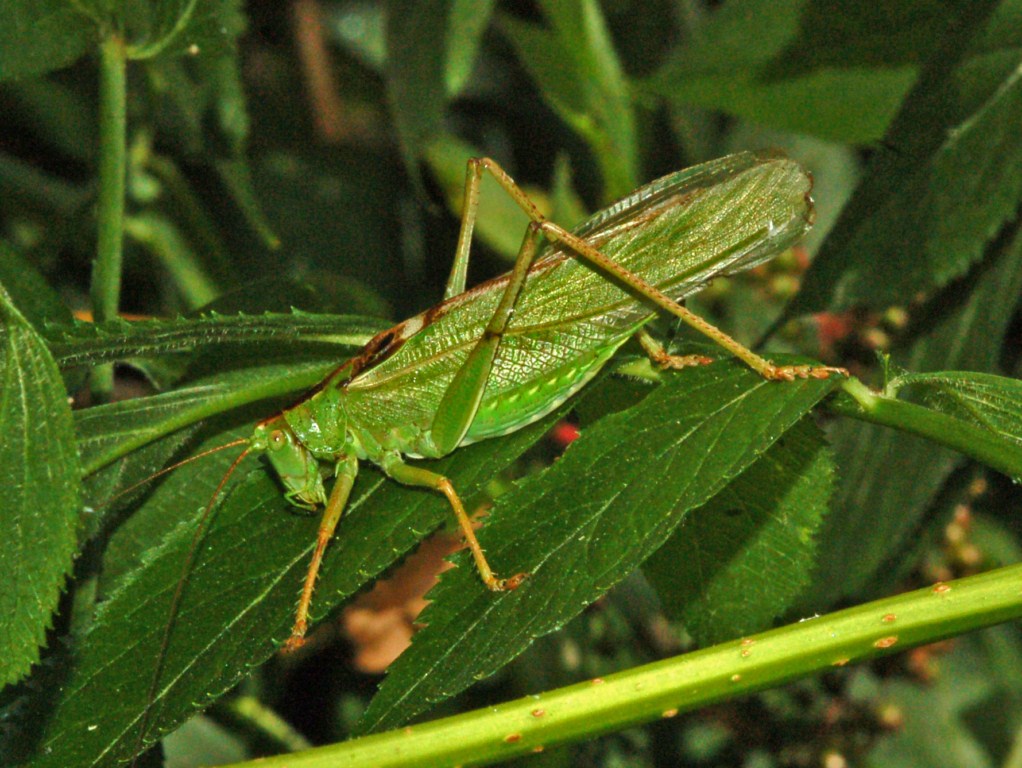
Where to see the Great Green Bush-cricket in the Netherlands
Easy 🦗 Grasshopper
Where and when do you see a Great Green Bush-cricket? This species is easy to see, from July to October.
How do you recognise a Great Green Bush-cricket?
Our largest bush-cricket: 28 to 42 millimetres. Mainly green with a brown stripe along the back; the legs are sometimes yellowish, but the whole animal is rarely yellow. The wings are very long and reach past the knee of the hind leg. The female has a long, straight ovipositor that in adults reaches the wing tips.
What does a Great Green Bush-cricket sound like?
Recording: Gunther Tschuch, CC BY-SA 4.0, via Wikimedia Commons
Where do you see this species in the Netherlands?
Common everywhere. The species has adapted to all sorts of surroundings and occurs in nature areas as well as in gardens, parks and wall vegetation right into the middle of town. Very wet marshland is avoided.
Habitat: Rough vegetation, scrub, wood edges, verges, gardens and parks; anywhere with tall, dense growth. Often sits high in bramble thickets or nettles. The Great Green Bush-cricket is largely a predator: it eats caterpillars, aphids and other grasshoppers, and supplements that with fruit and leaf buds. For the gardener it is a useful insect rather than a harmful one.
This is a common, widespread species: you can come across it in far more places than the areas listed below. Treat that list as a starting point rather than a full survey.
📍 Nationaal Park Weerribben-Wieden
presence reported📍 Sint-Pietersberg & Zuid-Limburg
presence reported📍 Gelderse Poort & Millingerwaard
presence reported📍 Nationaal Park Zuid-Limburg (in formation)
presence reported📍 Oostvaardersplassen
presence reported📍 Nationaal Park Veluwezoom
presence reported📍 Nationaal Park De Biesbosch
presence reported📍 Fochteloërveen
presence reported📍 Nationaal Park Utrechtse Heuvelrug
presence reported📍 Amsterdamse Waterleidingduinen
presence reported📍 Nationaal Park De Meinweg
presence reported📍 Nationaal Park Zuid-Kennemerland
presence reported📍 Nationaal Park De Hoge Veluwe
presence reported📍 Naardermeer
presence reported📍 Deelerwoude
presence reported📍 Nationaal Park De Groote Peel
presence reported📍 Onlanden & Leekstermeer
presence reported📍 Nationaal Park Dwingelderveld
presence reported📍 Zwin & Zeeuws-Vlaanderen
presence reported📍 Nationaal Park Drents-Friese Wold
presence reported📍 Nationaal Park Duinen van Texel
presence reported📍 Nationaal Park Lauwersmeer
presence reported📍 Nationaal Park Sallandse Heuvelrug
presence reported📍 Nationaal Park De Maasduinen
presence reported📍 Kroondomein Het Loo
presence reported📍 Nationaal Park Oosterschelde
presence reported📍 Planken Wambuis
presence reported📍 Grevelingenmeer
presence reported📍 Westerschelde & Saeftinghe
presence reported📍 IJssel-uiterwaarden
presence reported📍 Grensmaas
presence reported📍 IJsselmeer
presence reported📍 Haringvliet & Hollands Diep
presence reported📍 Eemland
presence reported📍 Leuvenumse Bossen
presence reported📍 Blauwe Kamer
presence reported📍 Zouweboezem
presence reported📍 Oostelijke Vechtplassen
presence reported📍 Noordhollands Duinreservaat
presence reported📍 Wormer- en Jisperveld
presence reported📍 Ilperveld
presence reported📍 De Dollard
presence reported📍 Zuidlaardermeergebied en Hunzedal
presence reported📍 Landgoed Ennemaborg
presence reported📍 Meijendel & Berkheide
presence reported📍 Voornes Duin
presence reported📍 Kampina & Oisterwijkse Vennen
presence reported📍 De Maashorst
presence reported📍 Strabrechtse Heide & Beuven
presence reported📍 Loonse en Drunense Duinen
presence reported📍 Schoorlse Duinen
presence reported📍 Haringvlietsluizen
presence reported📍 Vismigratierivier Afsluitdijk
presence reported📍 De Putten bij Camperduin
presence reportedThese links come straight from our database, with the chance, the source and the evidence level for each area.
When is the best time?
Green = present · orange = peak period. The bar is generated from our database.
Best period: Adults from July to October inclusive.
Best time of day: Late afternoon until well into the evening; the song carries on after sunset.
Recent sightings
👁️ Where has this species been seen recently?
Check the current sightings on Waarneming.nl. A useful addition to our own verified information.
How to improve your chances
- Listen first. Almost every species gives itself away by singing before you spot it.
- Go on a warm, windless afternoon. In cold or wind they fall silent.
- Walk slowly and note where the sound stops. That is where it sits, usually low in the vegetation.
- A bat detector makes audible the species that sing too high for human ears.
🎒 What you need for this
Your ears and a torch. Take a bearing on the rattle, walk slowly towards it and then search with the lamp in the top thirty centimetres of the vegetation.
Photography
Look in the early morning, when the animals are still stiff with cold and let you approach. Shoot at eye level with the head sharp and the long antennae in frame; otherwise they fall outside the crop. Do not pull branches aside — move yourself instead.
🌿 Watching responsibly
Keep your distance, stay on the paths, and never lure animals with food or sound. Leave as soon as an animal becomes uneasy.
Status: Verified · Last checked: 2026-08-08