
Where to see the harbour porpoise in the Netherlands
Rare 🦭 Marine mammal
Where and when do you see a harbour porpoise? This species is rarely seen, from November to April.
How do you recognise a harbour porpoise?
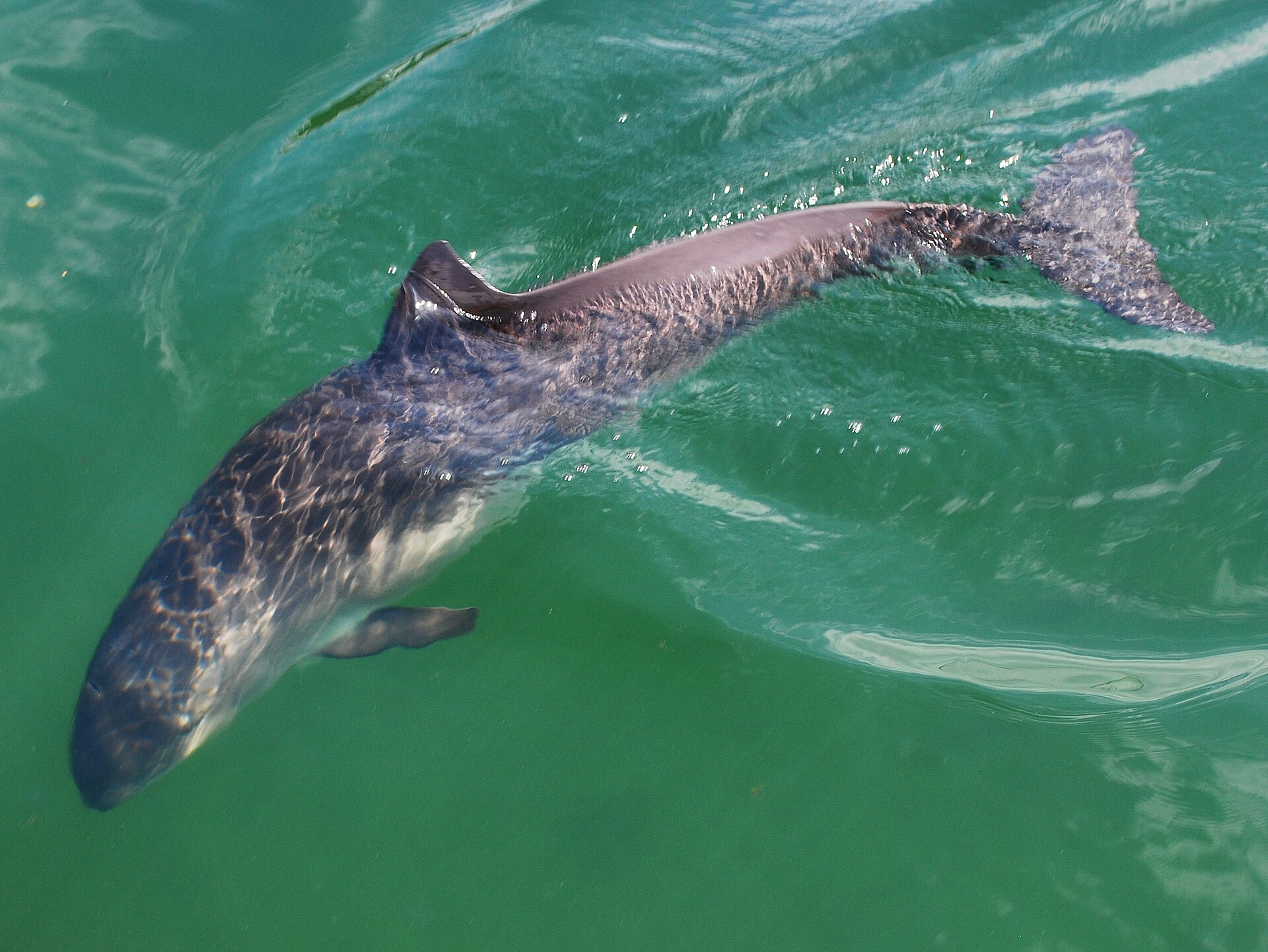
Mostly by how little you see. Dark above, pale below, with a small triangular dorsal fin; it is the smallest marine mammal on our coast. It rolls, it does not leap: the back breaks the surface briefly, the fin goes over, and the animal is gone. You rarely see the whole body and almost never the head. It does not ride the bow wave either, which dolphins do, so the rule of thumb is a negative one: if it jumps, it is not a porpoise.
Where do you see this species in the Netherlands?
The species lives on the North Sea, and in the cold months it comes closer in. The vantage points that work are the ones where deep water runs near land: the Oosterschelde dykes, which are the most reliable place in the country to watch from solid ground; the Brouwersdam and the tidal inlets of the Delta; and the ferries to the Wadden islands, where you are high up, you cross deep channels and you get two attempts in a day for no extra cost. The North Sea beaches and harbour moles work too, with winter walks giving the best odds. In the Wadden Sea itself your chances are noticeably poorer than in the Delta, and at Lauwersmeer the species is genuinely rare. If you want to see a porpoise, go to Zeeland.
📍 Nationaal Park Oosterschelde
With luck chance per source📍 Nationaal Park Zuid-Kennemerland
Rare verified📍 Nationaal Park Duinen van Texel
With luck verified📍 Nationaal Park Lauwersmeer
Very rare verified📍 Wadden Sea
With luck verified📍 Noordzeekustzone
presence reported📍 De Dollard
presence reported📍 Haringvlietsluizen
presence reportedThese links come straight from our database, with the chance, the source and the evidence level for each area.
When is the best time?
Green = present · orange = peak period. The bar is generated from our database.
Best period: From the shore, November to April, with February to April the strongest part of that window. June is the poorest month almost everywhere. On the open North Sea the species is present all year.
Best time of day: Daylight, and above all a flat sea. A dorsal fin ten centimetres high cannot be told from a whitecap: on calm water you can pick one out at several hundred metres, and in any kind of chop you will see nothing at all, however many animals are in front of you. So pick a windless, clear day and go then, even out of season, because a calm day in May beats a blowy one in March. Then stay put and scan the same stretch for half an hour.
Recent sightings
👁️ Where has this species been seen recently?
Check the current sightings on Waarneming.nl. A useful addition to our own verified information.
How to improve your chances
- Keep the wind in your face. Most mammals will smell you long before they see you.
- Arrive before sunrise and then stay put. Sitting still beats walking about.
- Wear muted colours, skip the scent, and put your phone on silent.
- Be patient. Expect to come back more than once before it works.
🎒 What you need for this
Binoculars
🌿 Watching responsibly
Keep your distance, stay on the paths, and never lure animals with food or sound. Leave as soon as an animal becomes uneasy.
Status: Verified · Last checked: 2026-08-08
A porpoise, not a dolphin
The harbour porpoise (Phocoena phocoena) is the only whale or dolphin you can expect to see in the Netherlands with any regularity. It is also the one that gives you least to look at: a small dark back rolling over once, a fin the size of your hand, and then nothing. Most people who have seen one are not sure they did.
Numbers
On the North Sea the harbour porpoise is common, and by a wide margin the most numerous cetacean in Dutch waters. That sits oddly with how seldom you see one, and the explanation is in the animal rather than the population: it is small, it shows almost nothing of itself, and it usually swims well out from the coast.
We are not quoting a national population figure here. The surveys that produce one cover the North Sea at a scale that does not translate into “how many are off the Dutch coast this winter”, and we would rather give you no number than a number that does not mean what it appears to mean.
If you find one stranded
Do not push it back into the sea and do not touch it. Call the animal ambulance or a specialist rescue centre and let them judge whether the animal has a chance.
This is worth being blunt about, because the instinct is so strong and so wrong. A stranded porpoise is almost always sick or exhausted — healthy ones do not come ashore. Returning it to the water usually buys it a slower death rather than a rescue.
Watching it responsibly
Porpoise watching is one of the few forms of wildlife watching where you are unlikely to disturb anything, simply because you cannot get near. That makes the rules easy: watch from the dyke, the dam or the deck, and do not try to follow an animal by boat. Underwater noise is the pressure that matters for this species, and keeping engines away from it is worth more than keeping your distance on land.
Sources
Our sources for this species are in Dutch.
- Rijkswaterstaat (in Dutch): occurrence on the Dutch North Sea.
- SOS Dolfijn (in Dutch): what to do with a stranded animal, and why returning it to the water is the wrong move.
- Area-level occurrence on our Dutch pages is based on NDFF Flora & Fauna Verkenner open data, consulted July–November 2026, alongside statements from the site managers. NDFF counts say something about presence, not about density or your chance of seeing an animal.
- The Wadden Sea — the area page, including the ferries as a viewpoint.
- Grey seal and harbour seal — the two marine mammals you are far more likely to see.
- How we work — where our facts come from, and why we leave a number out when we cannot stand behind it.
Frequently asked questions
Where can you see a harbour porpoise in the Netherlands?
On the North Sea, and in winter closer inshore: from the Oosterschelde dykes, from the Brouwersdam, from the tidal inlets, and from the ferries to the Wadden islands. It is the only cetacean you can see here with any regularity.
When are your chances best?
November to April, when porpoises are closer to the coast, with February to April the best stretch. Calm water matters at least as much as the season: on a flat sea you can see a fin at hundreds of metres, in waves you see nothing. Go on a windless, clear day.
How do you recognise one?
By how little you see. It surfaces briefly and rolls, showing a small triangular fin, and disappears. It does not jump, makes no bow wave and does not swim alongside boats — those are dolphins. A leaping fin is something else.
What should you do about a stranded porpoise?
Do not push it back and do not touch it. Call the animal ambulance or a specialist rescue centre; they assess whether the animal stands a chance. A stranded animal is nearly always ill or weakened, and putting it back into the sea usually means a slower death.
Are there many porpoises in the Netherlands?
On the North Sea the species is common — by far the most numerous cetacean in Dutch waters. That you still rarely see one is because it is small, shows little of itself, and mostly swims far from the coast.