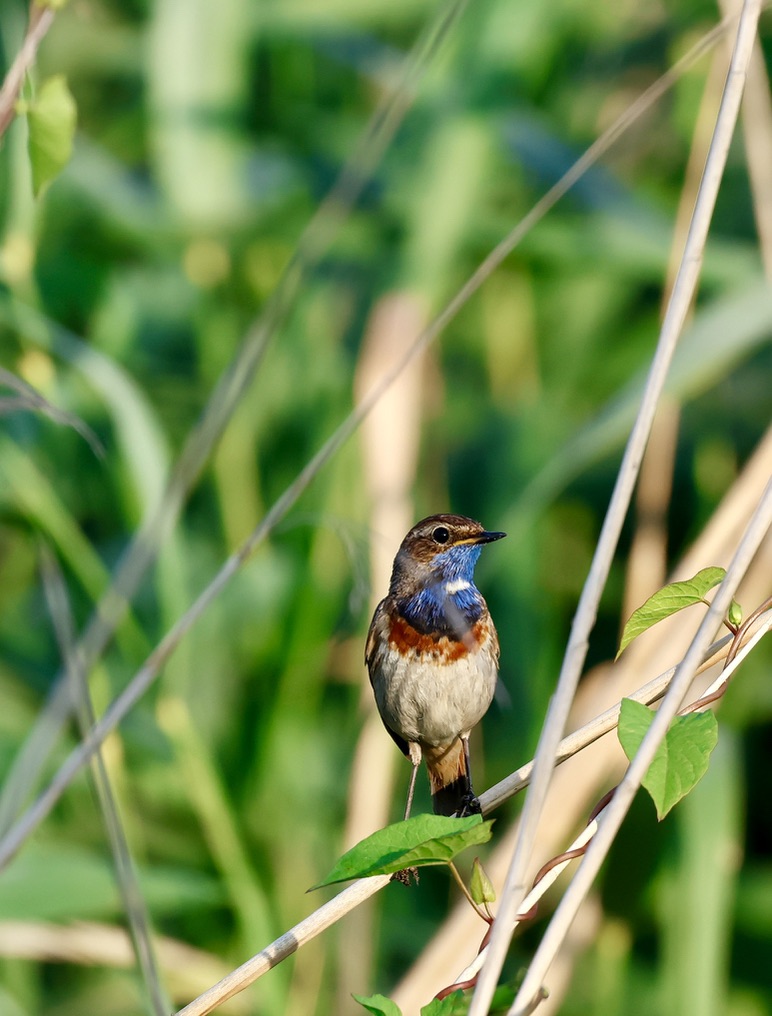
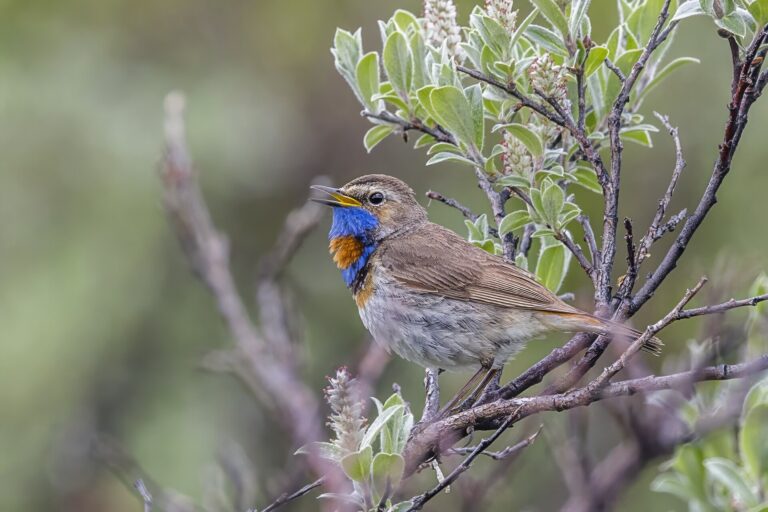
13 to 14 cm long. The male has a bright blue throat with a white or rusty star in the middle, bordered by a black and a rust-red band. The female is an unremarkable brown with a streaked throat. Both have rust-red sides to the base of the tail, which flash briefly as the bird takes off.
Rough reed and wetland across the Netherlands, with the Biesbosch, the Flevoland polders and the river area as strongholds.
NDFF open data, 4.078 records 2016-2026 · the national park
Nationwide period: April to July. Bluethroats arrive from Africa in late March and sing freely in April and May; by July the first birds are already leaving.
NDFF open data, 890 records 2016-2026 · Natuurmonumenten
Nationwide period: April to July. Bluethroats arrive from Africa in late March and sing freely in April and May; by July the first birds are already leaving.
NDFF open data, 204 records 2016-2026
Nationwide period: April to July. Bluethroats arrive from Africa in late March and sing freely in April and May; by July the first birds are already leaving.
NDFF open data, 210 records 2016-2026
Nationwide period: April to July. Bluethroats arrive from Africa in late March and sing freely in April and May; by July the first birds are already leaving.
Nationaal Park De Peel
Nationwide period: April to July. Bluethroats arrive from Africa in late March and sing freely in April and May; by July the first birds are already leaving.
Birdingplaces · Vogelmeer · top five
Nationwide period: April to July. Bluethroats arrive from Africa in late March and sing freely in April and May; by July the first birds are already leaving.
De Visdief · birdwatching guide to AWD
Nationwide period: April to July. Bluethroats arrive from Africa in late March and sing freely in April and May; by July the first birds are already leaving.
NDFF open data, 969 records 2016-2026 · npduinenvantexel.nl
Nationwide period: April to July. Bluethroats arrive from Africa in late March and sing freely in April and May; by July the first birds are already leaving.
NDFF open data, 1.863 records 2016-2026 · np-lauwersmeer.nl
Nationwide period: April to July. Bluethroats arrive from Africa in late March and sing freely in April and May; by July the first birds are already leaving.
NDFF open data, 1.210 records 2016-2026 · It Fryske Gea
Nationwide period: April to July. Bluethroats arrive from Africa in late March and sing freely in April and May; by July the first birds are already leaving.
NDFF open data, 387 records 2016-2026 · nationaal-parkdemaasduinen.nl
Nationwide period: April to July. Bluethroats arrive from Africa in late March and sing freely in April and May; by July the first birds are already leaving.
NDFF open data, 672 records 2016-2026
Nationwide period: April to July. Bluethroats arrive from Africa in late March and sing freely in April and May; by July the first birds are already leaving.
NDFF open data, 207 records 2016-2026
Nationwide period: April to July. Bluethroats arrive from Africa in late March and sing freely in April and May; by July the first birds are already leaving.
NDFF open data, 190 records 2016-2026
Nationwide period: April to July. Bluethroats arrive from Africa in late March and sing freely in April and May; by July the first birds are already leaving.
NDFF open data, 1.228 records 2016-2026 · Vogelbescherming
Nationwide period: April to July. Bluethroats arrive from Africa in late March and sing freely in April and May; by July the first birds are already leaving.
Natuurmonumenten, the site manager
Nationwide period: April to July. Bluethroats arrive from Africa in late March and sing freely in April and May; by July the first birds are already leaving.
De Visdief · birdwatching guide to Fochteloërveen
Nationwide period: April to July. Bluethroats arrive from Africa in late March and sing freely in April and May; by July the first birds are already leaving.
Natuurmonumenten
Nationwide period: April to July. Bluethroats arrive from Africa in late March and sing freely in April and May; by July the first birds are already leaving.
NDFF open data, 2.802 records 2016-2026
Nationwide period: April to July. Bluethroats arrive from Africa in late March and sing freely in April and May; by July the first birds are already leaving.
NDFF open data, 119 records 2016-2026
Nationwide period: April to July. Bluethroats arrive from Africa in late March and sing freely in April and May; by July the first birds are already leaving.
NDFF open data, 1.391 records 2016-2026 · Vogelbescherming
Nationwide period: April to July. Bluethroats arrive from Africa in late March and sing freely in April and May; by July the first birds are already leaving.
De Visdief · birdwatching guide to Biesbosch
Nationwide period: April to July. Bluethroats arrive from Africa in late March and sing freely in April and May; by July the first birds are already leaving.
NDFF open data
Nationwide period: April to July. Bluethroats arrive from Africa in late March and sing freely in April and May; by July the first birds are already leaving.
NDFF open data
Nationwide period: April to July. Bluethroats arrive from Africa in late March and sing freely in April and May; by July the first birds are already leaving.
NDFF open data
Nationwide period: April to July. Bluethroats arrive from Africa in late March and sing freely in April and May; by July the first birds are already leaving.
NDFF open data
Nationwide period: April to July. Bluethroats arrive from Africa in late March and sing freely in April and May; by July the first birds are already leaving.
NDFF open data
Nationwide period: April to July. Bluethroats arrive from Africa in late March and sing freely in April and May; by July the first birds are already leaving.
NDFF open data
Nationwide period: April to July. Bluethroats arrive from Africa in late March and sing freely in April and May; by July the first birds are already leaving.
NDFF open data
Nationwide period: April to July. Bluethroats arrive from Africa in late March and sing freely in April and May; by July the first birds are already leaving.
NDFF open data, 4.975 records 2016-2026
Nationwide period: April to July. Bluethroats arrive from Africa in late March and sing freely in April and May; by July the first birds are already leaving.
NDFF open data, 323 records 2016-2026
Nationwide period: April to July. Bluethroats arrive from Africa in late March and sing freely in April and May; by July the first birds are already leaving.
NDFF open data, 3.392 records 2016-2026
Nationwide period: April to July. Bluethroats arrive from Africa in late March and sing freely in April and May; by July the first birds are already leaving.
NDFF open data, 247 records 2016-2026
Nationwide period: April to July. Bluethroats arrive from Africa in late March and sing freely in April and May; by July the first birds are already leaving.
NDFF open data, 1.088 records 2016-2026
Nationwide period: April to July. Bluethroats arrive from Africa in late March and sing freely in April and May; by July the first birds are already leaving.
NDFF open data, 1.227 records 2016-2026
Nationwide period: April to July. Bluethroats arrive from Africa in late March and sing freely in April and May; by July the first birds are already leaving.
NDFF open data, 920 records 2016-2026
Nationwide period: April to July. Bluethroats arrive from Africa in late March and sing freely in April and May; by July the first birds are already leaving.
NDFF open data, 705 records 2016-2026
Nationwide period: April to July. Bluethroats arrive from Africa in late March and sing freely in April and May; by July the first birds are already leaving.
These links come straight from our database, with the chance, the source and the evidence level for each area.
Green = present · orange = peak period. The bar is generated from our database.