
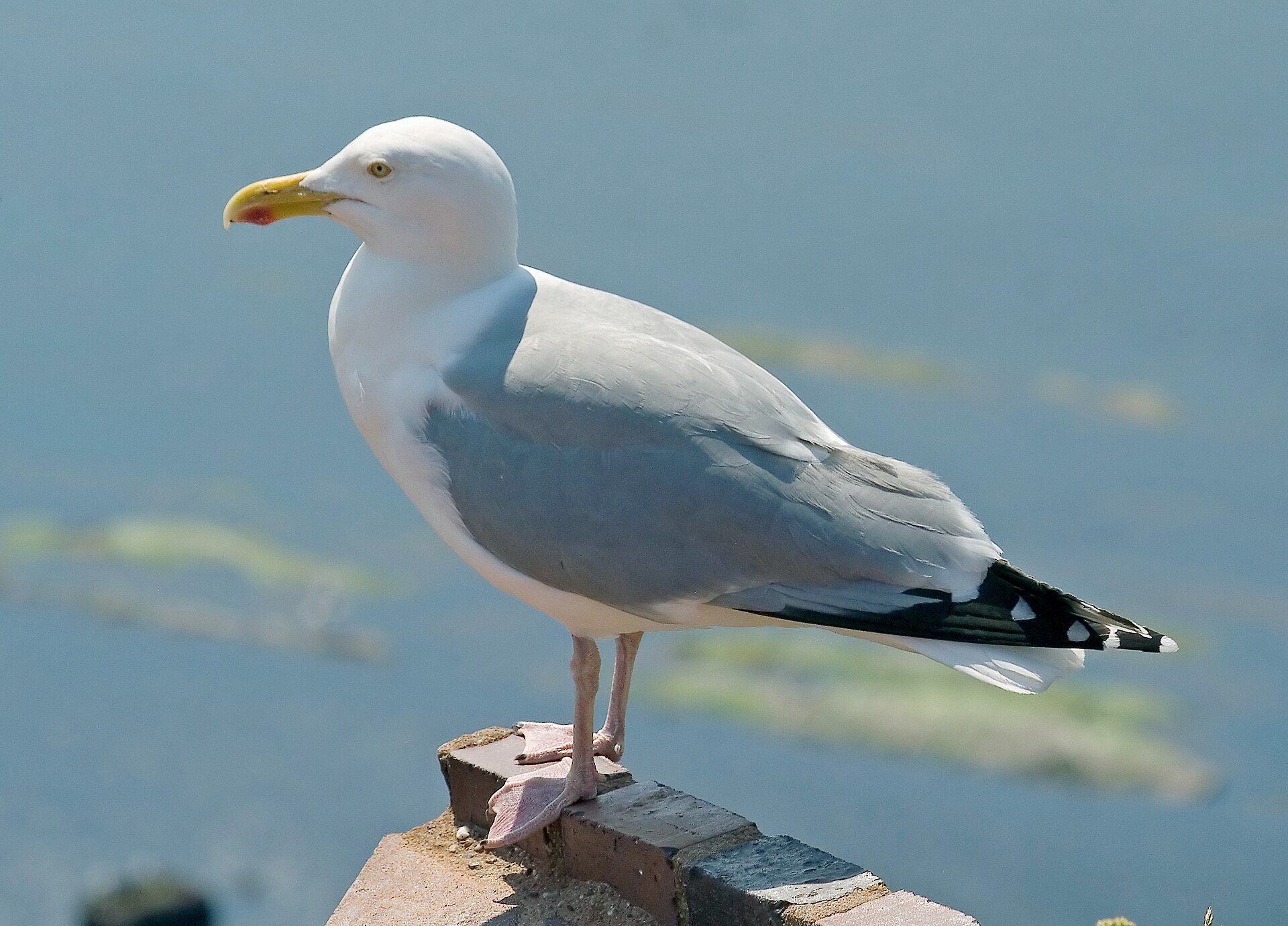
Where to see the European Herring Gull in the Netherlands
Easy 🦅 Bird
Where and when do you see a European Herring Gull? This species is easy to see, all year round.
How do you recognise a European Herring Gull?
A large gull of 55 to 67 centimetres with a wingspan of 125 to 155 centimetres: white head and underside, pale grey mantle, black wingtips with white mirrors, a yellow bill with a red spot and, the decisive feature, flesh-coloured pink legs.
What can you confuse a European Herring Gull with?
Looks like: Common Gull, Black-headed Gull, Lesser Black-backed Gull, Great Black-backed Gull
- Common Gull: Smaller, with a yellow bill without a red spot and dark eyes.
- Black-headed Gull: Much smaller, with red legs and bill.
- Lesser Black-backed Gull: The legs decide it: flesh-coloured pink on the herring gull, yellow on the lesser black-backed gull, which also has a dark grey to slate-grey mantle.
- Great Black-backed Gull: The great black-backed gull is clearly larger, with a jet-black mantle and a heavy bill.
What does a European Herring Gull sound like?
Recording: http://bio.acousti.ca/content/european-herring-gull-larus-argentatus, CC BY 3.0, via Wikimedia Commons
Where do you see this species in the Netherlands?
The whole coast, the dunes and the Wadden Sea, as well as the river area, large inland waters and increasingly rooftops in towns.
Habitat: Coast, beaches, dunes, harbours and landfill sites; it also breeds on flat roofs in built-up areas.
This is a common, widespread species: you can come across it in far more places than the areas listed below. Treat that list as a starting point rather than a full survey.
📍 Nationaal Park Duinen van Texel
presence reported📍 Nationaal Park De Biesbosch
presence reported📍 Nationaal Park Zuid-Kennemerland
presence reported📍 Nationaal Park Lauwersmeer
presence reported📍 Zwin & Zeeuws-Vlaanderen
presence reported📍 Oostvaardersplassen
presence reported📍 Nationaal Park Oosterschelde
presence reported📍 Amsterdamse Waterleidingduinen
presence reported📍 Gelderse Poort & Millingerwaard
presence reported📍 Sint-Pietersberg & Zuid-Limburg
presence reported📍 Naardermeer
presence reported📍 Onlanden & Leekstermeer
presence reported📍 Wadden Sea
Good chance chance per source📍 Blauwe Kamer
presence reported📍 Zouweboezem
presence reported📍 Oostelijke Vechtplassen
presence reported📍 Noordhollands Duinreservaat
presence reported📍 Wormer- en Jisperveld
presence reported📍 Ilperveld
presence reported📍 De Dollard
presence reported📍 Zuidlaardermeergebied en Hunzedal
presence reported📍 Meijendel & Berkheide
presence reported📍 Voornes Duin
presence reported📍 De Maashorst
presence reported📍 Strabrechtse Heide & Beuven
presence reported📍 Loonse en Drunense Duinen
presence reported📍 Schoorlse Duinen
presence reported📍 Haringvlietsluizen
presence reported📍 Vismigratierivier Afsluitdijk
presence reported📍 De Putten bij Camperduin
presence reportedThese links come straight from our database, with the chance, the source and the evidence level for each area.
When is the best time?
Green = present · orange = peak period. The bar is generated from our database.
Best period: All year; October to February the largest numbers, from northern winter visitors.
Best time of day: During the day.
Recent sightings
👁️ Where has this species been seen recently?
Check the current sightings on Waarneming.nl. A useful addition to our own verified information.
How to improve your chances
- Learn the calls first. You will hear most birds before you see them.
- Go in the first hour after sunrise, when the song is at its peak and the wind is still down.
- Use a hide or natural cover. Sitting still gets you more than walking closer.
- Keep the sun behind you. Against the light you see a silhouette and no colour.
🎒 What you need for this
Binoculars; a telescope helps when sorting out immature plumages
Photography
Sit low on the beach instead of looking down on it; at eye level a gull looks a good deal less ordinary straight away. The first hour after sunrise gives warm light on the white head, which otherwise burns out quickly
🌿 Watching responsibly
Keep your distance, stay on the paths, and never lure animals with food or sound. Leave as soon as an animal becomes uneasy.
Status: Verified · Last checked: 2026-08-07