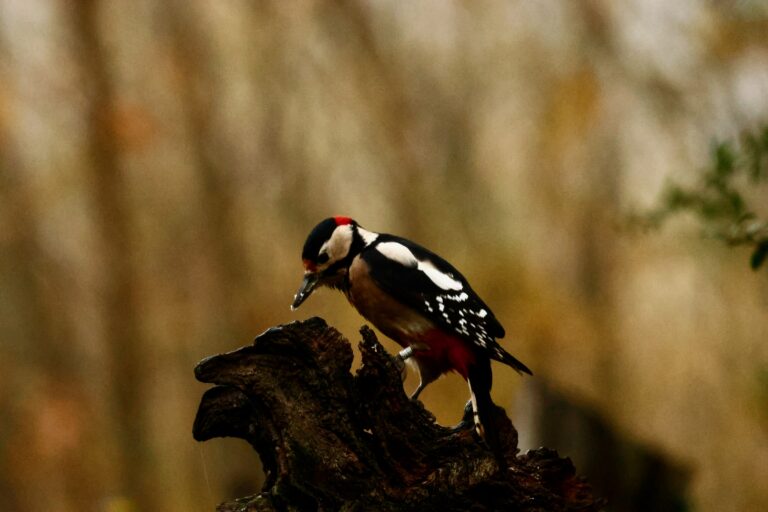
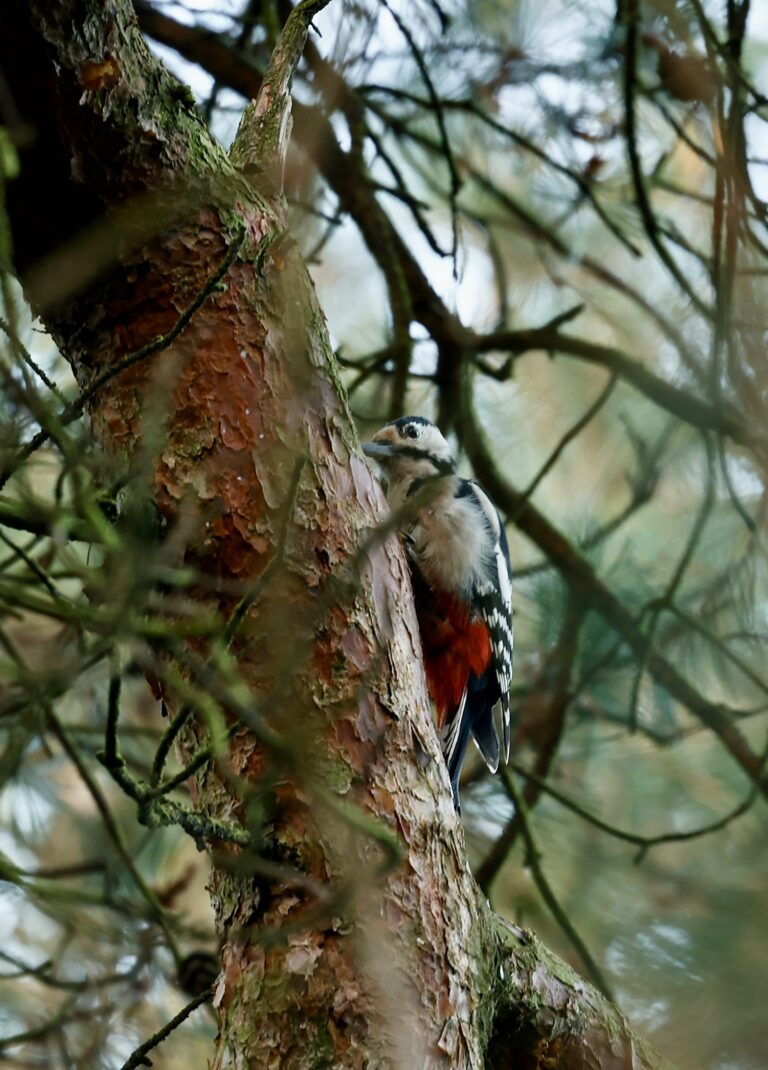
Where and when do you see a Great Spotted Woodpecker? This species is easy to see, all year round.
How do you recognise a Great Spotted Woodpecker?
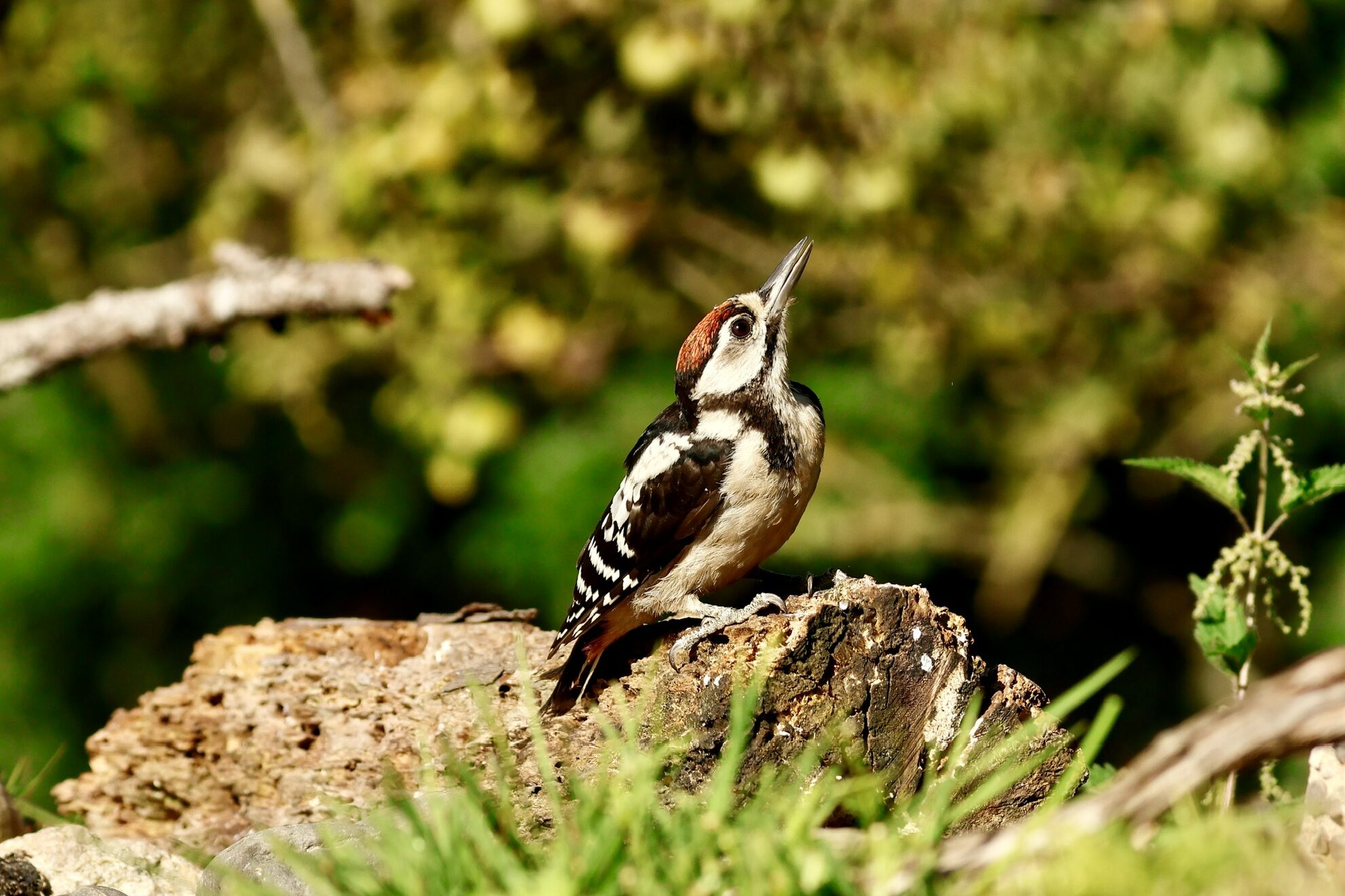
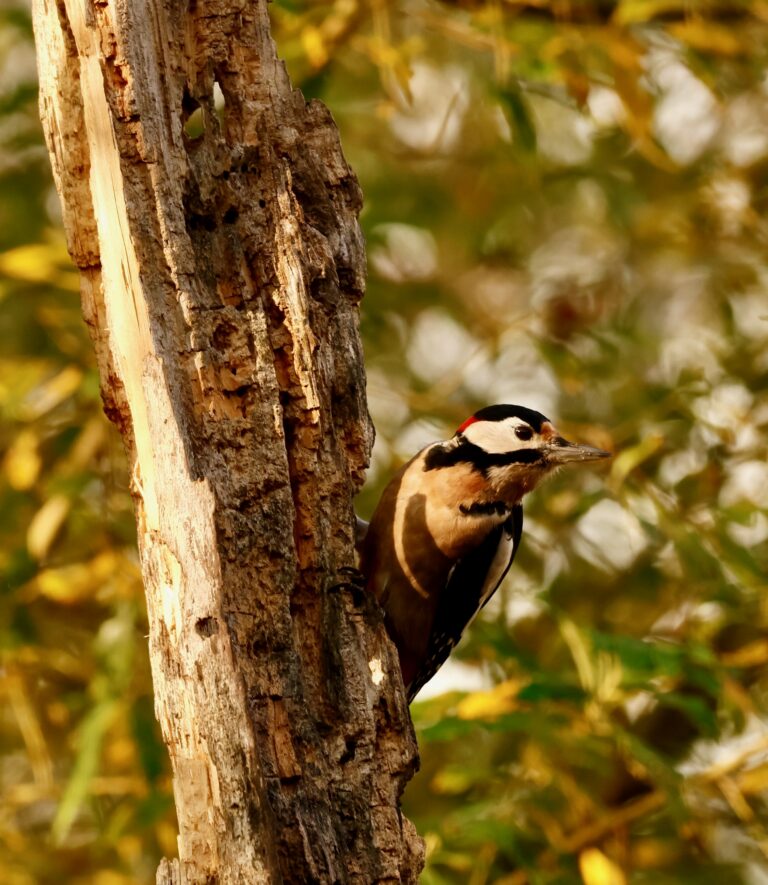
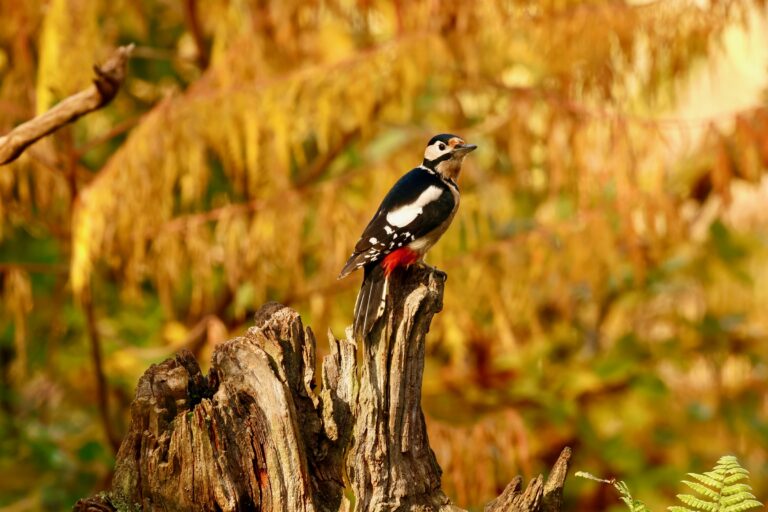
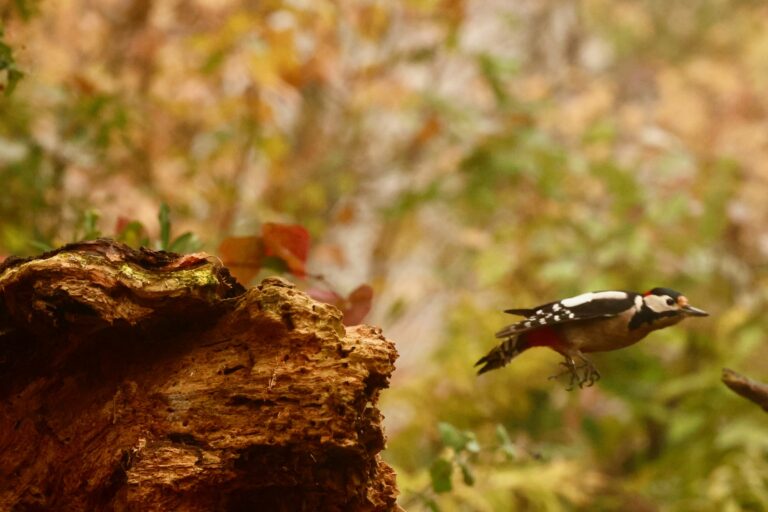
23 to 26 cm long. Black and white, with bright red under the tail and large white shoulder patches. The male has a red patch on the nape, the female does not, and young birds have a red crown. Do not confuse it with the much rarer Lesser Spotted Woodpecker, which is the size of a sparrow; the Great Spotted Woodpecker is as big as a blackbird.
Wingspan: 36 cm an indication from Wikidata; it varies by individual, sex and subspecies · compare all birds (in Dutch)
What can you confuse a Great Spotted Woodpecker with?
Looks like: Lesser Spotted Woodpecker, Middle Spotted Woodpecker
- Lesser Spotted Woodpecker: the size of a house sparrow, with barring across the back instead of two large white shoulder patches, and no red under the tail.
- Middle Spotted Woodpecker: a white face, an all-red cap without a black border, and a salmon-pink lower belly.
What does a Great Spotted Woodpecker sound like?
Where do you see this species in the Netherlands?
The whole of the Netherlands, in woodland, parks, avenues and gardens. It is by far the commonest woodpecker in the country.
Habitat: Woodland and stands of trees with dead wood, which it chisels for insect larvae and excavates for holes. It also lives in town parks and gardens with older trees, and in winter it comes to fat balls.
This is a common, widespread species: you can come across it in far more places than the areas listed below. Treat that list as a starting point rather than a full survey.
How certain is this? verified chance per source presence reported Links that do not clear the bottom threshold are not published. How we decide that.
Nationwide period: Present all year. February to April is the drumming season: it beats fast bursts on a dead branch or a post that carry for kilometres. In winter it is easier to see because the leaves are off the trees.
De Visdief · birdwatching guide
Nationwide period: Present all year. February to April is the drumming season: it beats fast bursts on a dead branch or a post that carry for kilometres. In winter it is easier to see because the leaves are off the trees.
Birdingplaces · most recorded species
Nationwide period: Present all year. February to April is the drumming season: it beats fast bursts on a dead branch or a post that carry for kilometres. In winter it is easier to see because the leaves are off the trees.
Vogelkijkhut.nl · Valenberg
Nationwide period: Present all year. February to April is the drumming season: it beats fast bursts on a dead branch or a post that carry for kilometres. In winter it is easier to see because the leaves are off the trees.
Own fieldwork
Nationwide period: Present all year. February to April is the drumming season: it beats fast bursts on a dead branch or a post that carry for kilometres. In winter it is easier to see because the leaves are off the trees.
NDFF open data
Nationwide period: Present all year. February to April is the drumming season: it beats fast bursts on a dead branch or a post that carry for kilometres. In winter it is easier to see because the leaves are off the trees.
NDFF open data
Nationwide period: Present all year. February to April is the drumming season: it beats fast bursts on a dead branch or a post that carry for kilometres. In winter it is easier to see because the leaves are off the trees.
NDFF open data
Nationwide period: Present all year. February to April is the drumming season: it beats fast bursts on a dead branch or a post that carry for kilometres. In winter it is easier to see because the leaves are off the trees.
NDFF open data
Nationwide period: Present all year. February to April is the drumming season: it beats fast bursts on a dead branch or a post that carry for kilometres. In winter it is easier to see because the leaves are off the trees.
NDFF open data
Nationwide period: Present all year. February to April is the drumming season: it beats fast bursts on a dead branch or a post that carry for kilometres. In winter it is easier to see because the leaves are off the trees.
NDFF open data
Nationwide period: Present all year. February to April is the drumming season: it beats fast bursts on a dead branch or a post that carry for kilometres. In winter it is easier to see because the leaves are off the trees.
NDFF open data
Nationwide period: Present all year. February to April is the drumming season: it beats fast bursts on a dead branch or a post that carry for kilometres. In winter it is easier to see because the leaves are off the trees.
NDFF open data
Nationwide period: Present all year. February to April is the drumming season: it beats fast bursts on a dead branch or a post that carry for kilometres. In winter it is easier to see because the leaves are off the trees.
NDFF open data
Nationwide period: Present all year. February to April is the drumming season: it beats fast bursts on a dead branch or a post that carry for kilometres. In winter it is easier to see because the leaves are off the trees.
Own field observation, 9 November 2026
Nationwide period: Present all year. February to April is the drumming season: it beats fast bursts on a dead branch or a post that carry for kilometres. In winter it is easier to see because the leaves are off the trees.
NDFF open data, 13.960 records 2016-2026
Nationwide period: Present all year. February to April is the drumming season: it beats fast bursts on a dead branch or a post that carry for kilometres. In winter it is easier to see because the leaves are off the trees.
NDFF open data, 520 records 2016-2026
Nationwide period: Present all year. February to April is the drumming season: it beats fast bursts on a dead branch or a post that carry for kilometres. In winter it is easier to see because the leaves are off the trees.
NDFF open data, 6.879 records 2016-2026
Nationwide period: Present all year. February to April is the drumming season: it beats fast bursts on a dead branch or a post that carry for kilometres. In winter it is easier to see because the leaves are off the trees.
NDFF open data, 5.877 records 2016-2026
Nationwide period: Present all year. February to April is the drumming season: it beats fast bursts on a dead branch or a post that carry for kilometres. In winter it is easier to see because the leaves are off the trees.
NDFF open data, 3.914 records 2016-2026
Nationwide period: Present all year. February to April is the drumming season: it beats fast bursts on a dead branch or a post that carry for kilometres. In winter it is easier to see because the leaves are off the trees.
NDFF open data, 4.771 records 2016-2026
Nationwide period: Present all year. February to April is the drumming season: it beats fast bursts on a dead branch or a post that carry for kilometres. In winter it is easier to see because the leaves are off the trees.
These links come straight from our database, with the chance, the source and the evidence level for each area.
When is the best time?
janfebmaraprmayjunjulaugsepoctnovdec
Green = present · orange = peak period. The bar is generated from our database.
Best period: Present all year. February to April is the drumming season: it beats fast bursts on a dead branch or a post that carry for kilometres. In winter it is easier to see because the leaves are off the trees.
Best time of day: The morning. That is when it is most active and drums most; through the rest of the day you mainly hear its short, sharp call.
Recent sightings
How to improve your chances
- Learn the calls first. You will hear most birds before you see them.
- Go in the first hour after sunrise, when the song is at its peak and the wind is still down.
- Use a hide or natural cover. Sitting still gets you more than walking closer.
- Keep the sun behind you. Against the light you see a silhouette and no colour.
🎒 What you need for this
Binoculars.
🌿 Watching responsibly
Keep your distance, stay on the paths, and never lure animals with food or sound. Leave as soon as an animal becomes uneasy.
Sources: Sovon
Vogelbescherming Nederland, 7 dingen die je nog niet wist over de grote bonte specht, geraadpleegd 21-08-2026; Vogelbescherming Nederland (vogelgids), geraadpleegd 02-11-2026
Status: Verified · Last checked: 2026-08-08