
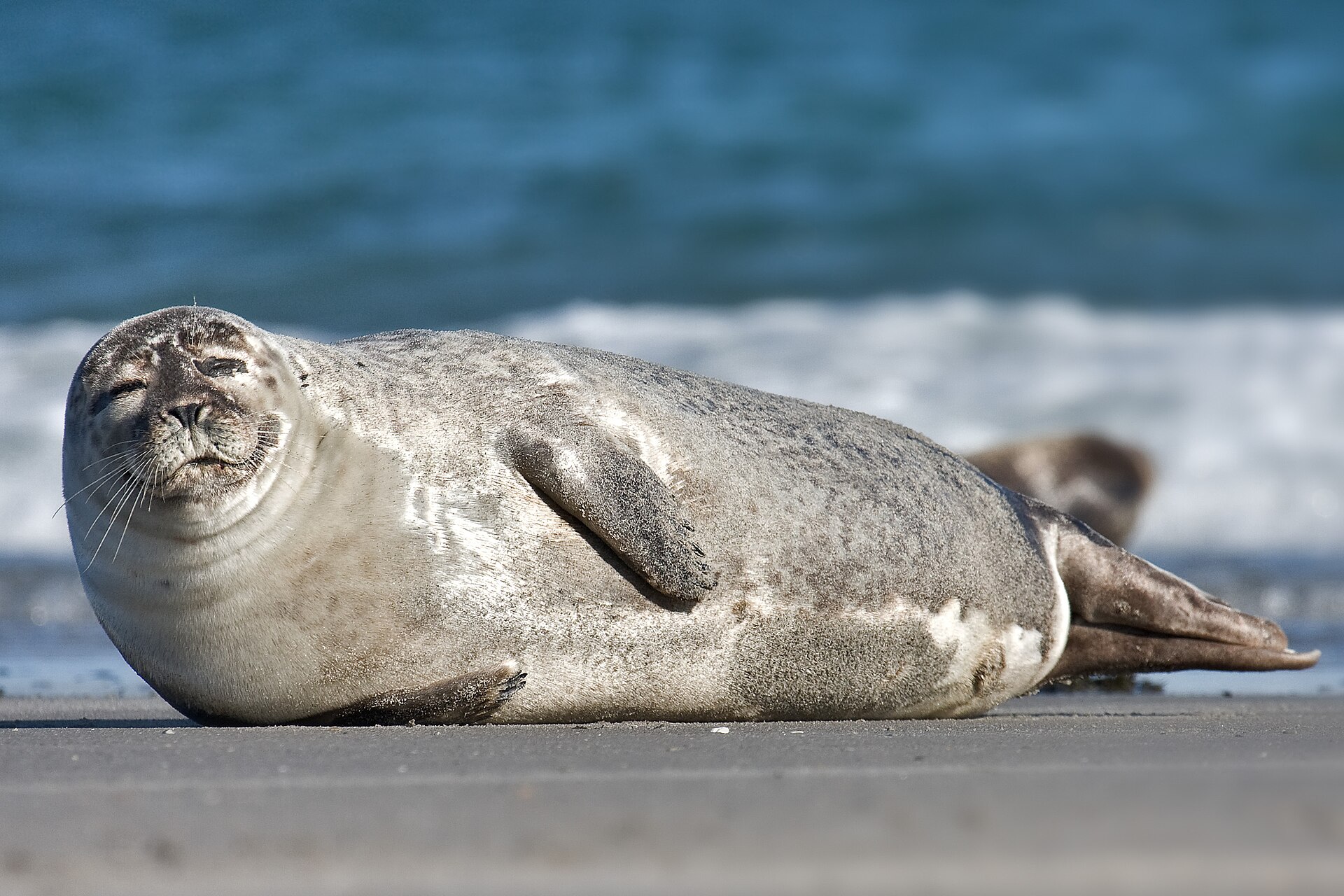
Where to see the harbour seal in the Netherlands
Easy 🦭 Marine mammal
Where and when do you see a harbour seal? This species is easy to see, all year round.
How do you recognise a harbour seal?
Grey with dark spots, and a round head with a short, dented snout, something like a labrador in profile. The nostrils form a V, where a grey seal's run parallel, and through a scope that is the deciding detail. Then there is the banana: on a sandbank a harbour seal very often lies with head and hind flippers lifted clear of the sand, bent into a shallow U, and once you have seen it you will spot it at a kilometre. It is also smaller than a grey seal, which is considerably bigger with a long, straight head that suggests a horse. Adults are usually silent; the pups are not, with a wailing, complaining call that carries a long way across an open sandbank.
What can you confuse a harbour seal with?
Looks like: Grey seal
- Grey seal: Considerably larger, with a long, straight head that suggests a horse and nostrils that run parallel.
What does a harbour seal sound like?
Recording: Beeld en Geluid, CC BY-SA 3.0, via Wikimedia Commons
Where do you see this species in the Netherlands?
Two regions, and they give different days out. The Wadden Sea holds the bulk of the Dutch population, resting on sandbanks that dry out at low tide, which in most places means some way offshore. The Delta, meaning the Oosterschelde, the Westerschelde and the Voordelta, is the quieter alternative and in some ways the better one for a first look: the Oosterschelde in particular has banks within reach of the dykes, so a chance without a boat. Further north along the North Sea coast, in Zuid-Kennemerland and on the Texel beaches, you may find a single animal resting on the sand, mostly in the winter half of the year and after storms. Treat those with extra care: a seal alone on a mainland beach is often there because something is wrong.
📍 Nationaal Park Duinen van Texel
Good chance verified📍 Nationaal Park Oosterschelde
Good chance chance per source📍 Wadden Sea
Good chance in season verified📍 Nationaal Park Zuid-Kennemerland
With luck verified📍 Nationaal Park Lauwersmeer
Good chance verified📍 Zwin & Zeeuws-Vlaanderen
Good chance verified📍 Westerschelde & Saeftinghe
presence reported📍 Noordzeekustzone
presence reported📍 De Dollard
presence reported📍 Haringvlietsluizen
presence reported📍 Vismigratierivier Afsluitdijk
presence reportedThese links come straight from our database, with the chance, the source and the evidence level for each area.
When is the best time?
Green = present · orange = peak period. The bar is generated from our database.
Best period: Present all year, always around low water. August is the single best month for numbers, because the moult puts most of the population out of the water at the same time, which is also when the annual count is made. Pups are born from mid-May onwards with a peak around late June and are nursed for about three weeks; unlike grey seal pups, they can swim almost straight away.
Best time of day: Around low water. That is the whole trick: the banks only emerge as the tide drops, the animals haul out on them, and as the water comes back they slide off. Low water shifts by roughly an hour every day, so plan on the tide table rather than the clock, and use the measuring station nearest where you are going.
Recent sightings
👁️ Where has this species been seen recently?
Check the current sightings on Waarneming.nl. A useful addition to our own verified information.
How to improve your chances
- Keep the wind in your face. Most mammals will smell you long before they see you.
- Arrive before sunrise and then stay put. Sitting still beats walking about.
- Wear muted colours, skip the scent, and put your phone on silent.
- Be patient. Expect to come back more than once before it works.
🎒 What you need for this
Binoculars, and 400 mm or more for photographs
🌿 Watching responsibly
Keep your distance, stay on the paths, and never lure animals with food or sound. Leave as soon as an animal becomes uneasy.
Status: Verified · Last checked: 2026-07-29
A species that is losing ground
The harbour seal (Phoca vitulina) is the animal most people mean when they say “seal” in the Netherlands. It is the easier of our two species to see, the more numerous on the banks, and the one whose numbers are quietly going the wrong way.
Numbers and trend
This is where an easy species turns into a worrying one.
- 7,475 counted in the Dutch Wadden Sea during the moult of August 2024.
- 1,738 counted in the Delta in 2023.
- 23,772 across the whole international Wadden Sea in 2024.
In absolute terms that is a healthy animal. The trend is not. Before 2012 the Dutch population grew by more than ten percent a year; after that, in the researchers’ own words, it “almost stopped growing”. Since 2020 the count has been falling by four to five percent a year. Pup numbers rose from roughly 7,000 in 2012 to 10,903 in 2021, then dropped — twelve percent down in 2024, the third year running with markedly lower counts.
Why is not settled, and we are not going to pretend otherwise. What is clear is the contrast: on the same banks, the grey seal is increasing by an average of six percent a year.
And the standing caveat applies here too. Wageningen Marine Research calls its own count “an index and not an actual number of animals in the area”, because some of the animals are always in the water. Trend, not census.
Watching it responsibly
The thing worth internalising about seals is that disturbance is not dramatic. It looks like nothing. A seal that lifts its head, or shuffles towards the water, has already been disturbed — and every time that happens it costs energy the animal needs for moulting, nursing or getting through a cold month.
So: stay on the boat or behind the dyke and use binoculars or a long lens. The Wadden code of conduct gives the raised head as the signal that you are too close to the group; the Dutch Seal Agreement gives the number, at least thirty metres, all year round. Never walk towards them, do not anchor or dry out nearby, keep dogs on a lead, and no drones.
If you find an animal that looks to be in trouble, call rather than act. On Texel, Ecomare on +31 222 317741. Everywhere else, 144 — the Dutch national animal emergency number, which applies to all seals and not only pups.
Sources
These sources are in Dutch. Quotations on this page are our translations from the Dutch originals.
- Wageningen Marine Research — Harbour seal population in the Dutch Wadden Sea (in Dutch): the counts, the 2012 turning point, the fall in pup numbers, and the caveat that a count is an index.
- Ecomare — Harbour seal (in Dutch): pupping from mid-May and the roughly three-week nursing period.
- Compendium voor de Leefomgeving — harbour and grey seal 1960–2025 (in Dutch): the long-run series and the Delta figures.
- Zodion (in Dutch): identification features separating the two species.
- Dutch Seal Agreement (in Dutch): the thirty-metre distance and the 144 procedure.
- Wadden code of conduct — “Ik pas op het Wad” (pdf) (in Dutch): the full code.
- Ecomare — A seal on the beach (in Dutch): what to do, and the Texel number.
- Area-level occurrence on our Dutch pages is based on NDFF Flora & Fauna Verkenner open data, consulted July–November 2026, alongside statements from the site managers. NDFF counts say something about presence, not about density or your chance of seeing an animal.
- Seal watching in the Dutch Wadden Sea — boat trips, fares, tides and the pup-on-the-beach procedure.
- Grey seal — the larger species on the same banks, and the one that is increasing.
- The Wadden Sea — the area page.
- How we work — where our facts come from and what we leave out.
Frequently asked questions
Where can you see seals in the Netherlands?
In the Wadden Sea and in the Delta: the Oosterschelde, the Westerschelde and the Voordelta. They lie on sandbanks that dry out at low tide, so you see them from a boat or from the shore with binoculars — rarely just by walking onto a beach.
When is the best time to see them?
Around low water, when the banks emerge. That shifts every day, so plan on the tide table and not on a fixed hour. In August they moult and most of the population is ashore at the same time.
What is the difference between a harbour seal and a grey seal?
The harbour seal is smaller, with a round head and a short, dented snout — a bit dog-like. The grey seal is considerably larger, with a long, straight head closer to a horse’s.
How many seals live in the Netherlands?
7,475 harbour seals were counted in the Dutch Wadden Sea in August 2024 and another 1,738 in the Delta in 2023. The important part: since 2020 the count has been falling by four to five percent a year.
How close may you get to a seal?
Not close. A seal that raises its head or shuffles towards the water is already disturbed, and that costs it energy it needs. Keep at least thirty metres, stay on the boat or behind the dyke, and use a binocular or a telephoto lens.
What does a harbour seal sound like?
Mostly nothing. The pups wail — a complaining call that carries a long way over a sandbank.