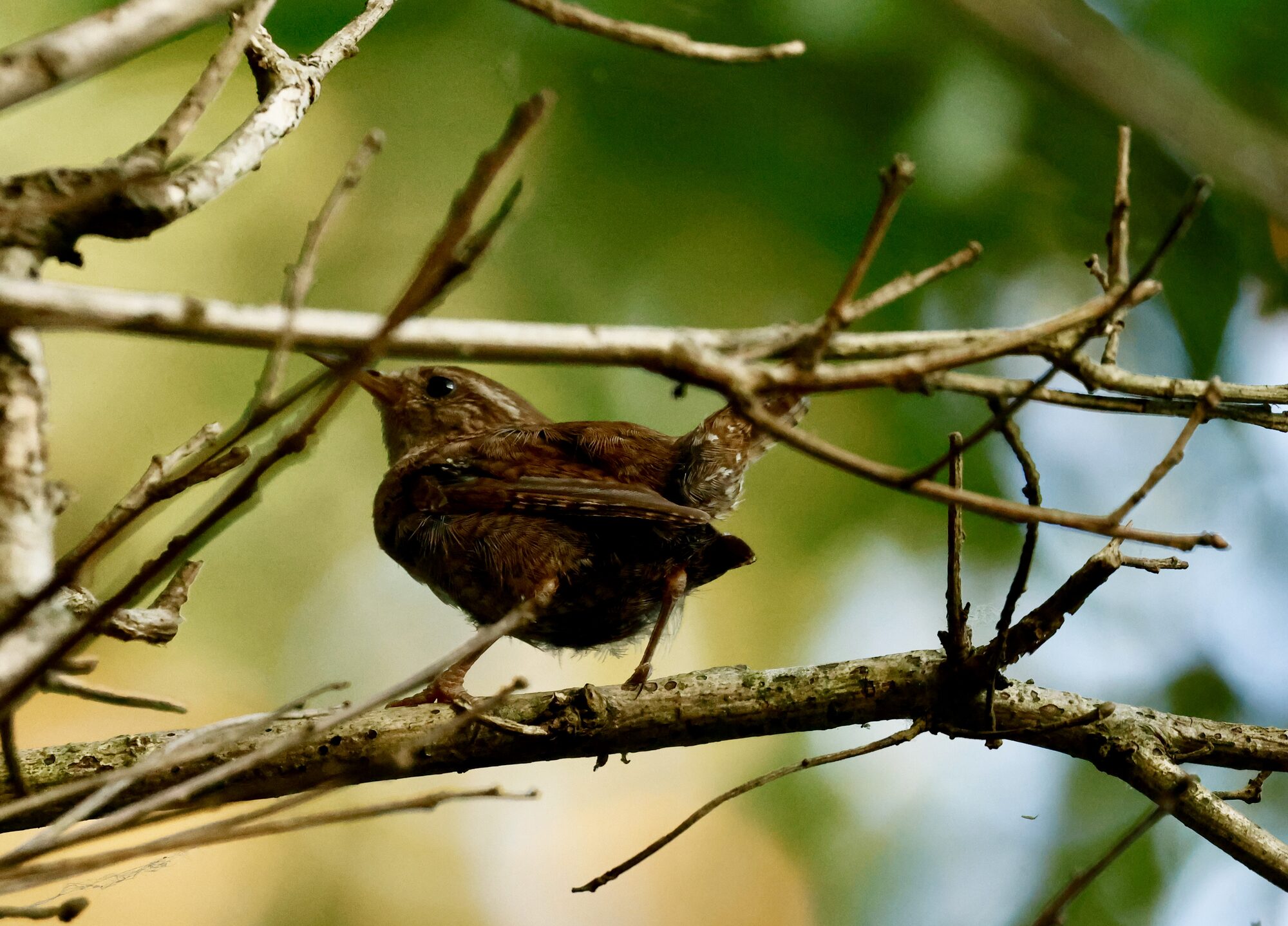
Where and when do you see a Eurasian Wren? This species is easy to see, all year round.
How do you recognise a Eurasian Wren?
Length 9 to 10.5 cm. Tiny and brown, with a finely barred wing and a short tail it often cocks upright. It is one of the smallest birds in the Netherlands, but has a surprisingly loud, rattling song you can hear from a long way off. It moves mouse-like and low through shrubs and brush piles.
Wingspan: 15 cm an indication from Wikidata; it varies by individual, sex and subspecies · compare all birds (in Dutch)
What does a Eurasian Wren sound like?
Where do you see this species in the Netherlands?
Almost the whole of the Netherlands, anywhere with undergrowth and cover: woodland, scrub, gardens, reed fringes and hedgerows.
Habitat: Dense, untidy undergrowth close to the ground. Brush piles, nettles, ivy and bankside vegetation matter more to it than tall trees.
This is a common, widespread species: you can come across it in far more places than the areas listed below. Treat that list as a starting point rather than a full survey.
How certain is this? verified chance per source presence reported Links that do not clear the bottom threshold are not published. How we decide that.
Own observation with a photo (14 August 2026); species account Vogelbescherming Nederland
Nationwide period: Present all year. From February to June it sings freely and is easiest to find. Severe winters cost it dearly: wrens then sometimes crowd into a single nest box by the dozen to keep warm.
Own fieldwork
Nationwide period: Present all year. From February to June it sings freely and is easiest to find. Severe winters cost it dearly: wrens then sometimes crowd into a single nest box by the dozen to keep warm.
NDFF open data
Nationwide period: Present all year. From February to June it sings freely and is easiest to find. Severe winters cost it dearly: wrens then sometimes crowd into a single nest box by the dozen to keep warm.
NDFF open data
Nationwide period: Present all year. From February to June it sings freely and is easiest to find. Severe winters cost it dearly: wrens then sometimes crowd into a single nest box by the dozen to keep warm.
NDFF open data
Nationwide period: Present all year. From February to June it sings freely and is easiest to find. Severe winters cost it dearly: wrens then sometimes crowd into a single nest box by the dozen to keep warm.
NDFF open data
Nationwide period: Present all year. From February to June it sings freely and is easiest to find. Severe winters cost it dearly: wrens then sometimes crowd into a single nest box by the dozen to keep warm.
NDFF open data
Nationwide period: Present all year. From February to June it sings freely and is easiest to find. Severe winters cost it dearly: wrens then sometimes crowd into a single nest box by the dozen to keep warm.
NDFF open data
Nationwide period: Present all year. From February to June it sings freely and is easiest to find. Severe winters cost it dearly: wrens then sometimes crowd into a single nest box by the dozen to keep warm.
NDFF open data
Nationwide period: Present all year. From February to June it sings freely and is easiest to find. Severe winters cost it dearly: wrens then sometimes crowd into a single nest box by the dozen to keep warm.
NDFF open data
Nationwide period: Present all year. From February to June it sings freely and is easiest to find. Severe winters cost it dearly: wrens then sometimes crowd into a single nest box by the dozen to keep warm.
NDFF open data
Nationwide period: Present all year. From February to June it sings freely and is easiest to find. Severe winters cost it dearly: wrens then sometimes crowd into a single nest box by the dozen to keep warm.
NDFF open data, 15.840 records 2016-2026
Nationwide period: Present all year. From February to June it sings freely and is easiest to find. Severe winters cost it dearly: wrens then sometimes crowd into a single nest box by the dozen to keep warm.
NDFF open data, 1.169 records 2016-2026
Nationwide period: Present all year. From February to June it sings freely and is easiest to find. Severe winters cost it dearly: wrens then sometimes crowd into a single nest box by the dozen to keep warm.
NDFF open data, 4.357 records 2016-2026
Nationwide period: Present all year. From February to June it sings freely and is easiest to find. Severe winters cost it dearly: wrens then sometimes crowd into a single nest box by the dozen to keep warm.
NDFF open data, 4.069 records 2016-2026
Nationwide period: Present all year. From February to June it sings freely and is easiest to find. Severe winters cost it dearly: wrens then sometimes crowd into a single nest box by the dozen to keep warm.
NDFF open data, 1.924 records 2016-2026
Nationwide period: Present all year. From February to June it sings freely and is easiest to find. Severe winters cost it dearly: wrens then sometimes crowd into a single nest box by the dozen to keep warm.
NDFF open data, 2.722 records 2016-2026
Nationwide period: Present all year. From February to June it sings freely and is easiest to find. Severe winters cost it dearly: wrens then sometimes crowd into a single nest box by the dozen to keep warm.
NDFF open data, 6.455 records 2016-2026
Nationwide period: Present all year. From February to June it sings freely and is easiest to find. Severe winters cost it dearly: wrens then sometimes crowd into a single nest box by the dozen to keep warm.
NDFF open data, 333 records 2016-2026
Nationwide period: Present all year. From February to June it sings freely and is easiest to find. Severe winters cost it dearly: wrens then sometimes crowd into a single nest box by the dozen to keep warm.
NDFF open data, 212 records 2016-2026
Nationwide period: Present all year. From February to June it sings freely and is easiest to find. Severe winters cost it dearly: wrens then sometimes crowd into a single nest box by the dozen to keep warm.
NDFF open data, 278 records 2016-2026
Nationwide period: Present all year. From February to June it sings freely and is easiest to find. Severe winters cost it dearly: wrens then sometimes crowd into a single nest box by the dozen to keep warm.
These links come straight from our database, with the chance, the source and the evidence level for each area.
When is the best time?
janfebmaraprmayjunjulaugsepoctnovdec
Green = present · orange = peak period. The bar is generated from our database.
Best period: Present all year. From February to June it sings freely and is easiest to find. Severe winters cost it dearly: wrens then sometimes crowd into a single nest box by the dozen to keep warm.
Best time of day: The morning, when it sings most. You usually see it only briefly, as it darts from one bit of cover to the next.
Recent sightings
How to improve your chances
- Learn the calls first. You will hear most birds before you see them.
- Go in the first hour after sunrise, when the song is at its peak and the wind is still down.
- Use a hide or natural cover. Sitting still gets you more than walking closer.
- Keep the sun behind you. Against the light you see a silhouette and no colour.
Photography
Quick and dark where it sits: high ISO, wait at a fixed song post
🌿 Watching responsibly
Keep your distance, stay on the paths, and never lure animals with food or sound. Leave as soon as an animal becomes uneasy.
Sources: Sovon / Vogelbescherming / Zodion / Vlinderstichting; Vogelbescherming Nederland (vogelgids), geraadpleegd 02-11-2026
Status: Verified · Last checked: 2026-08-08