
Where to see the Eurasian Oystercatcher in the Netherlands
Easy 🦅 Bird
Where and when do you see a Eurasian Oystercatcher? This species is easy to see, from March to July.
How do you recognise a Eurasian Oystercatcher?
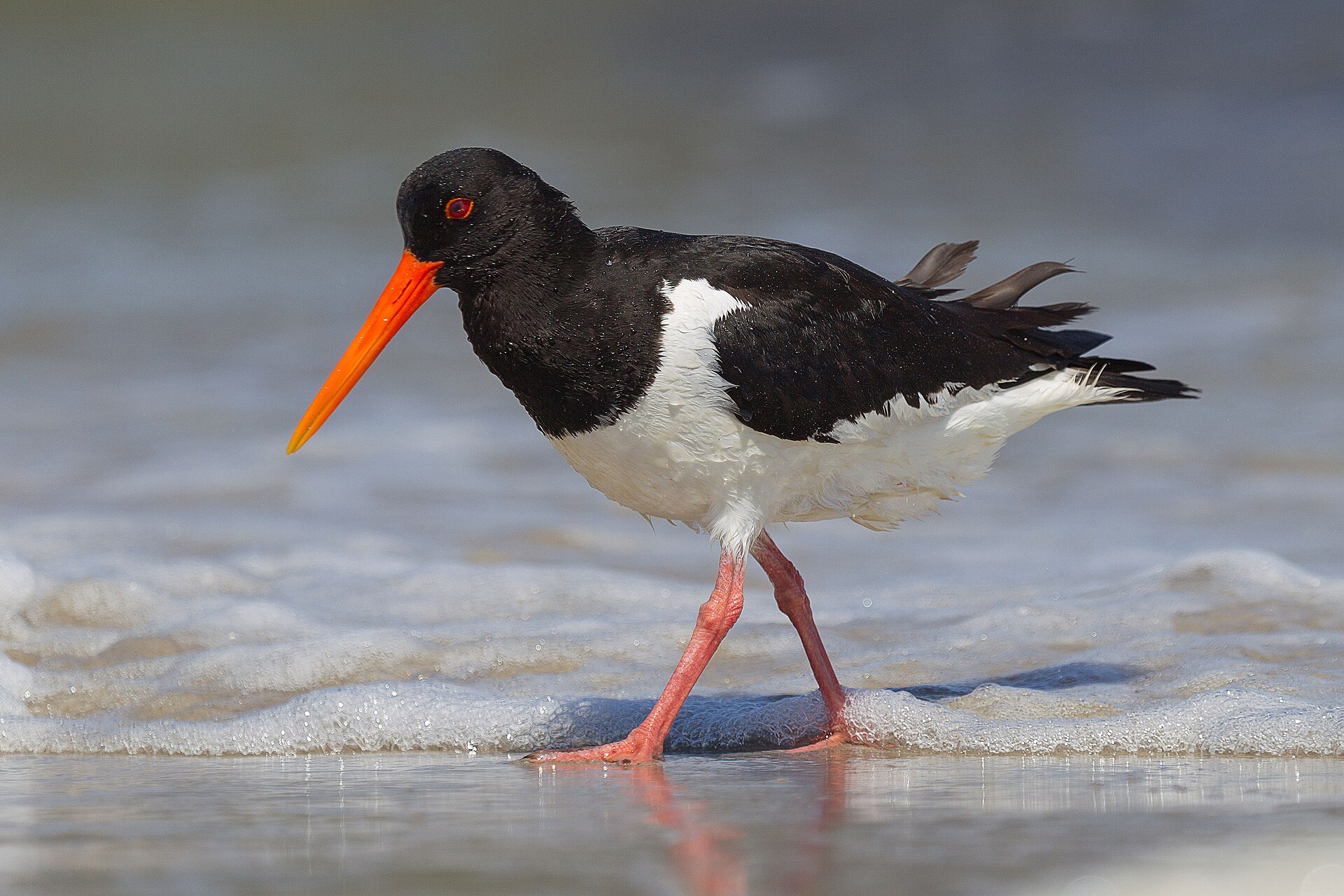
Bold black and white, 39 to 44 centimetres long with a wingspan of 72 to 83 centimetres — a substantial bird, not a small wader. A long orange-red bill, pink legs and a red eye. In flight, a broad white wing bar runs the length of the wing. Then there is the voice: a sharp, high, far-carrying te-piet. It is a loud bird, and it gives itself away long before you have it in view. There is nothing else in the Netherlands you can confuse it with.
What does a Eurasian Oystercatcher sound like?
Recording: MVmath20, CC BY-SA 4.0, via Wikimedia Commons
Where do you see this species in the Netherlands?
Nearly everywhere, and that is the interesting part. The oystercatcher started out as a coastal bird and still is one — salt marshes, mudflats and beaches to feed on shellfish, with the Wadden Sea and the Delta holding large numbers in winter. But it now also breeds well inland, on open grassland and arable fields. And on roofs. A flat gravel roof looks, to an oystercatcher, like the bare open ground it evolved to nest on, with one improvement: no foxes and no dogs. So the species breeds in the middle of Dutch villages and cities, which is why a visitor can hear one in a built-up street and assume they have misidentified it. They probably have not.
📍 Eemland
Good chance in season chance per source📍 Wadden Sea
Good chance chance per source📍 Marker Wadden
Good chance chance per source📍 Nationaal Park Oosterschelde
Good chance chance per source📍 Zwin & Zeeuws-Vlaanderen
presence reported📍 Blauwe Kamer
presence reported📍 Zouweboezem
presence reported📍 Oostelijke Vechtplassen
presence reported📍 Noordhollands Duinreservaat
presence reported📍 Wormer- en Jisperveld
presence reported📍 Ilperveld
presence reported📍 De Dollard
presence reported📍 Zuidlaardermeergebied en Hunzedal
presence reported📍 Schoorlse Duinen
Good chance verified📍 Meijendel & Berkheide
presence reported📍 Voornes Duin
presence reported📍 Kampina & Oisterwijkse Vennen
presence reported📍 De Maashorst
presence reported📍 Strabrechtse Heide & Beuven
presence reported📍 Loonse en Drunense Duinen
presence reported📍 Haringvlietsluizen
presence reported📍 Vismigratierivier Afsluitdijk
presence reported📍 De Putten bij Camperduin
presence reportedThese links come straight from our database, with the chance, the source and the evidence level for each area.
When is the best time?
Green = present · orange = peak period. The bar is generated from our database.
Best period: All year. March to July is the breeding season, when the birds are at their loudest and most visible; in winter large numbers gather on the flats and in the Delta.
Best time of day: Mornings are best, and on the coast the tide matters more than the month. Around low water they feed, spread out over the exposed flats; around high water they stand packed together at high-tide roosts — the easier way to see numbers, and the moment to keep your distance.
Recent sightings
👁️ Where has this species been seen recently?
Check the current sightings on Waarneming.nl. A useful addition to our own verified information.
How to improve your chances
- Learn the calls first. You will hear most birds before you see them.
- Go in the first hour after sunrise, when the song is at its peak and the wind is still down.
- Use a hide or natural cover. Sitting still gets you more than walking closer.
- Keep the sun behind you. Against the light you see a silhouette and no colour.
🎒 What you need for this
Binoculars are plenty.
Photography
Dives at you near a nest: keep your distance and use a telephoto lens.
🌿 Watching responsibly
Keep your distance, stay on the paths, and never lure animals with food or sound. Leave as soon as an animal becomes uneasy.
Status: Verified · Last checked: 2026-08-08
Easy to identify, quietly in trouble
The Eurasian Oystercatcher (Haematopus ostralegus) is the easiest wader in the Netherlands to identify and the hardest to ignore. Black and white, a long orange-red bill, and a shrill te-piet that carries across half a polder. You will almost always hear it before you see it.
It is also a quietly worrying bird. Still common, still conspicuous, and declining for decades.
What it eats, and the bill that goes with it
On the coast, shellfish — cockles and mussels above all. Inland, earthworms and leatherjackets.
There is a neat detail here that you can sometimes see in the field: the bill shape follows the diet. Birds that break shells open have a blunter bill than birds that probe soft ground for worms. It is the same species doing two different jobs with the same tool, shaped differently.
How it is doing
Not well, and this is worth stating plainly because the bird’s visibility hides it. The oystercatcher is still common and still everywhere, but numbers have been falling for decades — on the coast and in farmland alike.
Two pressures are named: fewer shellfish on the coast, and more intensive land use inland. A bird you see on every walk can still be in long-term decline, and this is the clearest example of that in the Netherlands.
Watching it responsibly
The oystercatcher asks less of you than most waders, because it will often sit on a fence post and shout at you regardless. Two things still matter.
In the breeding season, a noisy, agitated adult circling you means a nest or chicks nearby on the ground. Walk away rather than looking for them; the nest is a scrape in the open and chicks are easy to tread on.
At a high-tide roost, the same rule as for every wader: that hour is the only rest the birds get between tides. Stay behind the dyke.
Sources
Our sources for this species are in Dutch.
- Vogelbescherming Nederland (bird guide), consulted 2 November 2026 (in Dutch): identification, measurements, diet, bill shape and voice.
- Sovon Vogelonderzoek Nederland (in Dutch): the long-term decline on the coast and in farmland.
- Area-level occurrence on our Dutch pages is based on NDFF Flora & Fauna Verkenner open data alongside statements from the site managers. NDFF counts say something about presence, not about density or your chance of seeing a bird.
- Eurasian Curlew — the largest wader on the flats, and another species whose coastal numbers hide a breeding problem.
- Red Knot — and the full explanation of the high-tide roost.
- The Wadden Sea — the area page.
- How we work — where our facts come from and what we leave out.
Frequently asked questions
How do you recognise an oystercatcher?
By the long orange-red bill on a black-and-white body, with pink legs and a red eye. In flight you see a broad white wing bar. Its sharp te-piet carries a long way and makes it easy to identify without seeing it at all.
Why do oystercatchers nest on roofs?
Because a flat gravel roof resembles the bare, open ground they nest on naturally — and no foxes or dogs get up there. It began as a coastal bird, but through that adaptation it now breeds in the middle of villages and cities.
What does an oystercatcher eat?
Mainly shellfish such as cockles and mussels along the coast, and earthworms and leatherjackets inland. The bill shape differs accordingly: birds that break shells open have a blunter bill than birds that probe into soft ground.
When are your chances best?
March to July, in the breeding season, when they are at their loudest. On the coast the tide decides more than the month: around low water they feed on the exposed flats, and at high water they stand packed together at roosts.
Is the oystercatcher doing well?
No. The species is still common and conspicuous, but numbers have been declining for decades, both along the coast and in farmland. Fewer shellfish and more intensive land use both play a part.
What does an oystercatcher sound like?
Shrill, high and far-carrying: a loud te-piet. It is a noisy bird and generally announces itself well before you see it.