Where to see the brown rat in the Netherlands
Easy 🦌 Mammal (land)
Where and when do you see a brown rat? This species is easy to see, all year round.
How do you recognise a brown rat?
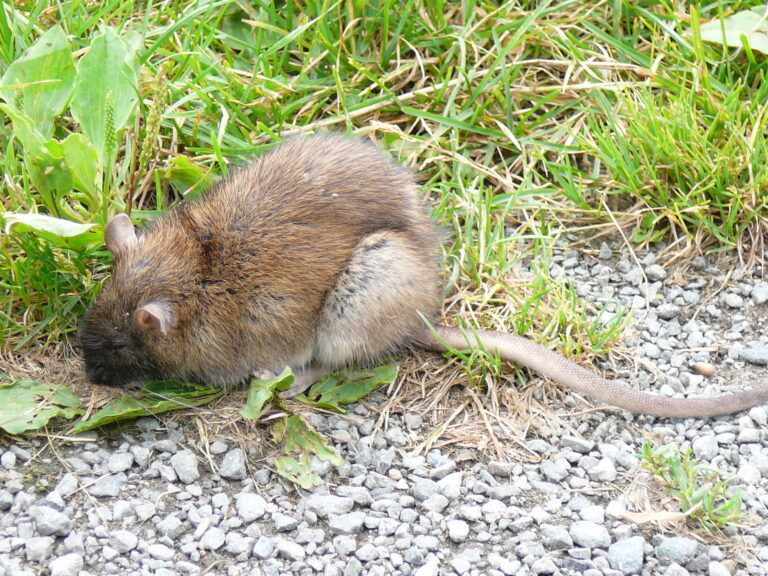
A hefty rodent with a head and body of 20 to 27 centimetres and a thick, scaly tail that is shorter than the head and body. Grey-brown coat with a paler belly, a blunt snout and small, densely haired ears. Swims well and dives without hesitating.
What can you confuse a brown rat with?
Looks like: Black rat, European water vole
- Black rat: slimmer, with larger ears and a tail longer than head and body together; the black rat climbs and lives high up in buildings.
- Water vole: a blunt snout, small ears that disappear into the fur and a shorter tail.
What tracks does a brown rat leave?
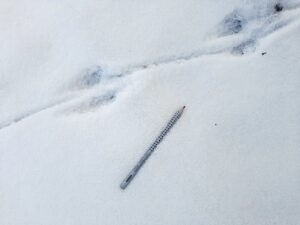
Track: the forefoot is 18 to 22 mm long and as wide, with four toes; the hind foot is over 40 mm long and 20 to 25 mm wide with five toes. That long heel print is the difference from the water vole. Trail: at a walking pace the fore and hind feet fall behind each other, in a bounding gallop beside each other. Droppings: 12 to 20 mm long and 5 to 7 mm thick, coarse in texture and pointed at one or both ends; a rat leaves forty a day, scattered or in latrines. Runs: paths 5 to 10 cm wide, visible in buildings as broken grease smears along the walls. Feeding signs: incisor marks 2 to 6 mm wide.


Where do you see this species in the Netherlands?
Throughout the country, with the emphasis on built-up areas, harbours, the banks of town water, sewer systems and farmyards.
Habitat: Damp places by human buildings: quaysides, banks, sewers, yards and food stores; digs extensive tunnel systems.
This is a common, widespread species: you can come across it in far more places than the areas listed below. Treat that list as a starting point rather than a full survey.
📍 Nationaal Park De Biesbosch
presence reported📍 Nationaal Park De Hoge Veluwe
presence reported📍 Nationaal Park Veluwezoom
presence reported📍 Oostvaardersplassen
presence reported📍 Nationaal Park Dwingelderveld
presence reported📍 Nationaal Park Drents-Friese Wold
presence reported📍 Nationaal Park De Groote Peel
presence reported📍 Nationaal Park Zuid-Kennemerland
presence reported📍 Amsterdamse Waterleidingduinen
presence reported📍 Nationaal Park Duinen van Texel
presence reported📍 Nationaal Park Lauwersmeer
presence reported📍 Nationaal Park De Alde Feanen
presence reported📍 Nationaal Park De Maasduinen
presence reported📍 Nationaal Park Sallandse Heuvelrug
presence reported📍 Nationaal Park De Meinweg
presence reported📍 Nationaal Park Utrechtse Heuvelrug
presence reported📍 Sint-Pietersberg & Zuid-Limburg
presence reported📍 Nationaal Park Oosterschelde
presence reported📍 Fochteloërveen
presence reported📍 Kroondomein Het Loo
presence reported📍 Deelerwoude
presence reported📍 Naardermeer
presence reported📍 Onlanden & Leekstermeer
presence reported📍 Zwin & Zeeuws-Vlaanderen
presence reported📍 Gelderse Poort & Millingerwaard
presence reported📍 Leuvenumse Bossen
presence reported📍 Blauwe Kamer
presence reported📍 Zouweboezem
presence reported📍 Oostelijke Vechtplassen
presence reported📍 Noordhollands Duinreservaat
presence reported📍 Wormer- en Jisperveld
presence reported📍 Ilperveld
presence reported📍 De Dollard
presence reported📍 Zuidlaardermeergebied en Hunzedal
presence reported📍 Landgoed Ennemaborg
presence reported📍 Meijendel & Berkheide
presence reported📍 Voornes Duin
presence reported📍 Kampina & Oisterwijkse Vennen
presence reported📍 De Maashorst
presence reported📍 Strabrechtse Heide & Beuven
presence reported📍 Loonse en Drunense Duinen
presence reported📍 Schoorlse Duinen
presence reported📍 Haringvlietsluizen
presence reported📍 Vismigratierivier Afsluitdijk
presence reported📍 De Putten bij Camperduin
presence reportedThese links come straight from our database, with the chance, the source and the evidence level for each area.
When is the best time?
Green = present · orange = peak period. The bar is generated from our database.
Best period: All year.
Best time of day: Dusk and night; also by day where numbers are high.
Recent sightings
👁️ Where has this species been seen recently?
Check the current sightings on Waarneming.nl. A useful addition to our own verified information.
How to improve your chances
- Keep the wind in your face. Most mammals will smell you long before they see you.
- Arrive before sunrise and then stay put. Sitting still beats walking about.
- Wear muted colours, skip the scent, and put your phone on silent.
- Be patient. Expect to come back more than once before it works.
🎒 What you need for this
Binoculars; nothing else
Photography
A canal or harbour with a steep quay is the easiest place: rats run fixed routes there along the waterline. Sit down and wait rather than walking. In the late afternoon there is often still enough light
🌿 Watching responsibly
Keep your distance, stay on the paths, and never lure animals with food or sound. Leave as soon as an animal becomes uneasy.
Status: Verified · Last checked: 2026-08-07
More photos