Where to see the Sanderling in the Netherlands
Easy 🦅 Bird
Where and when do you see a Sanderling? This species is easy to see, from August to May.
How do you recognise a Sanderling?
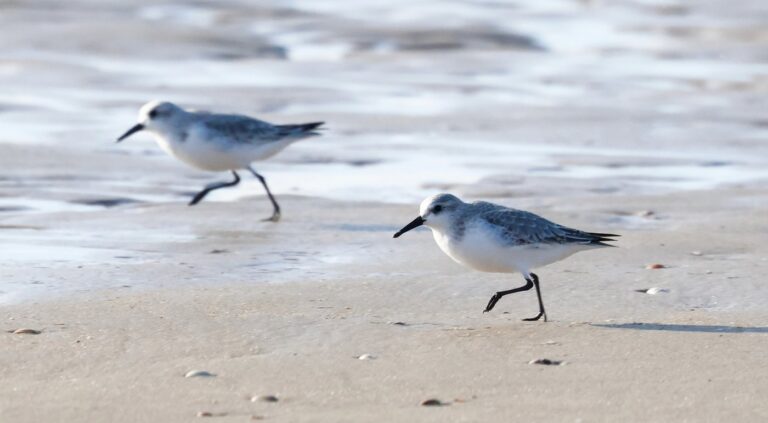
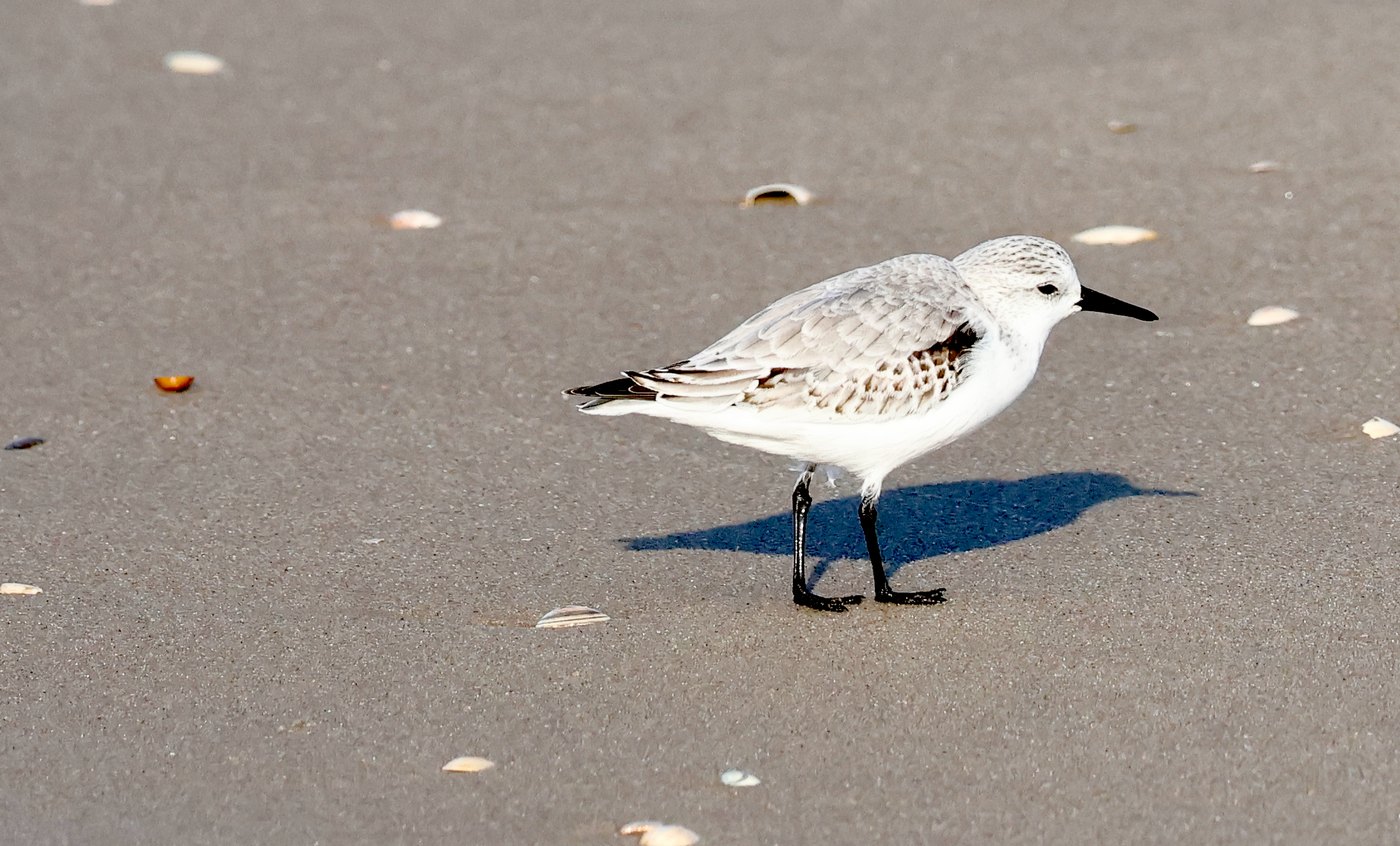
Start with the behaviour. It sprints away from each advancing wave and immediately chases the water back down the slope, in small tight groups, over and over. No other wader here does that so consistently. If you see it, you have your identification before you have raised the binoculars. Then the plumage. In winter it is strikingly white — the whitest wader we have — with a dark shoulder patch, a black bill and black legs. In late spring it turns deep rust-red on the head and breast, which makes a May bird look like something else entirely. 20 to 21 centimetres, wingspan 35 to 39 centimetres: between a Dunlin and a Red Knot in size.
Where do you see this species in the Netherlands?
Sandy beaches, along the full length of the North Sea coast, and sandbanks in the Wadden Sea. It is more tied to the beach than any other wader here, and you will rarely find it on groynes or stony shores. That makes it the exception in this group. The Dunlin and the Red Knot are birds you go to a tidal flat to see, at a specific point in the tide, with a scope. The Sanderling you simply run into on a walk at Zandvoort or on Terschelling.
📍 Nationaal Park Duinen van Texel
presence reported📍 Zwin & Zeeuws-Vlaanderen
presence reported📍 Amsterdamse Waterleidingduinen
presence reported📍 Nationaal Park Lauwersmeer
presence reported📍 Nationaal Park De Biesbosch
presence reported📍 Oostvaardersplassen
presence reported📍 Nationaal Park Oosterschelde
Good chance in season chance per source📍 Wadden Sea
Good chance in season chance per source📍 Noordhollands Duinreservaat
presence reported📍 De Dollard
presence reported📍 Meijendel & Berkheide
presence reported📍 Voornes Duin
presence reported📍 Schoorlse Duinen
presence reported📍 Haringvlietsluizen
presence reported📍 Vismigratierivier Afsluitdijk
presence reported📍 De Putten bij Camperduin
presence reportedThese links come straight from our database, with the chance, the source and the evidence level for each area.
When is the best time?
Green = present · orange = peak period. The bar is generated from our database.
Best period: The two passage periods are the best moments: August to October, and again in May. Birds are present through the winter as well.
Best time of day: Unusually for a wader here, go on a falling tide rather than around high water. As the water drops, the wet strip along the tideline comes free and that is the band the birds work. High water takes their feeding zone away rather than concentrating them.
Recent sightings
👁️ Where has this species been seen recently?
Check the current sightings on Waarneming.nl. A useful addition to our own verified information.
How to improve your chances
- Learn the calls first. You will hear most birds before you see them.
- Go in the first hour after sunrise, when the song is at its peak and the wind is still down.
- Use a hide or natural cover. Sitting still gets you more than walking closer.
- Keep the sun behind you. Against the light you see a silhouette and no colour.
🎒 What you need for this
Binoculars. This is one wader you do not need a telescope for.
🌿 Watching responsibly
Keep your distance, stay on the paths, and never lure animals with food or sound. Leave as soon as an animal becomes uneasy.
Status: Verified · Last checked: 2026-08-08
The wader you meet on an ordinary beach walk
The Sanderling (Calidris alba) is the one wader you can meet on an ordinary walk along a Dutch beach. The others want mud; this one wants sand and surf. And you will identify it by behaviour long before you get a good look at it, because nothing else runs away from each incoming wave and straight back after it like a wind-up toy.
Numbers
- 13,000 to 21,800 birds here in winter.
- 22,200 to 38,700 passing through in May.
Numbers have been stable since 2010 — which, among the waders on this coast, counts as good news.
Where the name comes from
The Dutch name, drieteenstrandloper, means “three-toed sandpiper”, and it is literal: the Sanderling has no hind toe. Three toes forward and nothing behind, which makes it unique among our waders. You will almost never see this in the field, but it explains the name.
The scientific name points at the other obvious feature: alba, for that winter white.
What it eats, and where it breeds
Small crabs, shrimps, molluscs, worms and insects, taken from the wet sand by pecking and probing. It uses smell, taste, touch and sight — a wider toolkit than the Dunlin, which works almost entirely by feel.
It breeds in the high Arctic: Greenland, Svalbard, northern Canada and Siberia, on sparsely vegetated stony tundra. A bird running along the tideline at Camperduin in September has come a very long way to be there, and will go further still.
Watching it responsibly
Easier than most, because the birds are busy and the beach is wide. Two things help: walk along the dry sand rather than down on the tideline the birds are working, and keep dogs on a lead. A loose dog clears several hundred metres of beach in seconds, and a bird that is refuelling for a flight to Greenland cannot spare the energy.
Sources
Our sources for this species are in Dutch.
- Vogelbescherming Nederland (bird guide), consulted 2 November 2026 (in Dutch): identification, measurements, behaviour, diet and breeding range.
- Sovon Vogelonderzoek Nederland (in Dutch): the winter and passage totals, and the stable trend since 2010.
- Area-level occurrence on our Dutch pages is based on NDFF Flora & Fauna Verkenner open data alongside statements from the site managers. NDFF counts say something about presence, not about density or your chance of seeing a bird.
- Dunlin — the mud-loving counterpart, and the one you will not find on a sandy beach.
- Red Knot — and the full explanation of the high-tide roost.
- The Wadden Sea — the area page.
- How we work — where our facts come from and what we leave out.
Frequently asked questions
Where do you see sanderlings?
On sandy beaches along the whole North Sea coast and on sandbanks in the Wadden Sea. It is more tied to the beach than other waders and is rarely found on groynes or stony shores. This is the wader you simply come across on an ordinary beach walk at Zandvoort or on Terschelling.
When are your chances best?
During passage in August to October and again in May. Birds are present in winter too: 13,000 to 21,800. In May, 22,200 to 38,700 pass through. Look on a falling tide, when the tideline comes free.
What identifies it immediately?
Its behaviour. It sprints away from every incoming wave and straight back after it, in small groups, like a wind-up toy. No other wader does it that way. In winter plumage it is also strikingly white — the whitest wader we have — with a dark shoulder patch and a black bill and legs. In late spring it turns deep rust-red.
Why is it called three-toed in Dutch?
Because it has no hind toe, which makes it unique among our waders: three toes forward and nothing behind. You can barely see it in the field, but it explains the name. Its scientific name, Calidris alba, refers to that conspicuous white.
What does it eat, and where does it breed?
Small crabs, shrimps, molluscs, worms and insects, taken from the wet sand by pecking and probing, using smell, taste, touch and sight. It breeds in the high Arctic — Greenland, Svalbard, northern Canada and Siberia — on sparsely vegetated stony tundra. Numbers have been stable since 2010.
More photos