
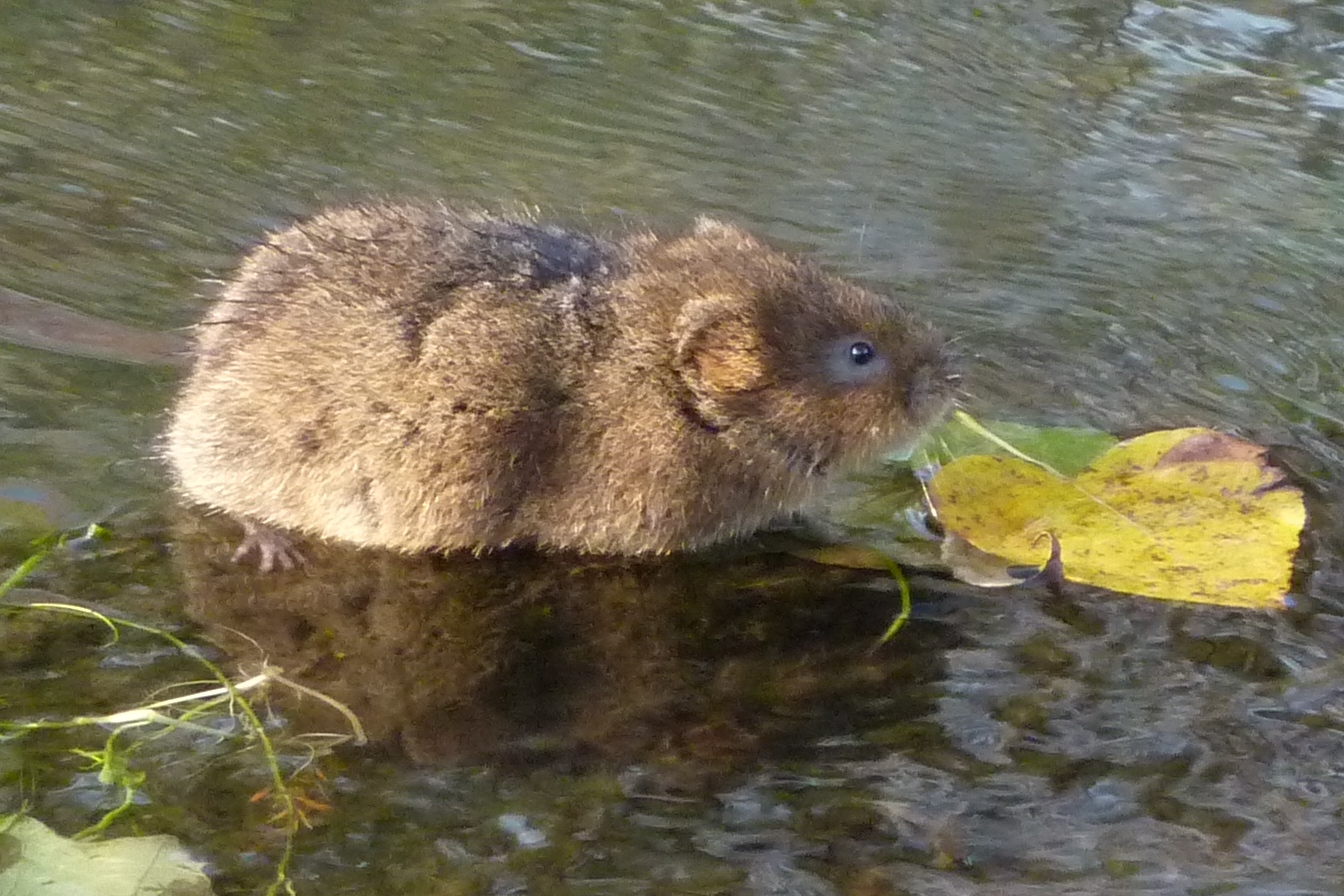
Where to see the European water vole in the Netherlands
With luck 🦌 Mammal (land)
Where and when do you see a European water vole? With some luck you can see this species, all year round.
How do you recognise a European water vole?
Our largest native vole: a blunt snout, small hidden ears, yellow incisors and a thick glossy coat.
What can you confuse a European water vole with?
Looks like: Brown rat, Muskrat, European mole
- Brown rat: A more pointed snout, larger ears that stick out above the fur and a longer tail; the water vole has a blunt snout with small ears.
- Muskrat: Far larger and a true swimmer, with a flattened tail.
- European mole: It makes round, loose heaps of fine soil without plant remains; water vole heaps are more irregular and contain roots and greenery.
What tracks does a European water vole leave?
Print: the forefoot is 15 mm wide and just as long and has four toes, the hind foot is 10 to 15 mm wide and 20 to 33 mm long with five toes; the claws usually press in clearly. Trail: walking, 60 to 90 mm between the prints, along runways 4 to 9 cm wide. Droppings: 7 to 10 mm long and 3 to 4 mm thick, beige-brown to dark brown when fresh and later black, found above all where the animal enters or leaves the water. Feeding signs: gnawed stems of water and bankside plants, and in winter gnawing on tree roots up to 20 or 30 cm thick.

Where do you see this species in the Netherlands?
By clean fresh water with steep vegetated banks; everywhere except on the Wadden Islands.
This is a common, widespread species: you can come across it in far more places than the areas listed below. Treat that list as a starting point rather than a full survey.
📍 Nationaal Park De Biesbosch
presence reported📍 Oostvaardersplassen
presence reported📍 Nationaal Park Dwingelderveld
presence reported📍 Nationaal Park De Groote Peel
presence reported📍 Nationaal Park Zuid-Kennemerland
presence reported📍 Amsterdamse Waterleidingduinen
presence reported📍 Nationaal Park Lauwersmeer
presence reported📍 Nationaal Park De Alde Feanen
presence reported📍 Nationaal Park De Maasduinen
presence reported📍 Nationaal Park Oosterschelde
presence reported📍 Fochteloërveen
presence reported📍 Nationaal Park Zuid-Limburg (in formation)
presence reported📍 Naardermeer
presence reported📍 Onlanden & Leekstermeer
presence reported📍 Zwin & Zeeuws-Vlaanderen
presence reported📍 Oostelijke Vechtplassen
presence reported📍 Wormer- en Jisperveld
presence reported📍 Ilperveld
presence reported📍 De Dollard
presence reported📍 Zuidlaardermeergebied en Hunzedal
presence reported📍 Landgoed Ennemaborg
presence reported📍 Meijendel & Berkheide
presence reported📍 Voornes Duin
presence reported📍 Loonse en Drunense Duinen
presence reported📍 Schoorlse Duinen
presence reported📍 Haringvlietsluizen
presence reported📍 De Putten bij Camperduin
presence reportedThese links come straight from our database, with the chance, the source and the evidence level for each area.
When is the best time?
Green = present · orange = peak period. The bar is generated from our database.
Best period: All year; breeding March to October.
Best time of day: Dusk.
Recent sightings
👁️ Where has this species been seen recently?
Check the current sightings on Waarneming.nl. A useful addition to our own verified information.
How to improve your chances
- Keep the wind in your face. Most mammals will smell you long before they see you.
- Arrive before sunrise and then stay put. Sitting still beats walking about.
- Wear muted colours, skip the scent, and put your phone on silent.
- Be patient. Expect to come back more than once before it works.
🎒 What you need for this
Binoculars; sitting still at a ditch bank
🌿 Watching responsibly
Keep your distance, stay on the paths, and never lure animals with food or sound. Leave as soon as an animal becomes uneasy.
Status: Verified · Last checked: 2026-08-08