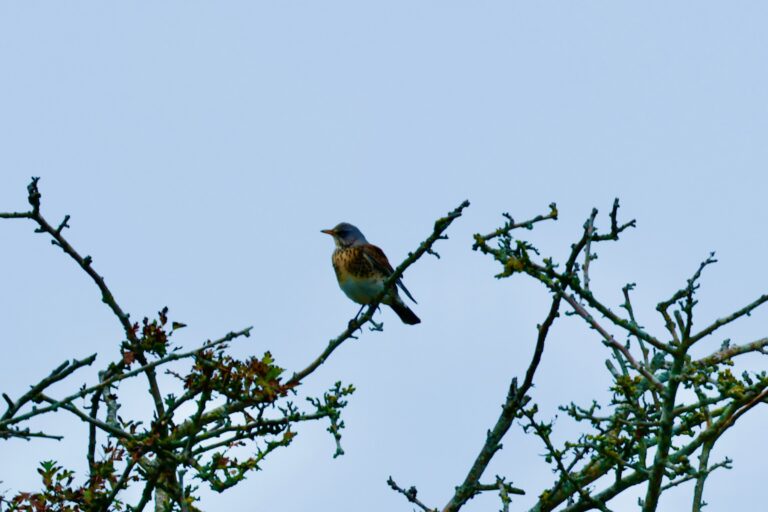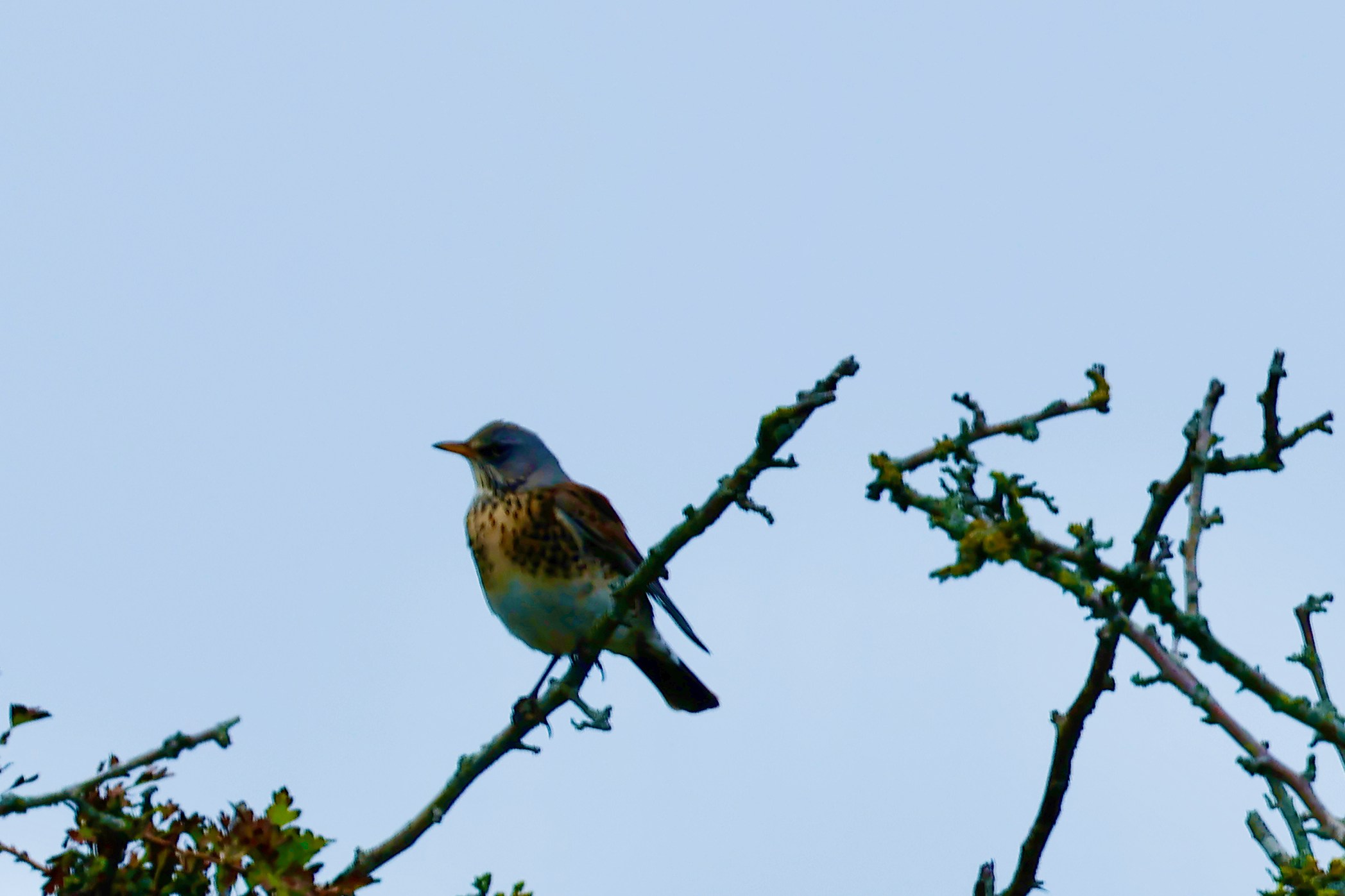
A Fieldfare in a hawthorn against a blue sky
📷 Foto: Bas de Bruin — Amsterdamse Waterleidingduinen, 31 oktober 2026

Where to see the Fieldfare in the Netherlands

Turdus pilaris · Fieldfare

Easy 🦅 Bird

Where and when do you see a Fieldfare? This species is easy to see, from October to April.

How do you recognise a Fieldfare?

A hefty thrush of 22 to 27 centimetres with a light grey head and grey rump, a chestnut back and a black tail; the orange-tinged breast is heavily spotted and in flight the white underwings light up.

Wingspan: 42 cm an indication from Wikidata; it varies by individual, sex and subspecies · compare all birds (in Dutch)

What can you confuse a Fieldfare with?

Looks like: Redwing, Mistle Thrush

  • Redwing: both winter visitors in flocks; the Redwing is smaller, with a cream-white eyebrow stripe and copper-red flanks, the Fieldfare larger with a grey head and rump.
  • Mistle Thrush: the same size, but the Mistle Thrush is an even grey-brown without the grey head and chestnut back.

What does a Fieldfare sound like?

Recording: Benoît Van Hecke, CC BY-SA 4.0, via Wikimedia Commons

Where do you see this species in the Netherlands?

In the winter half of the year throughout the country: meadows, orchards, parks and gardens with berry-bearing shrubs. As a breeding bird extremely scarce, mainly in Zuid-Limburg, the Achterhoek and Twente.

How certain is this? verified chance per source presence reported Links that do not clear the bottom threshold are not published. How we decide that.
NDFF open data, 1.972 records 2016-2026
Nationwide period: October to March, with the largest flocks in October and November.
NDFF open data, 1.256 records 2016-2026
Nationwide period: October to March, with the largest flocks in October and November.

📍 Oostvaardersplassen

presence reported
NDFF open data, 902 records 2016-2026
Nationwide period: October to March, with the largest flocks in October and November.
NDFF open data, 735 records 2016-2026
Nationwide period: October to March, with the largest flocks in October and November.
NDFF open data, 527 records 2016-2026
Nationwide period: October to March, with the largest flocks in October and November.
NDFF open data, 525 records 2016-2026
Nationwide period: October to March, with the largest flocks in October and November.

📍 Nationaal Park De Meinweg

presence reported
NDFF open data, 499 records 2016-2026
Nationwide period: October to March, with the largest flocks in October and November.
NDFF open data, 495 records 2016-2026
Nationwide period: October to March, with the largest flocks in October and November.

📍 Gelderse Poort & Millingerwaard

With luck chance per source
Vogelwerkgroep Nijmegen · area description
Nationwide period: October to March, with the largest flocks in October and November.

📍 Fochteloërveen

presence reported
NDFF open data, 476 records 2016-2026
Nationwide period: October to March, with the largest flocks in October and November.
NDFF open data, 465 records 2016-2026
Nationwide period: October to March, with the largest flocks in October and November.

📍 Naardermeer

presence reported
NDFF open data, 420 records 2016-2026
Nationwide period: October to March, with the largest flocks in October and November.
NDFF open data, 405 records 2016-2026
Nationwide period: October to March, with the largest flocks in October and November.

📍 Onlanden & Leekstermeer

presence reported
NDFF open data, 285 records 2016-2026
Nationwide period: October to March, with the largest flocks in October and November.
NDFF open data, 270 records 2016-2026
Nationwide period: October to March, with the largest flocks in October and November.
NDFF open data, 233 records 2016-2026
Nationwide period: October to March, with the largest flocks in October and November.
NDFF open data, 194 records 2016-2026
Nationwide period: October to March, with the largest flocks in October and November.
NDFF open data, 190 records 2016-2026
Nationwide period: October to March, with the largest flocks in October and November.

📍 Kroondomein Het Loo

presence reported
NDFF open data, 128 records 2016-2026
Nationwide period: October to March, with the largest flocks in October and November.

📍 Deelerwoude

presence reported
NDFF open data, 110 records 2016-2026
Nationwide period: October to March, with the largest flocks in October and November.
NDFF open data, 106 records 2016-2026
Nationwide period: October to March, with the largest flocks in October and November.

📍 Marker Wadden

Good chance in season chance per source
Natuurmonumenten, the site manager
Nationwide period: October to March, with the largest flocks in October and November.

📍 Planken Wambuis

presence reported
NDFF open data, 1.061 records 2016-2026
Nationwide period: October to March, with the largest flocks in October and November.

📍 Blauwe Kamer

presence reported
NDFF open data
Nationwide period: October to March, with the largest flocks in October and November.

📍 Zouweboezem

presence reported
NDFF open data
Nationwide period: October to March, with the largest flocks in October and November.

📍 Oostelijke Vechtplassen

presence reported
NDFF open data
Nationwide period: October to March, with the largest flocks in October and November.
NDFF open data
Nationwide period: October to March, with the largest flocks in October and November.

📍 Wormer- en Jisperveld

presence reported
NDFF open data
Nationwide period: October to March, with the largest flocks in October and November.

📍 Ilperveld

presence reported
NDFF open data
Nationwide period: October to March, with the largest flocks in October and November.

📍 De Dollard

presence reported
NDFF open data
Nationwide period: October to March, with the largest flocks in October and November.
NDFF open data
Nationwide period: October to March, with the largest flocks in October and November.

📍 Meijendel & Berkheide

presence reported
NDFF open data, 3.346 records 2016-2026
Nationwide period: October to March, with the largest flocks in October and November.

📍 Voornes Duin

presence reported
NDFF open data, 213 records 2016-2026
Nationwide period: October to March, with the largest flocks in October and November.
NDFF open data, 1.134 records 2016-2026
Nationwide period: October to March, with the largest flocks in October and November.

📍 De Maashorst

presence reported
NDFF open data, 1.450 records 2016-2026
Nationwide period: October to March, with the largest flocks in October and November.
NDFF open data, 456 records 2016-2026
Nationwide period: October to March, with the largest flocks in October and November.

📍 Loonse en Drunense Duinen

presence reported
NDFF open data, 601 records 2016-2026
Nationwide period: October to March, with the largest flocks in October and November.

📍 Schoorlse Duinen

presence reported
NDFF open data, 1.052 records 2016-2026
Nationwide period: October to March, with the largest flocks in October and November.
NDFF open data, 139 records 2016-2026
Nationwide period: October to March, with the largest flocks in October and November.

📍 De Putten bij Camperduin

presence reported
NDFF open data, 294 records 2016-2026
Nationwide period: October to March, with the largest flocks in October and November.

These links come straight from our database, with the chance, the source and the evidence level for each area.

When is the best time?

Green = present · orange = peak period. The bar is generated from our database.

Best period: October to March, with the largest flocks in October and November.

Best time of day: By day.

Recent sightings

👁️ Where has this species been seen recently?

Check the current sightings on Waarneming.nl. A useful addition to our own verified information.

Current sightings on Waarneming.nl →

How to improve your chances

  • Learn the calls first. You will hear most birds before you see them.
  • Go in the first hour after sunrise, when the song is at its peak and the wind is still down.
  • Use a hide or natural cover. Sitting still gets you more than walking closer.
  • Keep the sun behind you. Against the light you see a silhouette and no colour.

🎒 What you need for this

Binoculars; a telescope helps with flocks far out in the meadow

Photography

Find a berry bush the flock keeps coming back to and wait at a distance; Fieldfares put up with a car as a hide far better than with a person

🌿 Watching responsibly

Keep your distance, stay on the paths, and never lure animals with food or sound. Leave as soon as an animal becomes uneasy.

Sources: NDFF Flora & Fauna Verkenner (open data), geraadpleegd 31-07-2026; Vogelbescherming Nederland; Sovon Vogelonderzoek Nederland
Status: Verified · Last checked: 2026-08-07

More photos
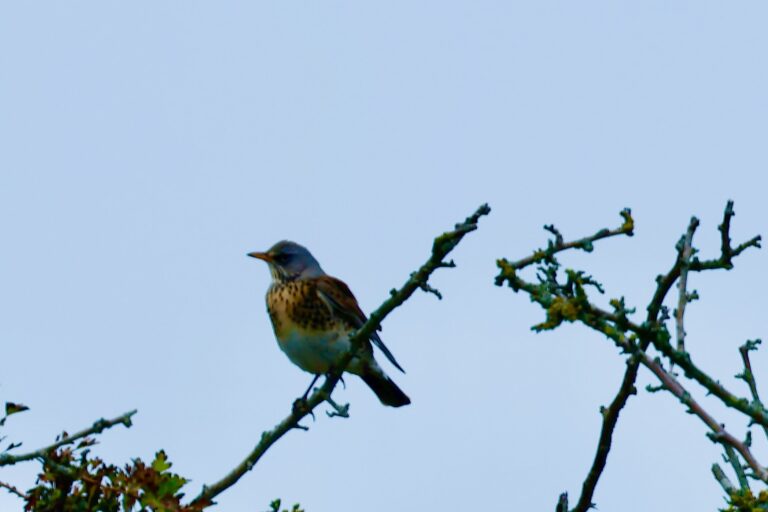
A Fieldfare in a hawthorn against a blue sky
Photo: Bas de Bruin — Amsterdamse Waterleidingduinen, 31 oktober 2026
Kramsvogel boven in een meidoorn, ruimer beeld
Photo: Bas de Bruin — Amsterdamse Waterleidingduinen, 31 oktober 2026