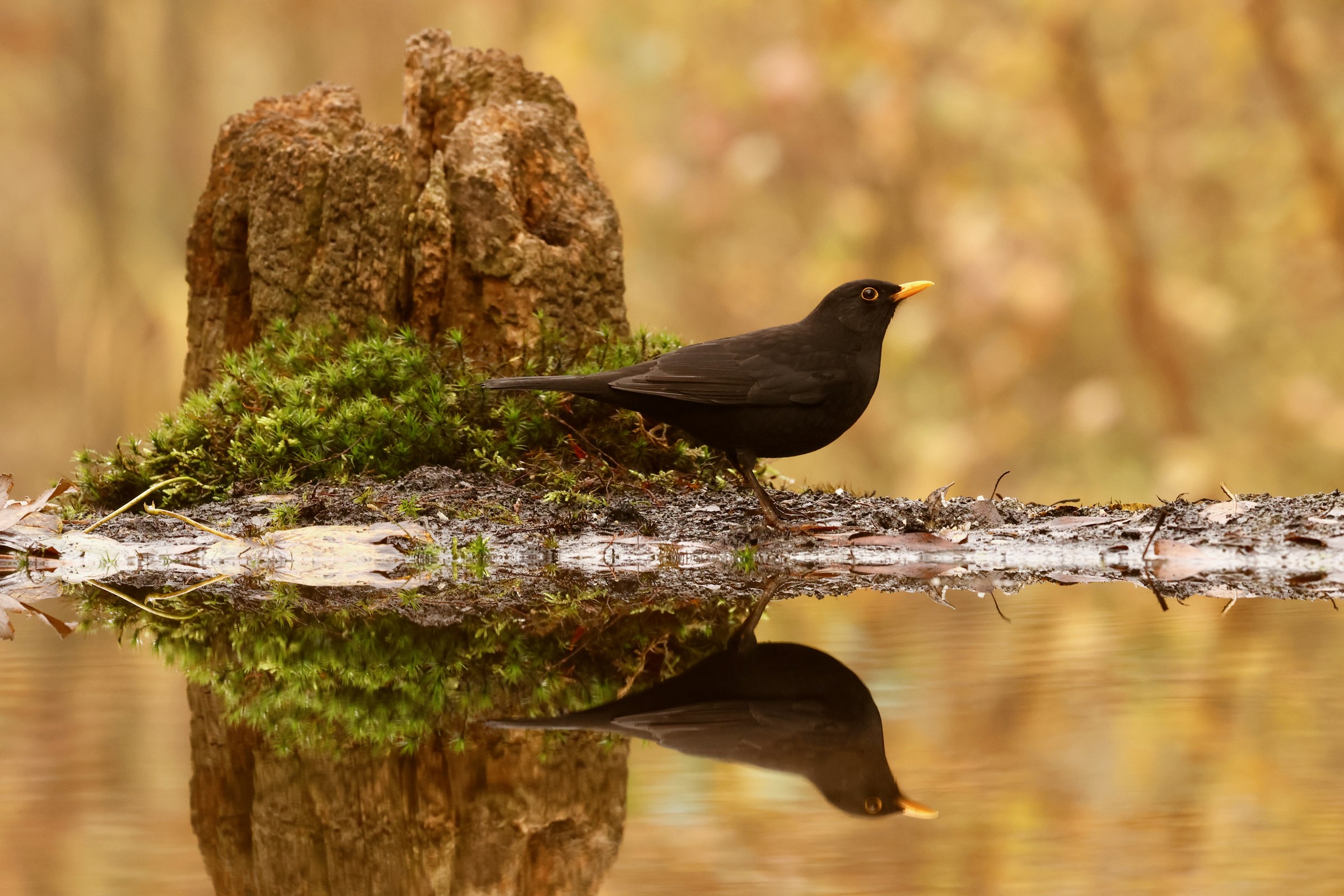
Black male blackbird with a yellow bill on a mossy trunk, with a reflection
📷 Foto: Bas de Bruin — fotohut HBN-1XL (Han Bouwmeester), Twente, 30 oktober 2026

Where to see the Common Blackbird in the Netherlands

Turdus merula · Common Blackbird

Easy 🦅 Bird

Where and when do you see a Common Blackbird? This species is easy to see, all year round.

How do you recognise a Common Blackbird?

Length 23.5 to 29 cm, wingspan 34 to 38 cm. The male is jet black with an orange-yellow bill and a yellow eye-ring; the female is dark brown with a faintly mottled breast and is therefore often taken for another species. Young blackbirds are rusty brown and heavily spotted. On the ground it alternates hopping and running, with short stops in which it tilts its head to look down.

What can you confuse a Common Blackbird with?

Looks like: Common Starling, Carrion Crow, Ring Ouzel, Song Thrush

  • Common Starling: Also black at a distance, but the starling walks across grass instead of hopping, has a shorter tail and a triangular silhouette in flight.
  • Carrion Crow: Far larger and more heavily built, with a thick black bill; the blackbird has an orange-yellow bill and a yellow eye-ring.
  • Ring Ouzel: Blackbird-like, but with a striking white crescent-shaped breast band and pale wing edges.
  • Song Thrush: The brown female blackbird is often taken for this; the song thrush has a clearly pale breast with arrowhead spots, the female blackbird only faint mottling.

What does a Common Blackbird sound like?

Recording: Ryan Hodnett, CC BY-SA 4.0, via Wikimedia Commons

Where do you see this species in the Netherlands?

Almost the whole of the Netherlands, from woodland to city centre. The blackbird is one of the few species that has adapted completely to the town.

Habitat: Woodland, park, garden and scrub: anywhere with soil life to search and shrubs to nest in. A garden with leaves and a strip of bare earth is worth more to it than a lawn.

This is a common, widespread species: you can come across it in far more places than the areas listed below. Treat that list as a starting point rather than a full survey.

How certain is this? verified chance per source presence reported Links that do not clear the bottom threshold are not published. How we decide that.

📍 Nationaal Park De Hoge Veluwe

Good chance verified
Nationwide period: Present all year. From March to July the male sings from a high perch, usually at first and last light, for many people the best-known bird sound in the Netherlands.

📍 Gelderse Poort & Millingerwaard

Good chance chance per source
Vogelwerkgroep Nijmegen · area description
Nationwide period: Present all year. From March to July the male sings from a high perch, usually at first and last light, for many people the best-known bird sound in the Netherlands.

📍 Blauwe Kamer

presence reported
NDFF open data
Nationwide period: Present all year. From March to July the male sings from a high perch, usually at first and last light, for many people the best-known bird sound in the Netherlands.

📍 Zouweboezem

presence reported
NDFF open data
Nationwide period: Present all year. From March to July the male sings from a high perch, usually at first and last light, for many people the best-known bird sound in the Netherlands.

📍 Oostelijke Vechtplassen

presence reported
NDFF open data
Nationwide period: Present all year. From March to July the male sings from a high perch, usually at first and last light, for many people the best-known bird sound in the Netherlands.
NDFF open data
Nationwide period: Present all year. From March to July the male sings from a high perch, usually at first and last light, for many people the best-known bird sound in the Netherlands.

📍 Wormer- en Jisperveld

presence reported
NDFF open data
Nationwide period: Present all year. From March to July the male sings from a high perch, usually at first and last light, for many people the best-known bird sound in the Netherlands.

📍 Ilperveld

presence reported
NDFF open data
Nationwide period: Present all year. From March to July the male sings from a high perch, usually at first and last light, for many people the best-known bird sound in the Netherlands.

📍 De Dollard

presence reported
NDFF open data
Nationwide period: Present all year. From March to July the male sings from a high perch, usually at first and last light, for many people the best-known bird sound in the Netherlands.
NDFF open data
Nationwide period: Present all year. From March to July the male sings from a high perch, usually at first and last light, for many people the best-known bird sound in the Netherlands.

📍 Landgoed Ennemaborg

presence reported
NDFF open data
Nationwide period: Present all year. From March to July the male sings from a high perch, usually at first and last light, for many people the best-known bird sound in the Netherlands.

📍 Meijendel & Berkheide

presence reported
NDFF open data, 21.027 records 2016-2026
Nationwide period: Present all year. From March to July the male sings from a high perch, usually at first and last light, for many people the best-known bird sound in the Netherlands.

📍 Voornes Duin

presence reported
NDFF open data, 1.666 records 2016-2026
Nationwide period: Present all year. From March to July the male sings from a high perch, usually at first and last light, for many people the best-known bird sound in the Netherlands.
NDFF open data, 4.890 records 2016-2026
Nationwide period: Present all year. From March to July the male sings from a high perch, usually at first and last light, for many people the best-known bird sound in the Netherlands.

📍 De Maashorst

presence reported
NDFF open data, 9.116 records 2016-2026
Nationwide period: Present all year. From March to July the male sings from a high perch, usually at first and last light, for many people the best-known bird sound in the Netherlands.
NDFF open data, 3.754 records 2016-2026
Nationwide period: Present all year. From March to July the male sings from a high perch, usually at first and last light, for many people the best-known bird sound in the Netherlands.

📍 Loonse en Drunense Duinen

presence reported
NDFF open data, 4.941 records 2016-2026
Nationwide period: Present all year. From March to July the male sings from a high perch, usually at first and last light, for many people the best-known bird sound in the Netherlands.

📍 Schoorlse Duinen

presence reported
NDFF open data, 24.290 records 2016-2026
Nationwide period: Present all year. From March to July the male sings from a high perch, usually at first and last light, for many people the best-known bird sound in the Netherlands.

📍 Haringvlietsluizen

presence reported
NDFF open data, 218 records 2016-2026
Nationwide period: Present all year. From March to July the male sings from a high perch, usually at first and last light, for many people the best-known bird sound in the Netherlands.
NDFF open data, 257 records 2016-2026
Nationwide period: Present all year. From March to July the male sings from a high perch, usually at first and last light, for many people the best-known bird sound in the Netherlands.

📍 De Putten bij Camperduin

presence reported
NDFF open data, 155 records 2016-2026
Nationwide period: Present all year. From March to July the male sings from a high perch, usually at first and last light, for many people the best-known bird sound in the Netherlands.

These links come straight from our database, with the chance, the source and the evidence level for each area.

When is the best time?

Green = present · orange = peak period. The bar is generated from our database.

Best period: Present all year. From March to July the male sings from a high perch, usually at first and last light, for many people the best-known bird sound in the Netherlands.

Best time of day: Early morning and the last hour of light. That is when it sings, and when it searches the ground for worms.

Recent sightings

👁️ Where has this species been seen recently?

Check the current sightings on Waarneming.nl. A useful addition to our own verified information.

Current sightings on Waarneming.nl →

How to improve your chances

  • Learn the calls first. You will hear most birds before you see them.
  • Go in the first hour after sunrise, when the song is at its peak and the wind is still down.
  • Use a hide or natural cover. Sitting still gets you more than walking closer.
  • Keep the sun behind you. Against the light you see a silhouette and no colour.

Photography

Searches for worms on the lawn: lie flat for eye level

🌿 Watching responsibly

Keep your distance, stay on the paths, and never lure animals with food or sound. Leave as soon as an animal becomes uneasy.

Sources: Sovon / Vogelbescherming / Zodion / Vlinderstichting; Vogelbescherming Nederland (vogelgids), geraadpleegd 02-11-2026
Status: Verified · Last checked: 2026-08-08

More photos
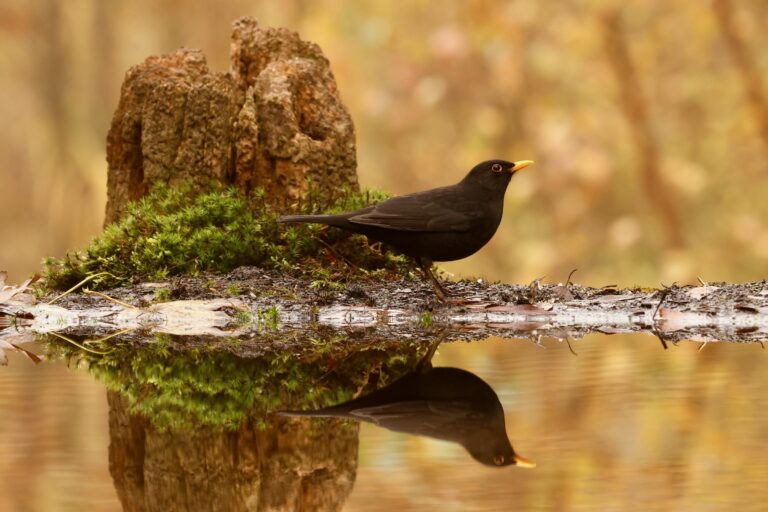
Black male blackbird with a yellow bill on a mossy trunk, with a reflection
Photo: Bas de Bruin — fotohut HBN-1XL (Han Bouwmeester), Twente, 30 oktober 2026
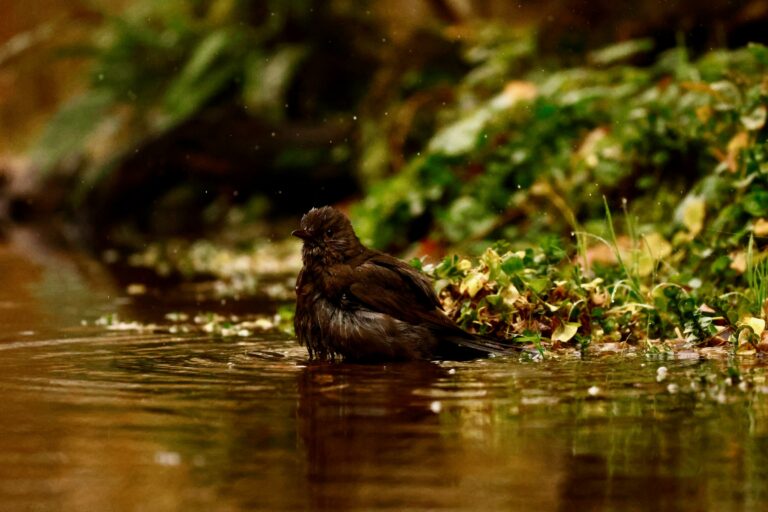
Badderende merel in de oever, met opspattend water
Photo: Bas de Bruin — fotohut HBN-1XL (Han Bouwmeester), Twente, 30 oktober 2026
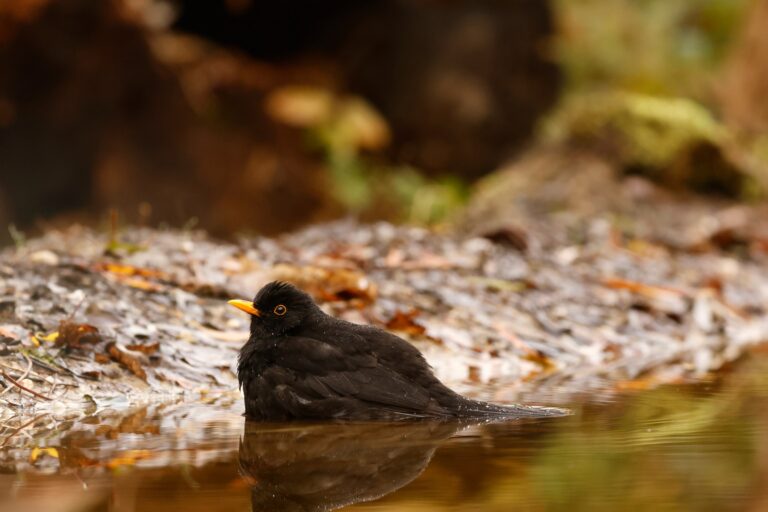
Merelman tot aan de borst in het water, met gele snavel
Photo: Bas de Bruin — fotohut HBN-1XL (Han Bouwmeester), Twente, 30 oktober 2026