
Where to see the grey seal in the Netherlands
With luck 🦭 Marine mammal
Where and when do you see a grey seal? With some luck you can see this species, all year round.
How do you recognise a grey seal?
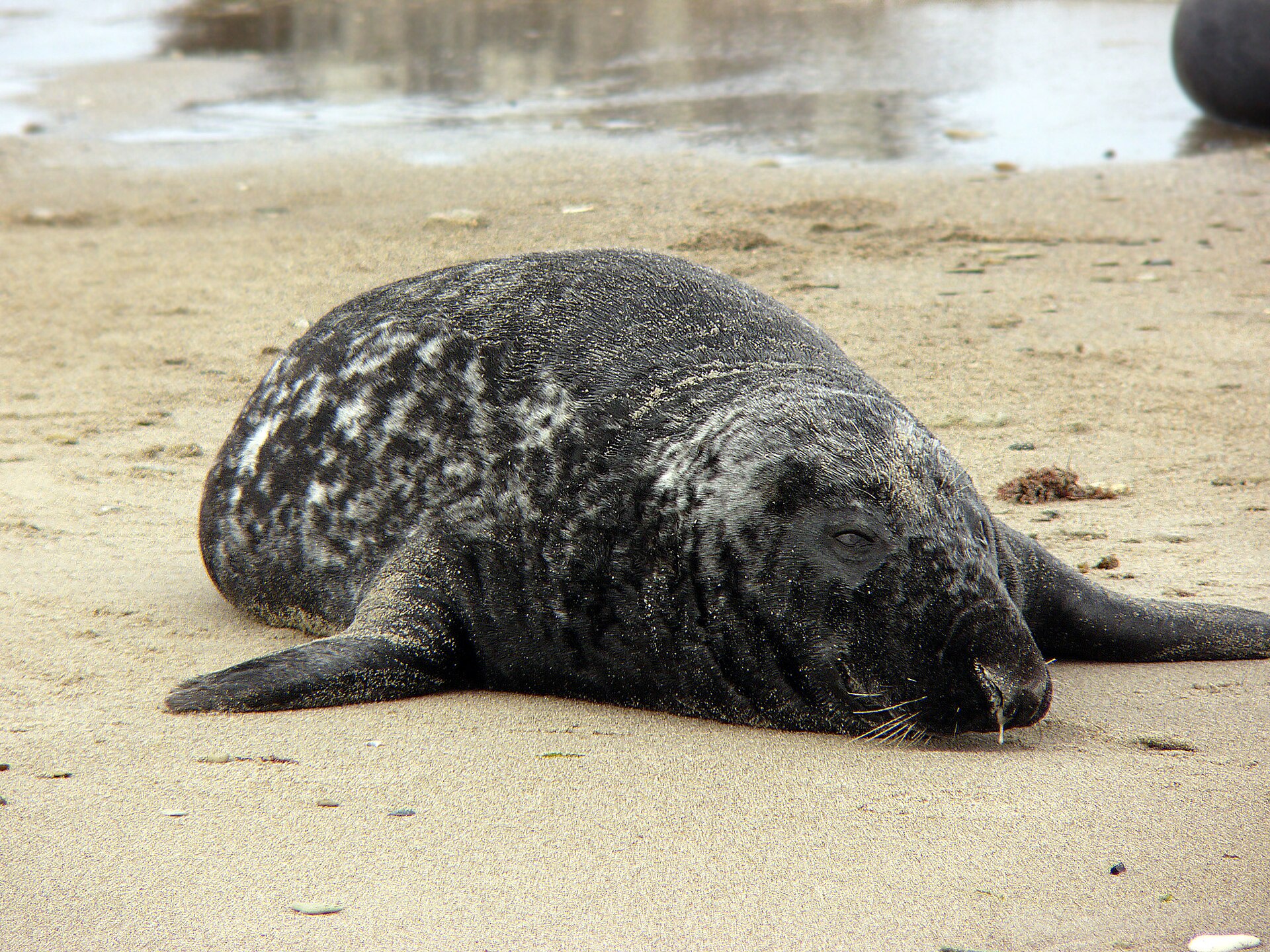
Considerably larger than a harbour seal, with a long, straight head that suggests a horse in profile rather than a dog. The nostrils run parallel instead of forming a V, and that is the detail that settles it through a scope. Males grow to over two metres and darken with age; females stay lighter and more slender. Grey seals are also less shy, so the head that keeps watching you as the boat drifts past is more often a grey. And in winter the season does the work for you: a white, woolly youngster hauled out between November and February is a grey seal, because harbour seals pup in summer.
What can you confuse a grey seal with?
Looks like: Harbour seal
- Harbour seal: Smaller, with a round head and a short snout, and nostrils in a V; on a sandbank it often lies in a banana pose.
What tracks does a grey seal leave?
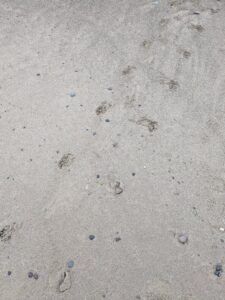
Scat is 4 to 4.5 cm across, grey, brown or black, and closely resembles a dog's. Seals leave no footprints: they leave a broad dragged furrow where the whole body has pushed through wet sand, although Zodion gives no measurements for that.

Where do you see this species in the Netherlands?
Mainly the western Wadden Sea, with the Richel, the Engelse Hoek, the Vliehors and the Razende Bol as the regular haul-out sites; in the Delta the numbers are smaller. That is the honest picture: the places this animal likes best are sandbanks some way offshore, several of them closed to the public precisely because the seals lie there, so a boat trip is the realistic route. Beyond the Wadden you may run into one in the Oosterschelde, along the North Sea beaches of North and South Holland, on the Texel coast and occasionally at Lauwersmeer, although a grey seal on a mainland beach is often a weakened animal rather than a resting one.
📍 Nationaal Park Oosterschelde
With luck chance per source📍 Wadden Sea
Good chance verified📍 Nationaal Park Zuid-Kennemerland
Rare verified📍 Nationaal Park Duinen van Texel
With luck verified📍 Nationaal Park Lauwersmeer
With luck verified📍 Noordzeekustzone
presence reported📍 De Dollard
presence reported📍 Haringvlietsluizen
presence reported📍 Vismigratierivier Afsluitdijk
presence reportedThese links come straight from our database, with the chance, the source and the evidence level for each area.
When is the best time?
Green = present · orange = peak period. The bar is generated from our database.
Best period: Present all year. December and January are special: that is when the pups are born, in a season running from November to February, and the white-coated young then lie on the bank for weeks. March and April bring the moult, when the most animals are out of the water at the same time.
Best time of day: Around low water, like the harbour seal. Because it uses the higher banks, it often stays hauled out well after the water has started to come back.
Recent sightings
👁️ Where has this species been seen recently?
Check the current sightings on Waarneming.nl. A useful addition to our own verified information.
How to improve your chances
- Keep the wind in your face. Most mammals will smell you long before they see you.
- Arrive before sunrise and then stay put. Sitting still beats walking about.
- Wear muted colours, skip the scent, and put your phone on silent.
- Be patient. Expect to come back more than once before it works.
🎒 What you need for this
Binoculars, and a telephoto lens if you want a usable photograph
🌿 Watching responsibly
Keep your distance, stay on the paths, and never lure animals with food or sound. Leave as soon as an animal becomes uneasy.
Status: Verified · Last checked: 2026-07-29
A species that came back
The grey seal is the largest wild predator in the Netherlands, and it is the one that turned a Dutch winter into a wildlife season. It was gone from these coasts for centuries. The first pups were seen on the sandbanks off Terschelling in 1980, and the population has been climbing ever since.
The pups, and why winter is different
Grey seal pups are born in the middle of winter, on quiet beaches and on sand ridges that stay dry. They arrive in a thick white coat that keeps them warm ashore but works against them in the water: it slows them down and dries slowly. They can swim, and a pup that ends up in the sea will not drown, but the short coat that follows the moult is far better suited to it, so they stay put for several weeks until they have moulted and built up fat.
They do that fast. Pups weigh 10 to 20 kilograms at birth and put on 1.5 to 2 kilograms a day while nursing. The mother stays nearby but not continuously, and that is the single fact behind most of the trouble on Dutch beaches each winter: a pup lying alone is usually not abandoned. See the seal watching guide for what to do and which number to call.
Distance matters more in these months than at any other time. A mother disturbed into the water leaves her pup behind, and if she does not come back it does not survive. That is why haul-out sites are often closed in the birth season and why boats keep further off. Hold to it even when the animal looks perfectly relaxed.
Numbers and trend
This is a species going up while its neighbour goes down.
- 8,981 grey seals counted in the Dutch Wadden Sea in 2026, four percent up on the year before, with an average rise of six percent a year over the last five years.
- 8,638 moulting animals counted in the 2024/2025 season, ten percent up on the season before, alongside 1,640 pups.
- 12,497 across the whole international Wadden Sea in 2026.
- Roughly one in three seals counted in the Dutch Wadden Sea is now a grey seal.
One caveat belongs with every one of those figures, and it comes from the people doing the counting: there is no moment in the year when every seal is hauled out. Wageningen Marine Research calls its own result an index and not an actual number of animals in the area. Read it as a trend, not a census.
Keeping your distance from grey seals
The Wadden code of conduct does not give a distance in metres. It gives a signal you can see: the moment a seal raises its head, you are too close to the group. The number comes from the Dutch Seal Agreement, at least thirty metres, and A Seal in Stellendam confirms to us that this applies all year, not only in the pupping seasons.
Use both. Thirty metres is what you plan with; the raised head is what you watch for, and it can tell you that you are too close at forty. Never walk towards them, do not anchor or dry out nearby, keep dogs on a lead, and leave the drone at home, because Wadden birds read it as a bird of prey and put everything into the water at once.
Sources
These sources are in Dutch. Quotations on this page are our translations from the Dutch originals.
- Wageningen Marine Research, Grey seal population in the Dutch Wadden Sea (in Dutch): counts, method, birth and moulting periods, and the caveat that a count is an index.
- Zodion, Grey seal (in Dutch): identification, scat dimensions, and where the species is observable.
- Ecomare, Grey seal (in Dutch): size, the white coat, the pupping season, and the haul-out sites.
- Compendium voor de Leefomgeving, harbour and grey seal 1960 to 2025 (in Dutch): the long-run series for both species.
- Dutch Seal Agreement (in Dutch): the thirty-metre distance and the reporting procedure.
- Wadden code of conduct, Ik pas op het Wad (pdf) (in Dutch): the full code.
- A Seal, Stellendam, animal care department, by email, 18 November 2026: that the thirty metres applies all year.
- Area-level occurrence on our Dutch pages is based on NDFF Flora & Fauna Verkenner open data, consulted July to November 2026, alongside statements from the site managers. NDFF counts say something about presence, not about density or your chance of seeing an animal.
- Seal watching in the Dutch Wadden Sea, the practical day plan: boat trips, fares, tides and the pup-on-the-beach procedure.
- Harbour seal, the other species on the same banks, and the one that is declining.
- The Wadden Sea, the area page.
- How we work, where our facts come from and what we leave out.
Frequently asked questions
Where can you see grey seals in the Netherlands?
Mainly in the western Wadden Sea. The Richel, the Engelse Hoek, the Vliehors and the Razende Bol are the best-known haul-out sites; in the Delta the numbers are smaller. In practice you see them from a boat, or from the shore with good binoculars.
What is the difference from a harbour seal?
Size and head. The grey seal is considerably larger, males over two metres, with a long, straight head that suggests a horse, and nostrils that run parallel. The harbour seal is smaller, with a round head, a short snout and V-shaped nostrils.
When are the pups born?
From November to February, with December and January as the peak, the exact opposite of the harbour seal, which pups in summer. The pups have a white coat and stay on the bank for weeks; they are poor swimmers in that period.
How many grey seals are there?
8,981 were counted in the Dutch Wadden Sea in 2026. In the 2024/2025 season the count was 8,638 moulting animals plus 1,640 pups. Unlike the harbour seal, this species is increasing.
Why does distance matter more in winter?
Because the pups are there. A mother driven into the water leaves her young behind, and if she does not return it will not survive. Haul-out sites are often closed in the birth season for that reason, and boats keep further away.