
Where to see the Northern Goshawk in the Netherlands
Rare 🦅 Bird Sensitive species · R3
🛡️ No exact locations, on purpose
This is a sensitive species. We deliberately show no nest sites, and during the breeding season (March to July) we are extra careful about exact spots. Why we do that.
Where and when do you see a Northern Goshawk? This species is rarely seen, all year round.
How do you recognise a Northern Goshawk?
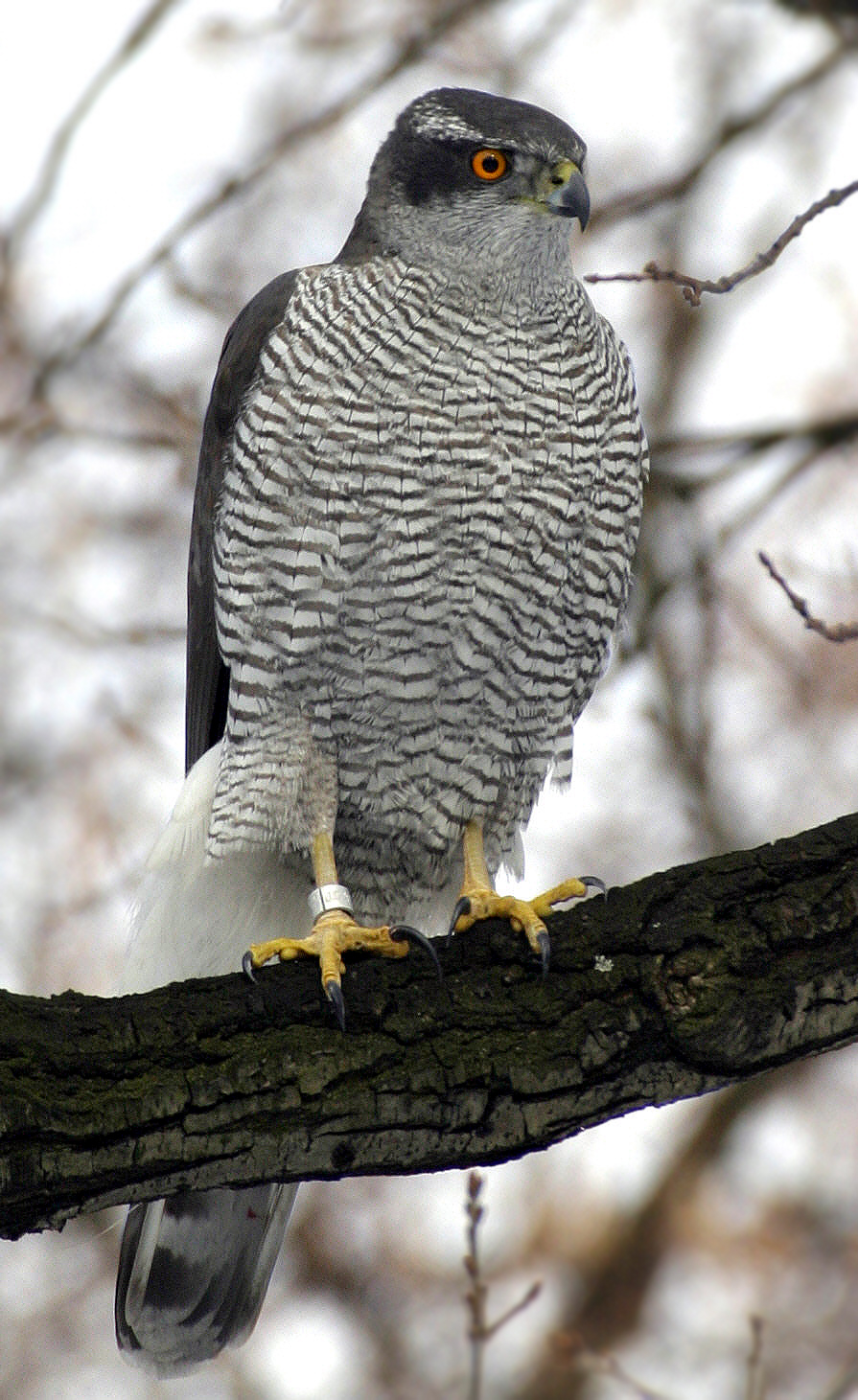
Length 46 to 63 cm, wingspan 89 to 122 cm. A powerful woodland raptor with short, broad wings and a long tail, built to manoeuvre between trees. Adults are finely barred below and have a striking white eyebrow stripe above a fierce eye. The female is considerably larger than the male, and in goshawks that difference is more extreme than in almost any other raptor.
What can you confuse a Northern Goshawk with?
Looks like: Eurasian Sparrowhawk, Common Buzzard
- Eurasian Sparrowhawk: Smaller and more finely built; the male is no bigger than a blackbird. Size is the most reliable guide, because the build is almost the same.
- Common Buzzard: Broader wings and a short tail, and it circles a great deal; a goshawk has a long tail and manoeuvres between the trees.
What does a Northern Goshawk sound like?
Recording: Adrienne Eaton, CC BY-SA 3.0, via Wikimedia Commons
What tracks does a Northern Goshawk leave?
Plucking post: a goshawk often drags its prey, so the feathers lie spread over a larger area, unlike the sparrowhawk, which works more neatly. Even so it remains difficult to assign a plucking post to one or the other with certainty. The size of the prey says more: a goshawk takes pigeons, crows and rabbits, where a sparrowhawk sticks to small songbirds.
Where do you see this species in the Netherlands?
Woodland areas throughout the Netherlands, from the Veluwe to copses in the river area. Goshawks now also breed in larger town parks.
📍 Deelerwoude
With luck chance per source📍 Nationaal Park Veluwezoom
With luck chance per source📍 Kroondomein Het Loo
With luck chance per source📍 Planken Wambuis
presence reported📍 Nationaal Park De Maasduinen
Rare chance per source📍 Wadden Sea
Rare chance per source📍 Naardermeer
With luck chance per source📍 Nationaal Park De Biesbosch
With luck chance per source📍 Sint-Pietersberg & Zuid-Limburg
With luck chance per source📍 Gelderse Poort & Millingerwaard
With luck chance per source📍 Onlanden & Leekstermeer
Rare chance per source📍 Blauwe Kamer
presence reported📍 Zouweboezem
presence reported📍 Oostelijke Vechtplassen
presence reported📍 Noordhollands Duinreservaat
presence reported📍 Wormer- en Jisperveld
presence reported📍 Ilperveld
presence reported📍 De Dollard
presence reported📍 Zuidlaardermeergebied en Hunzedal
presence reported📍 Landgoed Ennemaborg
presence reported📍 Meijendel & Berkheide
presence reported📍 Voornes Duin
presence reported📍 Kampina & Oisterwijkse Vennen
presence reported📍 De Maashorst
presence reported📍 Strabrechtse Heide & Beuven
presence reported📍 Loonse en Drunense Duinen
presence reported📍 Schoorlse Duinen
presence reported📍 Haringvlietsluizen
presence reported📍 Vismigratierivier Afsluitdijk
presence reported📍 De Putten bij Camperduin
presence reportedThese links come straight from our database, with the chance, the source and the evidence level for each area.
When is the best time?
Green = present · orange = peak period. The bar is generated from our database.
Best period: Present all year, but February and March are by far the most promising. Goshawks then display above the woodland, with undulating flights and loud calling, and give themselves away while staying invisible the rest of the year.
Best time of day: The morning. It is most active early in the day, and in spring goshawks then circle above their territory, practically the only moment you see them for longer than a few seconds.
Recent sightings
👁️ Where has this species been seen recently?
Check the current sightings on Waarneming.nl. A useful addition to our own verified information.
Current sightings on Waarneming.nl →
Note: for sensitive species the source already blurs or withholds sightings. We do not reproduce exact locations.
How to improve your chances
- Learn the calls first. You will hear most birds before you see them.
- Go in the first hour after sunrise, when the song is at its peak and the wind is still down.
- Use a hide or natural cover. Sitting still gets you more than walking closer.
- Keep the sun behind you. Against the light you see a silhouette and no colour.
🎒 What you need for this
Binoculars, a telephoto lens
🌿 Watching responsibly
Keep your distance, stay on the paths, and never lure animals with food or sound. Leave as soon as an animal becomes uneasy. This is a sensitive species. We deliberately show no nest sites, and during the breeding season (March to July) we are extra careful about exact spots.
Status: Verified · Last checked: 2026-08-08