
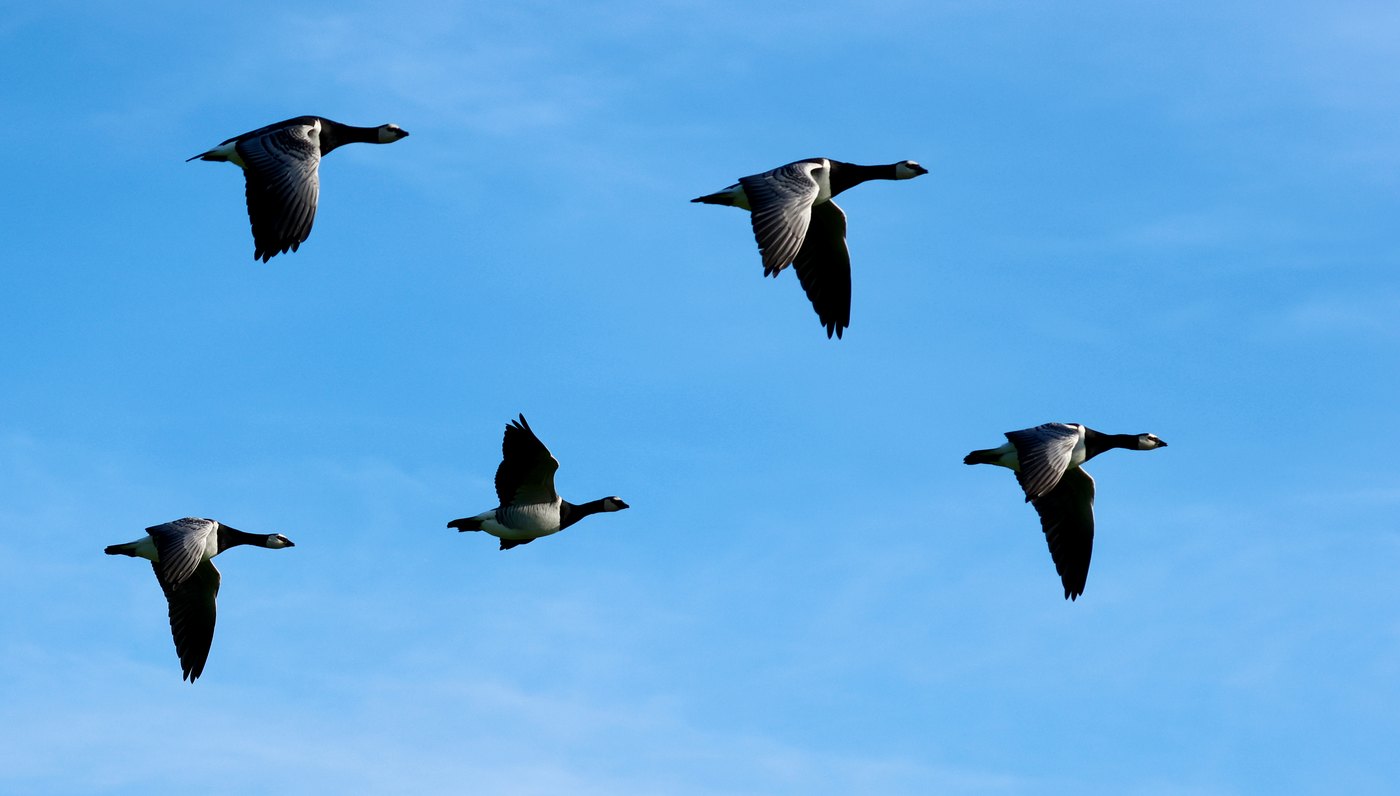
Five Barnacle Geese in flight over the polder, with white faces and black necks
📷 Bas de Bruin — Camperduin, 10 november 2026

Where to see the Barnacle Goose in the Netherlands

Branta leucopsis · Barnacle Goose

Easy 🦅 Bird

Where and when do you see a Barnacle Goose? This species is easy to see, from October to March.

How do you recognise a Barnacle Goose?

58 to 70 cm long, wingspan 132 to 145 cm. A compact black-and-white goose with a creamy white face, black neck and breast and a finely grey-barred back. The bill is short and black. In flight and at a distance a flock of barnacle geese looks strikingly contrasted, far blacker and whiter than other geese.

What can you confuse a Barnacle Goose with?

Looks like: Canada Goose, Greylag Goose, Greater White-fronted Goose

  • Canada Goose: much larger and brown, with a white chinstrap instead of a wholly white face.
  • Greylag Goose: larger and grey-brown, with a heavy orange-pink bill.
  • Greater White-fronted Goose: grey-brown with a white blaze around the bill.

What does a Barnacle Goose sound like?

Recording: Pascal Christe, CC BY-SA 4.0, via Wikimedia Commons

Where do you see this species in the Netherlands?

The coastal areas, wetlands and polders, with the Wadden region, Friesland and the Delta as strongholds. A growing number now also breed in the Netherlands itself.

How certain is this? verified chance per source presence reported Links that do not clear the bottom threshold are not published. How we decide that.

📍 Nationaal Park Oosterschelde

Good chance in season chance per source
NDFF open data, 540 records 2016-2026
Nationwide period: October to March for the wintering birds, with the largest numbers in midwinter. Some birds now breed in the Netherlands and stay all year.

📍 Wadden Sea

Good chance chance per source
It Fryske Gea
Nationwide period: October to March for the wintering birds, with the largest numbers in midwinter. Some birds now breed in the Netherlands and stay all year.

📍 Zwin & Zeeuws-Vlaanderen

Good chance in season verified
NDFF open data, 302 records 2016-2026 · zwin.be
Nationwide period: October to March for the wintering birds, with the largest numbers in midwinter. Some birds now breed in the Netherlands and stay all year.

📍 Nationaal Park Veluwezoom

presence reported
NDFF open data, 427 records 2016-2026
Nationwide period: October to March for the wintering birds, with the largest numbers in midwinter. Some birds now breed in the Netherlands and stay all year.

📍 Oostvaardersplassen

Good chance in season verified
Staatsbosbeheer
Nationwide period: October to March for the wintering birds, with the largest numbers in midwinter. Some birds now breed in the Netherlands and stay all year.

📍 Nationaal Park De Biesbosch

Good chance in season verified
NDFF open data, 6.511 records 2016-2026 · Sovon
Nationwide period: October to March for the wintering birds, with the largest numbers in midwinter. Some birds now breed in the Netherlands and stay all year.

📍 Nationaal Park Weerribben-Wieden

Good chance in season verified
NDFF open data, 375 records 2016-2026 · Sovon
Nationwide period: October to March for the wintering birds, with the largest numbers in midwinter. Some birds now breed in the Netherlands and stay all year.
NDFF open data, 432 records 2016-2026
Nationwide period: October to March for the wintering birds, with the largest numbers in midwinter. Some birds now breed in the Netherlands and stay all year.
NDFF open data, 1.440 records 2016-2026
Nationwide period: October to March for the wintering birds, with the largest numbers in midwinter. Some birds now breed in the Netherlands and stay all year.
NDFF open data, 288 records 2016-2026
Nationwide period: October to March for the wintering birds, with the largest numbers in midwinter. Some birds now breed in the Netherlands and stay all year.
NDFF open data, 3.055 records 2016-2026
Nationwide period: October to March for the wintering birds, with the largest numbers in midwinter. Some birds now breed in the Netherlands and stay all year.

📍 Nationaal Park Lauwersmeer

Good chance in season verified
Nationaal Park Lauwersmeer
Nationwide period: October to March for the wintering birds, with the largest numbers in midwinter. Some birds now breed in the Netherlands and stay all year.

📍 Nationaal Park De Alde Feanen

Good chance in season verified
NDFF open data, 1.659 records 2016-2026 · Sovon
Nationwide period: October to March for the wintering birds, with the largest numbers in midwinter. Some birds now breed in the Netherlands and stay all year.
NDFF open data, 556 records 2016-2026
Nationwide period: October to March for the wintering birds, with the largest numbers in midwinter. Some birds now breed in the Netherlands and stay all year.
NDFF open data, 619 records 2016-2026
Nationwide period: October to March for the wintering birds, with the largest numbers in midwinter. Some birds now breed in the Netherlands and stay all year.
NDFF open data, 126 records 2016-2026
Nationwide period: October to March for the wintering birds, with the largest numbers in midwinter. Some birds now breed in the Netherlands and stay all year.

📍 Marker Wadden

Good chance in season chance per source
Natuurmonumenten, the site manager
Nationwide period: October to March for the wintering birds, with the largest numbers in midwinter. Some birds now breed in the Netherlands and stay all year.

📍 Naardermeer

presence reported
NDFF open data, 981 records 2016-2026
Nationwide period: October to March for the wintering birds, with the largest numbers in midwinter. Some birds now breed in the Netherlands and stay all year.

📍 Onlanden & Leekstermeer

Good chance in season verified
NDFF open data, 843 records 2016-2026 · the national park
Nationwide period: October to March for the wintering birds, with the largest numbers in midwinter. Some birds now breed in the Netherlands and stay all year.
NDFF open data, 986 records 2016-2026 · Sovon
Nationwide period: October to March for the wintering birds, with the largest numbers in midwinter. Some birds now breed in the Netherlands and stay all year.

📍 Blauwe Kamer

presence reported
NDFF open data
Nationwide period: October to March for the wintering birds, with the largest numbers in midwinter. Some birds now breed in the Netherlands and stay all year.

📍 Zouweboezem

presence reported
NDFF open data
Nationwide period: October to March for the wintering birds, with the largest numbers in midwinter. Some birds now breed in the Netherlands and stay all year.

📍 Oostelijke Vechtplassen

presence reported
NDFF open data
Nationwide period: October to March for the wintering birds, with the largest numbers in midwinter. Some birds now breed in the Netherlands and stay all year.
NDFF open data
Nationwide period: October to March for the wintering birds, with the largest numbers in midwinter. Some birds now breed in the Netherlands and stay all year.

📍 Wormer- en Jisperveld

presence reported
NDFF open data
Nationwide period: October to March for the wintering birds, with the largest numbers in midwinter. Some birds now breed in the Netherlands and stay all year.

📍 Ilperveld

presence reported
NDFF open data
Nationwide period: October to March for the wintering birds, with the largest numbers in midwinter. Some birds now breed in the Netherlands and stay all year.

📍 De Dollard

presence reported
NDFF open data
Nationwide period: October to March for the wintering birds, with the largest numbers in midwinter. Some birds now breed in the Netherlands and stay all year.
NDFF open data
Nationwide period: October to March for the wintering birds, with the largest numbers in midwinter. Some birds now breed in the Netherlands and stay all year.

📍 De Putten bij Camperduin

Good chance verified
Own field observation, 10 November 2026
Nationwide period: October to March for the wintering birds, with the largest numbers in midwinter. Some birds now breed in the Netherlands and stay all year.

📍 Meijendel & Berkheide

presence reported
NDFF open data, 2.037 records 2016-2026
Nationwide period: October to March for the wintering birds, with the largest numbers in midwinter. Some birds now breed in the Netherlands and stay all year.

📍 Voornes Duin

presence reported
NDFF open data, 1.184 records 2016-2026
Nationwide period: October to March for the wintering birds, with the largest numbers in midwinter. Some birds now breed in the Netherlands and stay all year.
NDFF open data, 400 records 2016-2026
Nationwide period: October to March for the wintering birds, with the largest numbers in midwinter. Some birds now breed in the Netherlands and stay all year.

📍 De Maashorst

presence reported
NDFF open data, 104 records 2016-2026
Nationwide period: October to March for the wintering birds, with the largest numbers in midwinter. Some birds now breed in the Netherlands and stay all year.

📍 Loonse en Drunense Duinen

presence reported
NDFF open data, 967 records 2016-2026
Nationwide period: October to March for the wintering birds, with the largest numbers in midwinter. Some birds now breed in the Netherlands and stay all year.

📍 Schoorlse Duinen

presence reported
NDFF open data, 2.790 records 2016-2026
Nationwide period: October to March for the wintering birds, with the largest numbers in midwinter. Some birds now breed in the Netherlands and stay all year.

📍 Haringvlietsluizen

presence reported
NDFF open data, 1.121 records 2016-2026
Nationwide period: October to March for the wintering birds, with the largest numbers in midwinter. Some birds now breed in the Netherlands and stay all year.

These links come straight from our database, with the chance, the source and the evidence level for each area.

When is the best time?

Green = present · orange = peak period. The bar is generated from our database.

Best period: October to March for the wintering birds, with the largest numbers in midwinter. Some birds now breed in the Netherlands and stay all year.

Best time of day: During the day while they graze in the fields; around sunrise and sunset as they fly out and back in.

Recent sightings

👁️ Where has this species been seen recently?

Check the current sightings on Waarneming.nl. A useful addition to our own verified information.

Current sightings on Waarneming.nl →

How to improve your chances

  • Learn the calls first. You will hear most birds before you see them.
  • Go in the first hour after sunrise, when the song is at its peak and the wind is still down.
  • Use a hide or natural cover. Sitting still gets you more than walking closer.
  • Keep the sun behind you. Against the light you see a silhouette and no colour.

🎒 What you need for this

Binoculars.

🌿 Watching responsibly

Keep your distance, stay on the paths, and never lure animals with food or sound. Leave as soon as an animal becomes uneasy.

Sources: Sovon; Vogelbescherming Nederland (vogelgids), geraadpleegd 02-11-2026
Status: Verified · Last checked: 2026-08-08

More photos
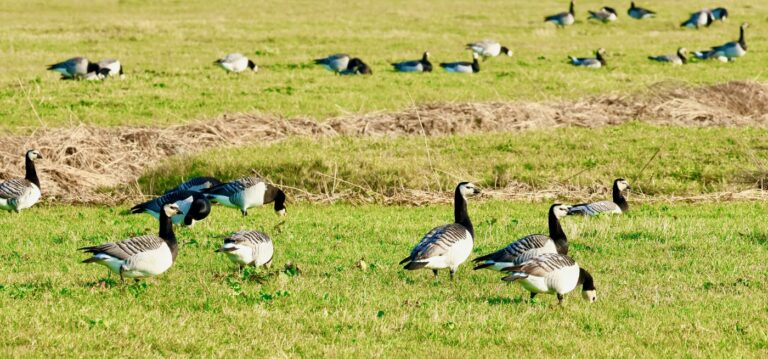
Groep grazende brandganzen in een weiland bij De Putten
Photo: Bas de Bruin — Camperduin, 10 november 2026