
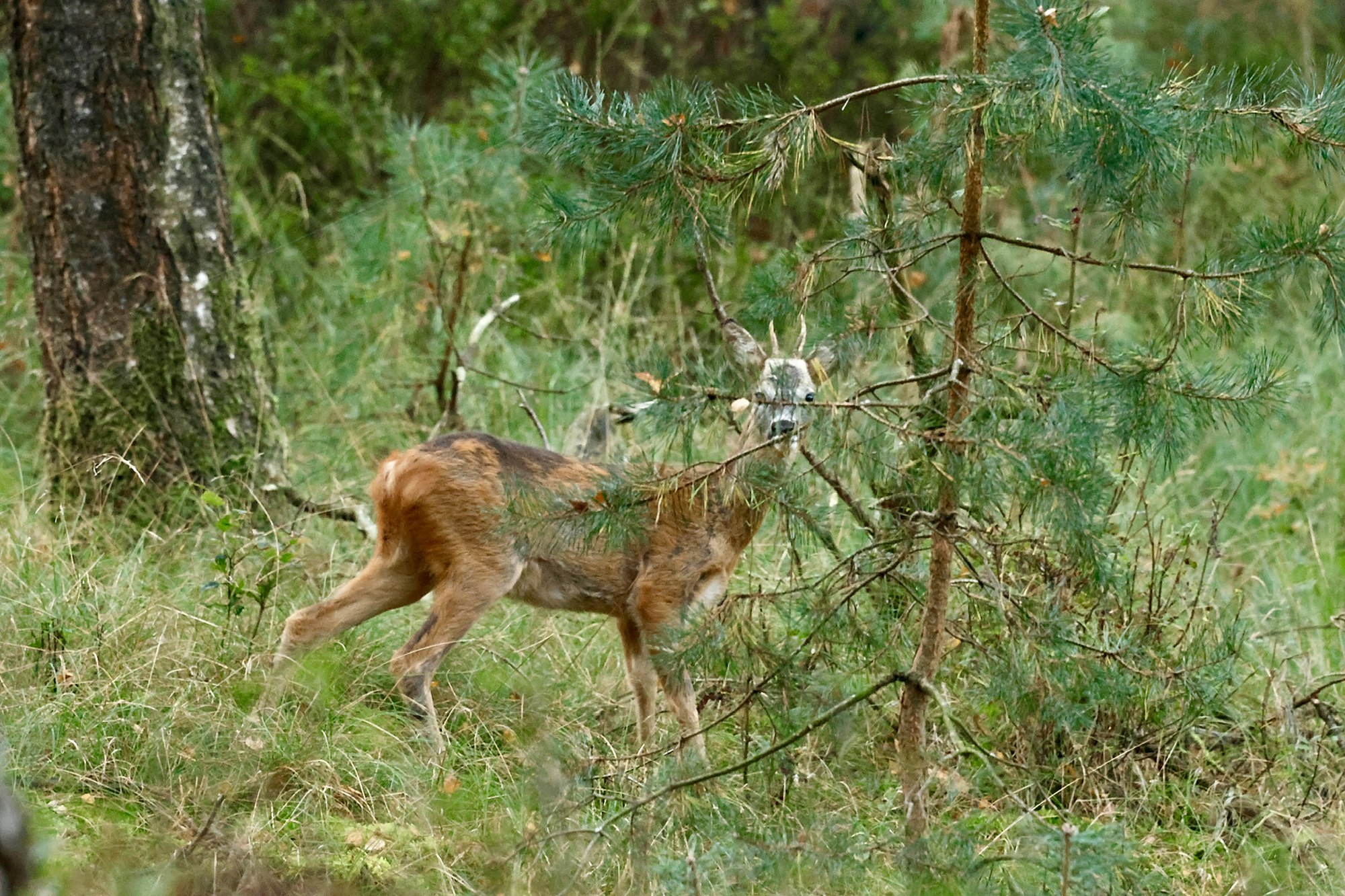
Where to see the roe deer in the Netherlands
Easy 🦌 Mammal (land)
Where and when do you see a roe deer? This species is easy to see, from April to August.
How do you recognise a roe deer?
Small and slender, about knee height. Reddish brown in summer, grey-brown in winter. The white rump patch is the feature you will see most often, because it is usually all that is left of the animal as it bounds away. There is no tail to speak of.
What can you confuse a roe deer with?
Looks like: Fallow deer, Red deer
- Fallow deer: Larger, reddish brown with white spots in summer, and with a long tail marked with a black stripe; a roe deer has only a white rump patch and barely any tail.
- Red deer: Much larger, and the stag carries branched antlers instead of the short, straight antlers of a roebuck.
What does a roe deer sound like?
Recording: 1bumer, CC BY-SA 4.0, via Wikimedia Commons
What tracks does a roe deer leave?
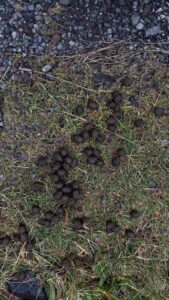
Track: 3 to 4 cm wide and a good 4.5 cm long, up to 7 cm when the hind toes press in as well. Slimmer and smaller than a red or fallow deer's, and more pointed and less splayed than a mouflon's. At a trot the prints lie up to 140 cm apart. Droppings: 7 to 10 mm thick and 6 to 13 mm long, acorn- or capsule-shaped, dark and often with a hollow at one end, left in small clusters. Browsing: a slanted cut with a frayed top edge, and along woodland edges a browse line up to about 150 cm. From March to June, fraying marks on bark.


Where do you see this species in the Netherlands?
Almost the whole of the Netherlands, and unlike red deer and fallow deer you do not need a nature reserve to find one — roe deer live right out into farmland, along woodland edges, hedgebanks and the corners of fields.
Habitat: The edge between cover and open ground: woodland margins, hedgebanks, and fields with scrub within reach.
This is a common, widespread species: you can come across it in far more places than the areas listed below. Treat that list as a starting point rather than a full survey.
📍 Leuvenumse Bossen
With luck presence reported📍 Oostvaardersplassen
Good chance chance per source📍 Nationaal Park Veluwezoom
Good chance verified📍 Kroondomein Het Loo
Good chance chance per source📍 Nationaal Park De Alde Feanen
With luck chance per source📍 Nationaal Park Dwingelderveld
With luck chance per source📍 Nationaal Park De Biesbosch
presence reported📍 Nationaal Park De Hoge Veluwe
presence reported📍 Nationaal Park Weerribben-Wieden
presence reported📍 Nationaal Park Drents-Friese Wold
presence reported📍 Nationaal Park De Groote Peel
presence reported📍 Nationaal Park Zuid-Kennemerland
presence reported📍 Amsterdamse Waterleidingduinen
presence reported📍 Nationaal Park Lauwersmeer
presence reported📍 Nationaal Park De Maasduinen
presence reported📍 Nationaal Park Sallandse Heuvelrug
presence reported📍 Nationaal Park De Meinweg
presence reported📍 Nationaal Park Utrechtse Heuvelrug
presence reported📍 Sint-Pietersberg & Zuid-Limburg
With luck chance per source📍 Nationaal Park Oosterschelde
presence reported📍 Fochteloërveen
With luck chance per source📍 Deelerwoude
presence reported📍 Naardermeer
presence reported📍 Onlanden & Leekstermeer
With luck chance per source📍 Zwin & Zeeuws-Vlaanderen
presence reported📍 Gelderse Poort & Millingerwaard
With luck chance per source📍 Planken Wambuis
With luck chance per source📍 Blauwe Kamer
presence reported📍 Zouweboezem
presence reported📍 Oostelijke Vechtplassen
presence reported📍 Noordhollands Duinreservaat
presence reported📍 Ilperveld
presence reported📍 De Dollard
presence reported📍 Zuidlaardermeergebied en Hunzedal
presence reported📍 Landgoed Ennemaborg
presence reported📍 Meijendel & Berkheide
presence reported📍 Voornes Duin
presence reported📍 Kampina & Oisterwijkse Vennen
presence reported📍 De Maashorst
presence reported📍 Strabrechtse Heide & Beuven
presence reported📍 Loonse en Drunense Duinen
presence reported📍 Schoorlse Duinen
presence reported📍 Haringvlietsluizen
presence reportedThese links come straight from our database, with the chance, the source and the evidence level for each area.
When is the best time?
Green = present · orange = peak period. The bar is generated from our database.
Best period: Present all year. The rut falls between mid July and mid August, unusually early for a deer: the fertilised egg then lies dormant for months before the pregnancy really begins, which is why the fawns are not born until May.
Best time of day: The first hour after sunrise and the last hour before sunset. Sit still rather than walk, and let the animals come to you; keep walking and all you will see is the rump patch bounding away.
Recent sightings
👁️ Where has this species been seen recently?
Check the current sightings on Waarneming.nl. A useful addition to our own verified information.
How to improve your chances
- Keep the wind in your face. Most mammals will smell you long before they see you.
- Arrive before sunrise and then stay put. Sitting still beats walking about.
- Wear muted colours, skip the scent, and put your phone on silent.
- Be patient. Expect to come back more than once before it works.
🎒 What you need for this
Binoculars 8x42, and a fast telephoto lens for the low light.
🌿 Watching responsibly
Keep your distance, stay on the paths, and never lure animals with food or sound. Leave as soon as an animal becomes uneasy.
Status: Verified · Last checked: 2026-07-29
Frequently asked questions
When is the best time to see roe deer?
In the first hour after sunrise and the last hour before sunset, at the edge of cover. During the day they usually lie out of sight. Sit down with a view of a woodland edge or the corner of a field and wait; walking about gets you little, because a roe deer hears you long before you see it.
When is the roe deer rut?
From mid July to mid August. That is strikingly early for a deer, and it explains something unusual: after mating, the fertilised egg lies dormant for months before the pregnancy gets going, so the fawns are not born until May.
What should I do if I find a roe deer fawn lying alone?
Nothing. Walk on and do not touch it. The fawn has not been abandoned: the doe is grazing nearby and will come back as soon as you have gone. Keep your dog on the lead in spring as well, because that is the biggest threat to young roe deer in the field.
Why does a roe deer bark?
As a warning, and during the rut. It is a short, hoarse sound that many people mistake for a dog in the dark. If you hear it, the animal has probably already noticed you.
How does a roe deer differ from the other deer here?
A roe deer is a deer, but it is the smallest of the Dutch species: 20 to 30 kilos against 60 to 90 for a fallow deer and well over 200 for a red deer. The antlers set it apart too: a roebuck carries a short set with at most three points a side, where red and fallow deer are far more heavily armed. And the rump is deceptively useful: on a roe deer a white heart- or kidney-shaped patch with no visible tail, on a fallow deer a white rump outlined in black and a long black tail.
What does a roe deer sound like?
Like a short, hard bark, a sound that surprises many walkers because it brings a dog to mind rather than a deer. Roe deer bark all year round; during the rut they also make plaintive cries and hoarse squeaks. There is a recording higher up this page.