
Where to see the Short-eared Owl in the Netherlands
Rare 🦅 Bird Sensitive species · R3
🛡️ No exact locations, on purpose
This is a sensitive species. We deliberately show no nest sites, and during the breeding season (March to July) we are extra careful about exact spots. Why we do that.
Where and when do you see a Short-eared Owl? This species is rarely seen, all year round.
How do you recognise a Short-eared Owl?
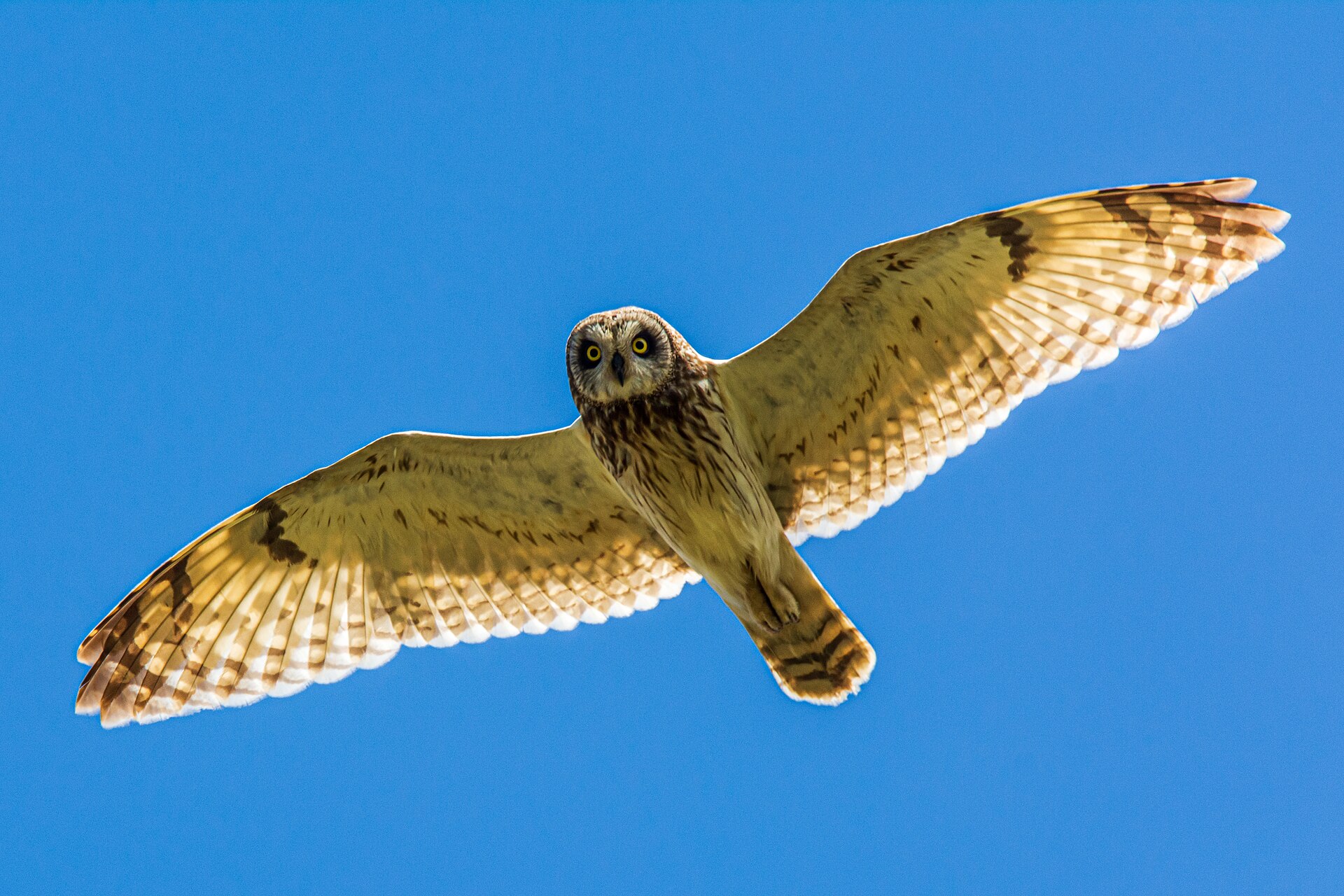
Pale yellow-brown, 37 to 39 centimetres, wingspan 95 to 110 centimetres. Bright sulphur-yellow eyes and very short ear tufts — usually so short you cannot see them at all. In flight, pale underwings with a clear dark patch at the carpal joint, the wrist. That is the field mark to look for, because you will almost always see this bird in the air.
What can you confuse a Short-eared Owl with?
Looks like: Long-eared Owl
- Long-eared Owl: orange eyes and long, conspicuous ear tufts. A twilight bird of woodland edges and hedgerows, hidden away during the day, whereas the Short-eared Owl hunts by day over open country. In practice the context does most of the work: an owl hunting in daylight over an open polder is a Short-eared Owl.
Where do you see this species in the Netherlands?
The requirement is open terrain with low vegetation: the Wadden islands, northern Groningen, open polders, raised bog and open dune.
Habitat: Open country with low vegetation: polders, raised bog, open dune and salt marsh.
This is a common, widespread species: you can come across it in far more places than the areas listed below. Treat that list as a starting point rather than a full survey.
📍 Wadden Sea
With luck chance per source📍 Planken Wambuis
presence reported📍 Blauwe Kamer
presence reported📍 Zouweboezem
presence reported📍 Ilperveld
presence reported📍 De Dollard
presence reported📍 Landgoed Ennemaborg
presence reported📍 Meijendel & Berkheide
presence reported📍 Schoorlse Duinen
presence reported📍 Haringvlietsluizen
presence reported📍 De Putten bij Camperduin
presence reportedThese links come straight from our database, with the chance, the source and the evidence level for each area.
When is the best time?
Green = present · orange = peak period. The bar is generated from our database.
Best period: As a breeding bird it is here from April to June, but your real chance is winter: from December to February northern birds arrive, and there are then 100 to 500 short-eared owls in the Netherlands. That is when a hunting bird over a polder becomes a realistic thing to go looking for.
Best time of day: Look in daylight and at dusk. Unlike almost every other owl, you do not need the dark — you need open ground and patience.
Recent sightings
👁️ Where has this species been seen recently?
Check the current sightings on Waarneming.nl. A useful addition to our own verified information.
Current sightings on Waarneming.nl →
Note: for sensitive species the source already blurs or withholds sightings. We do not reproduce exact locations.
How to improve your chances
- Learn the calls first. You will hear most birds before you see them.
- Go in the first hour after sunrise, when the song is at its peak and the wind is still down.
- Use a hide or natural cover. Sitting still gets you more than walking closer.
- Keep the sun behind you. Against the light you see a silhouette and no colour.
🎒 What you need for this
Binoculars.
🌿 Watching responsibly
Keep your distance, stay on the paths, and never lure animals with food or sound. Leave as soon as an animal becomes uneasy. This is a sensitive species. We deliberately show no nest sites, and during the breeding season (March to July) we are extra careful about exact spots.
Status: Verified · Last checked: 2026-08-08
The only owl you really watch flying
The Short-eared Owl (Asio flammeus) is, for most people, the only owl they ever genuinely watch flying. It hunts in daylight — low and sailing over open ground, with slow, almost butterfly-like wingbeats — and then drops onto a vole without warning.
It is also in serious trouble in the Netherlands, and it is a species we write about with a deliberate gap in it. We do not publish nest locations.
Everything depends on voles
This is the key to the species, and it is unusually absolute.
Breeding success depends entirely on the vole population. In the vole peak year of 2014, more than fifty pairs bred in the province of Friesland alone; in lean years almost nothing happens at all.
And the bird is nomadic: it breeds wherever the voles happen to be that year, rather than returning to a fixed site. That is a sensible strategy for a vole specialist, and a difficult one for conservation, because you cannot protect a nesting area that moves.
How it is doing
Badly. Not “declining” — badly.
- 130 to 185 breeding pairs in the 1970s.
- 15 to 30 breeding pairs in 2025.
It is classed as critically endangered on the Dutch Red List. The causes named are the loss of open, vole-rich terrain, the intensification of agriculture, and disrupted vole cycles.
Put next to the White-tailed Eagle on the same coast, which is increasing, it is a reminder that “Dutch nature” is not one trend. Some species are being given back what they need. This one is still losing it.
Watching it responsibly
This matters more here than on most pages, because the species is critically endangered and it nests on the ground.
So:
- Stay on the paths. A nest in low vegetation is invisible until you are standing on it.
- Keep dogs on a lead.
- Extra restraint from March to July.
- We name no nest locations, and nor should you. The species falls under a national publication regime for sensitive species, under which breeding records are deliberately blurred to a 10 by 10 kilometre grid. We follow it. How we work explains the regime.
A hunting owl in winter is a different matter and a gift: watch it from where you are. It is working, and a bird that has to break off a hunt has lost a meal.
Sources
Our sources for this species are in Dutch.
- Vogelbescherming Nederland (bird guide), consulted 2 November 2026 (in Dutch): identification, measurements, hunting behaviour and the separation from Long-eared Owl.
- Sovon Vogelonderzoek Nederland (in Dutch): breeding pairs in the 1970s and in 2025, the winter total, the vole dependence and the Red List status.
- NDFF List of Sensitive Species v1.2 (17 June 2026) (in Dutch): the publication regime under which breeding records are blurred to 10 by 10 kilometres, which is why we name no nest locations.
- Area-level occurrence on our Dutch pages is based on NDFF Flora & Fauna Verkenner open data alongside statements from the site managers. NDFF counts say something about presence, not about density or your chance of seeing a bird.
- White-tailed Eagle — the other species here under the same publication regime, and the one going the other way.
- The Wadden Sea — the area page, including the inland side of the Lauwersmeer dyke.
- How we work — the publication regime, what it covers, and why we follow it.
- Wildlife in the Netherlands — the English starting point.
Frequently asked questions
Why can you see this owl in daylight?
Because unlike most owls, the short-eared owl simply hunts in daylight. It flies low and sailing over open terrain with slow, almost butterfly-like wingbeats, and then drops suddenly onto a vole. For many people it is the only owl they ever really see flying.
Where and when do you have a chance?
In open terrain with low vegetation: the Wadden islands, northern Groningen, open polders, raised bog and dune. As a breeding bird from April to June, but the best chance is in winter: from December to February northern birds arrive and there are 100 to 500 short-eared owls in the Netherlands.
What is the difference from a long-eared owl?
Eyes and ear tufts. The short-eared owl has fierce sulphur-yellow eyes and very short tufts you often cannot see at all; the long-eared owl has orange eyes and long, conspicuous tufts. The short-eared owl is paler and more yellow, and hunts by day over open land, while the long-eared owl is a twilight bird of woodland edges and hedgerows. In flight the short-eared owl shows pale underwings with a clear dark patch at the wrist.
What do voles have to do with it?
Everything. Its breeding success depends entirely on the vole population. In the vole peak year of 2014, more than fifty pairs bred in Friesland alone, while in lean years almost nothing happens. It is also nomadic: it breeds wherever there happen to be plenty of voles that year.
How is the species doing?
Very badly. From 130 to 185 breeding pairs in the 1970s to 15 to 30 in 2025 — it is listed as critically endangered on the Dutch Red List. Loss of open, vole-rich terrain, the intensification of agriculture and disrupted vole cycles all play a part. It nests on the ground, so stay on the paths and keep dogs on a lead. We do not name nest locations.