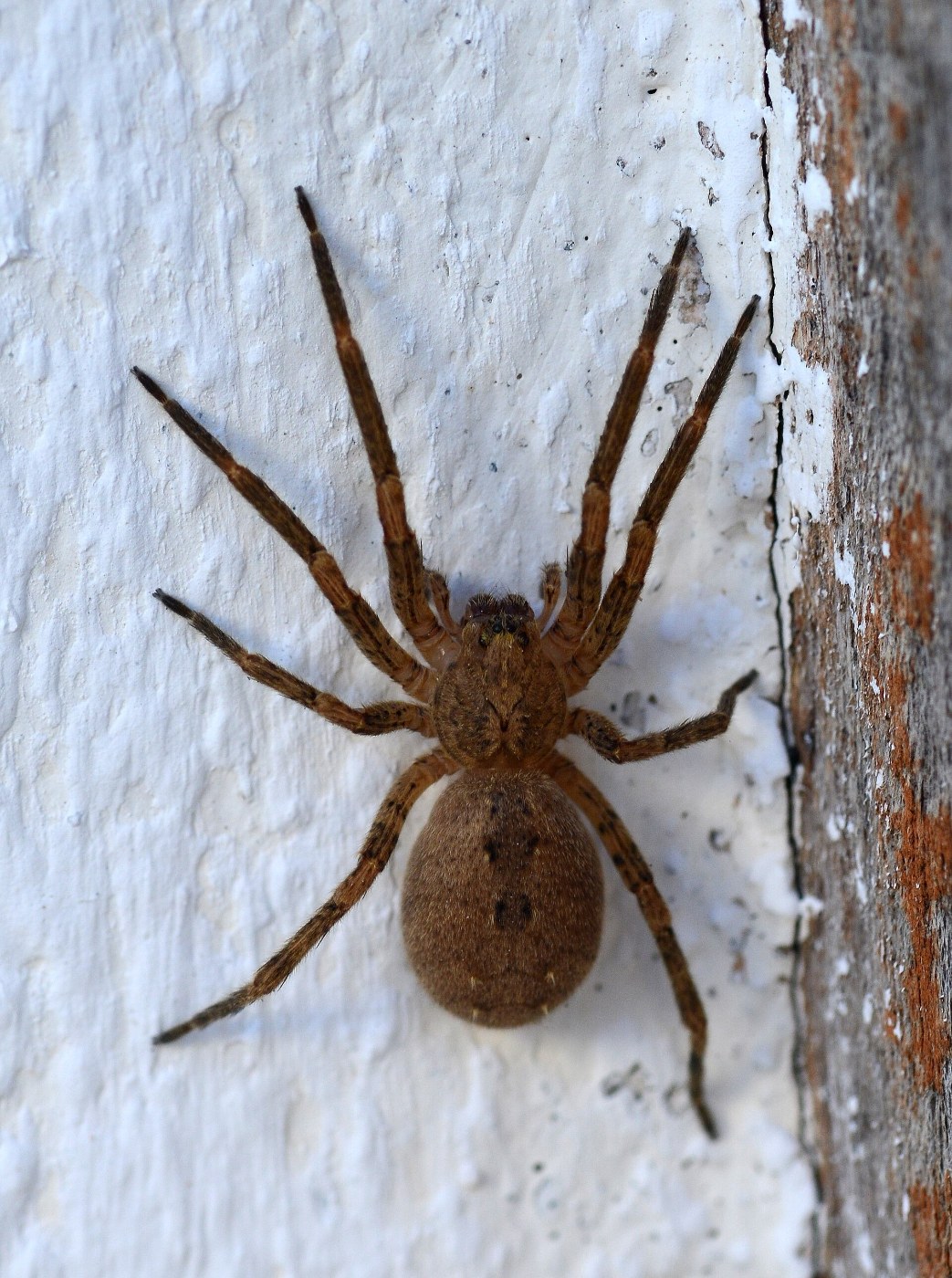
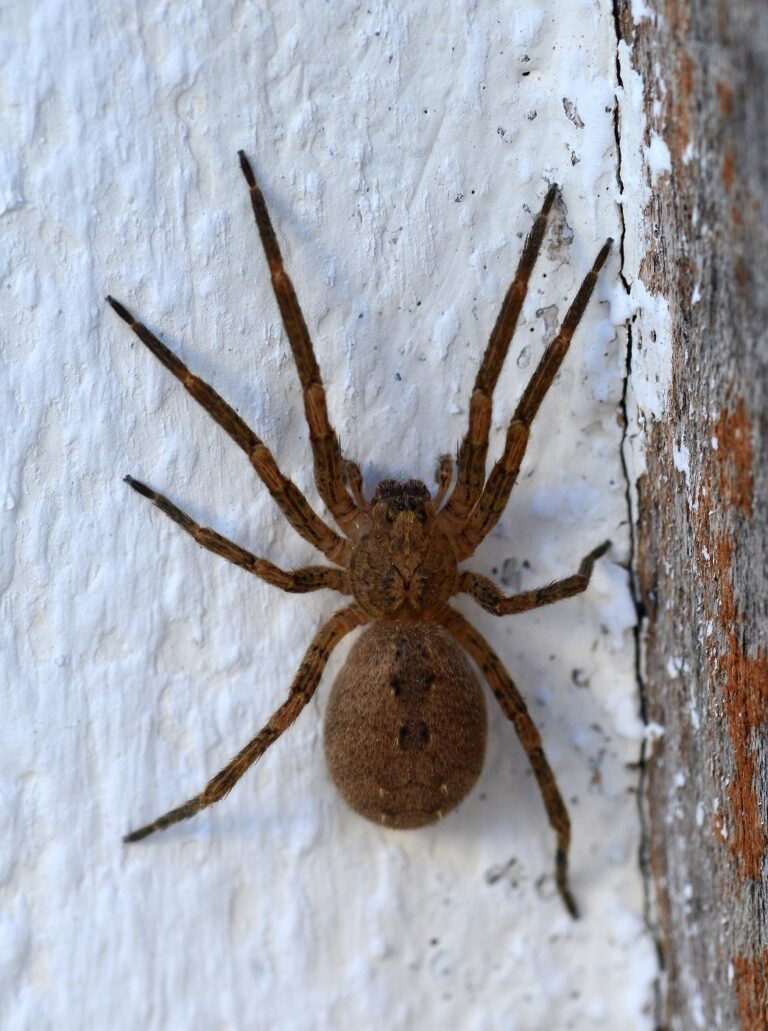
A sturdy, brown spider with a darkly blotched cephalothorax and a black central marking on the abdomen; the legs are speckled brown. The dark marking on the cephalothorax is compared to the face of the vampire from the film Nosferatu (1922) — hence the name. Spiders of Europe gives 10 to 19 mm (female) and 10 to 13 mm (male). Body lengths come from Spiders of Europe (Nentwig et al., araneae.nmbe.ch); those are European ranges, not Dutch measurements.
According to EIS Kenniscentrum Insecten it had been seen in every province except Flevoland by 2022. The first Dutch record dates from 2007: Radboud Kloos then found a specimen in a shed in Utrecht.
NDFF open data, 76 records 2016-2026
Nationwide period: The months in which adults are on the move cannot be established for the Netherlands from any source. In southern Europe the species is most conspicuous in late summer and autumn; Dutch reports peak in September. Note: the months come from British sources (British Arachnological Society and NatureSpot). Dutch phenology data per spider species could not be consulted — waarneming.nl and the Dutch Species Register blocked automated access. The climate is comparable, but this is not a Dutch measurement.
NDFF open data, 173 records 2016-2026
Nationwide period: The months in which adults are on the move cannot be established for the Netherlands from any source. In southern Europe the species is most conspicuous in late summer and autumn; Dutch reports peak in September. Note: the months come from British sources (British Arachnological Society and NatureSpot). Dutch phenology data per spider species could not be consulted — waarneming.nl and the Dutch Species Register blocked automated access. The climate is comparable, but this is not a Dutch measurement.
NDFF open data, 98 records 2016-2026
Nationwide period: The months in which adults are on the move cannot be established for the Netherlands from any source. In southern Europe the species is most conspicuous in late summer and autumn; Dutch reports peak in September. Note: the months come from British sources (British Arachnological Society and NatureSpot). Dutch phenology data per spider species could not be consulted — waarneming.nl and the Dutch Species Register blocked automated access. The climate is comparable, but this is not a Dutch measurement.
NDFF open data, 122 records 2016-2026
Nationwide period: The months in which adults are on the move cannot be established for the Netherlands from any source. In southern Europe the species is most conspicuous in late summer and autumn; Dutch reports peak in September. Note: the months come from British sources (British Arachnological Society and NatureSpot). Dutch phenology data per spider species could not be consulted — waarneming.nl and the Dutch Species Register blocked automated access. The climate is comparable, but this is not a Dutch measurement.
NDFF open data, 14 records 2016-2026
Nationwide period: The months in which adults are on the move cannot be established for the Netherlands from any source. In southern Europe the species is most conspicuous in late summer and autumn; Dutch reports peak in September. Note: the months come from British sources (British Arachnological Society and NatureSpot). Dutch phenology data per spider species could not be consulted — waarneming.nl and the Dutch Species Register blocked automated access. The climate is comparable, but this is not a Dutch measurement.
NDFF open data, 18 records 2016-2026
Nationwide period: The months in which adults are on the move cannot be established for the Netherlands from any source. In southern Europe the species is most conspicuous in late summer and autumn; Dutch reports peak in September. Note: the months come from British sources (British Arachnological Society and NatureSpot). Dutch phenology data per spider species could not be consulted — waarneming.nl and the Dutch Species Register blocked automated access. The climate is comparable, but this is not a Dutch measurement.
NDFF open data, 56 records 2016-2026
Nationwide period: The months in which adults are on the move cannot be established for the Netherlands from any source. In southern Europe the species is most conspicuous in late summer and autumn; Dutch reports peak in September. Note: the months come from British sources (British Arachnological Society and NatureSpot). Dutch phenology data per spider species could not be consulted — waarneming.nl and the Dutch Species Register blocked automated access. The climate is comparable, but this is not a Dutch measurement.
NDFF open data, 12 records 2016-2026
Nationwide period: The months in which adults are on the move cannot be established for the Netherlands from any source. In southern Europe the species is most conspicuous in late summer and autumn; Dutch reports peak in September. Note: the months come from British sources (British Arachnological Society and NatureSpot). Dutch phenology data per spider species could not be consulted — waarneming.nl and the Dutch Species Register blocked automated access. The climate is comparable, but this is not a Dutch measurement.
NDFF open data, 46 records 2016-2026
Nationwide period: The months in which adults are on the move cannot be established for the Netherlands from any source. In southern Europe the species is most conspicuous in late summer and autumn; Dutch reports peak in September. Note: the months come from British sources (British Arachnological Society and NatureSpot). Dutch phenology data per spider species could not be consulted — waarneming.nl and the Dutch Species Register blocked automated access. The climate is comparable, but this is not a Dutch measurement.
NDFF open data, 22 records 2016-2026
Nationwide period: The months in which adults are on the move cannot be established for the Netherlands from any source. In southern Europe the species is most conspicuous in late summer and autumn; Dutch reports peak in September. Note: the months come from British sources (British Arachnological Society and NatureSpot). Dutch phenology data per spider species could not be consulted — waarneming.nl and the Dutch Species Register blocked automated access. The climate is comparable, but this is not a Dutch measurement.
NDFF open data, 20 records 2016-2026
Nationwide period: The months in which adults are on the move cannot be established for the Netherlands from any source. In southern Europe the species is most conspicuous in late summer and autumn; Dutch reports peak in September. Note: the months come from British sources (British Arachnological Society and NatureSpot). Dutch phenology data per spider species could not be consulted — waarneming.nl and the Dutch Species Register blocked automated access. The climate is comparable, but this is not a Dutch measurement.
NDFF open data, 107 records 2016-2026
Nationwide period: The months in which adults are on the move cannot be established for the Netherlands from any source. In southern Europe the species is most conspicuous in late summer and autumn; Dutch reports peak in September. Note: the months come from British sources (British Arachnological Society and NatureSpot). Dutch phenology data per spider species could not be consulted — waarneming.nl and the Dutch Species Register blocked automated access. The climate is comparable, but this is not a Dutch measurement.
NDFF open data, 198 records 2016-2026
Nationwide period: The months in which adults are on the move cannot be established for the Netherlands from any source. In southern Europe the species is most conspicuous in late summer and autumn; Dutch reports peak in September. Note: the months come from British sources (British Arachnological Society and NatureSpot). Dutch phenology data per spider species could not be consulted — waarneming.nl and the Dutch Species Register blocked automated access. The climate is comparable, but this is not a Dutch measurement.
NDFF open data
Nationwide period: The months in which adults are on the move cannot be established for the Netherlands from any source. In southern Europe the species is most conspicuous in late summer and autumn; Dutch reports peak in September. Note: the months come from British sources (British Arachnological Society and NatureSpot). Dutch phenology data per spider species could not be consulted — waarneming.nl and the Dutch Species Register blocked automated access. The climate is comparable, but this is not a Dutch measurement.
NDFF open data, 64 records 2016-2026
Nationwide period: The months in which adults are on the move cannot be established for the Netherlands from any source. In southern Europe the species is most conspicuous in late summer and autumn; Dutch reports peak in September. Note: the months come from British sources (British Arachnological Society and NatureSpot). Dutch phenology data per spider species could not be consulted — waarneming.nl and the Dutch Species Register blocked automated access. The climate is comparable, but this is not a Dutch measurement.
NDFF open data, 93 records 2016-2026
Nationwide period: The months in which adults are on the move cannot be established for the Netherlands from any source. In southern Europe the species is most conspicuous in late summer and autumn; Dutch reports peak in September. Note: the months come from British sources (British Arachnological Society and NatureSpot). Dutch phenology data per spider species could not be consulted — waarneming.nl and the Dutch Species Register blocked automated access. The climate is comparable, but this is not a Dutch measurement.
NDFF open data, 29 records 2016-2026
Nationwide period: The months in which adults are on the move cannot be established for the Netherlands from any source. In southern Europe the species is most conspicuous in late summer and autumn; Dutch reports peak in September. Note: the months come from British sources (British Arachnological Society and NatureSpot). Dutch phenology data per spider species could not be consulted — waarneming.nl and the Dutch Species Register blocked automated access. The climate is comparable, but this is not a Dutch measurement.
NDFF open data, 80 records 2016-2026
Nationwide period: The months in which adults are on the move cannot be established for the Netherlands from any source. In southern Europe the species is most conspicuous in late summer and autumn; Dutch reports peak in September. Note: the months come from British sources (British Arachnological Society and NatureSpot). Dutch phenology data per spider species could not be consulted — waarneming.nl and the Dutch Species Register blocked automated access. The climate is comparable, but this is not a Dutch measurement.
NDFF open data, 64 records 2016-2026
Nationwide period: The months in which adults are on the move cannot be established for the Netherlands from any source. In southern Europe the species is most conspicuous in late summer and autumn; Dutch reports peak in September. Note: the months come from British sources (British Arachnological Society and NatureSpot). Dutch phenology data per spider species could not be consulted — waarneming.nl and the Dutch Species Register blocked automated access. The climate is comparable, but this is not a Dutch measurement.
NDFF open data, 86 records 2016-2026
Nationwide period: The months in which adults are on the move cannot be established for the Netherlands from any source. In southern Europe the species is most conspicuous in late summer and autumn; Dutch reports peak in September. Note: the months come from British sources (British Arachnological Society and NatureSpot). Dutch phenology data per spider species could not be consulted — waarneming.nl and the Dutch Species Register blocked automated access. The climate is comparable, but this is not a Dutch measurement.
NDFF open data, 15 records 2016-2026
Nationwide period: The months in which adults are on the move cannot be established for the Netherlands from any source. In southern Europe the species is most conspicuous in late summer and autumn; Dutch reports peak in September. Note: the months come from British sources (British Arachnological Society and NatureSpot). Dutch phenology data per spider species could not be consulted — waarneming.nl and the Dutch Species Register blocked automated access. The climate is comparable, but this is not a Dutch measurement.
These links come straight from our database, with the chance, the source and the evidence level for each area.
Green = present · orange = peak period. The bar is generated from our database.
The marking on the cephalothorax is the whole reason this spider has its name. So photograph it straight from above, with soft side light, so that the "face" shows. Flash straight from the front flattens the marking.