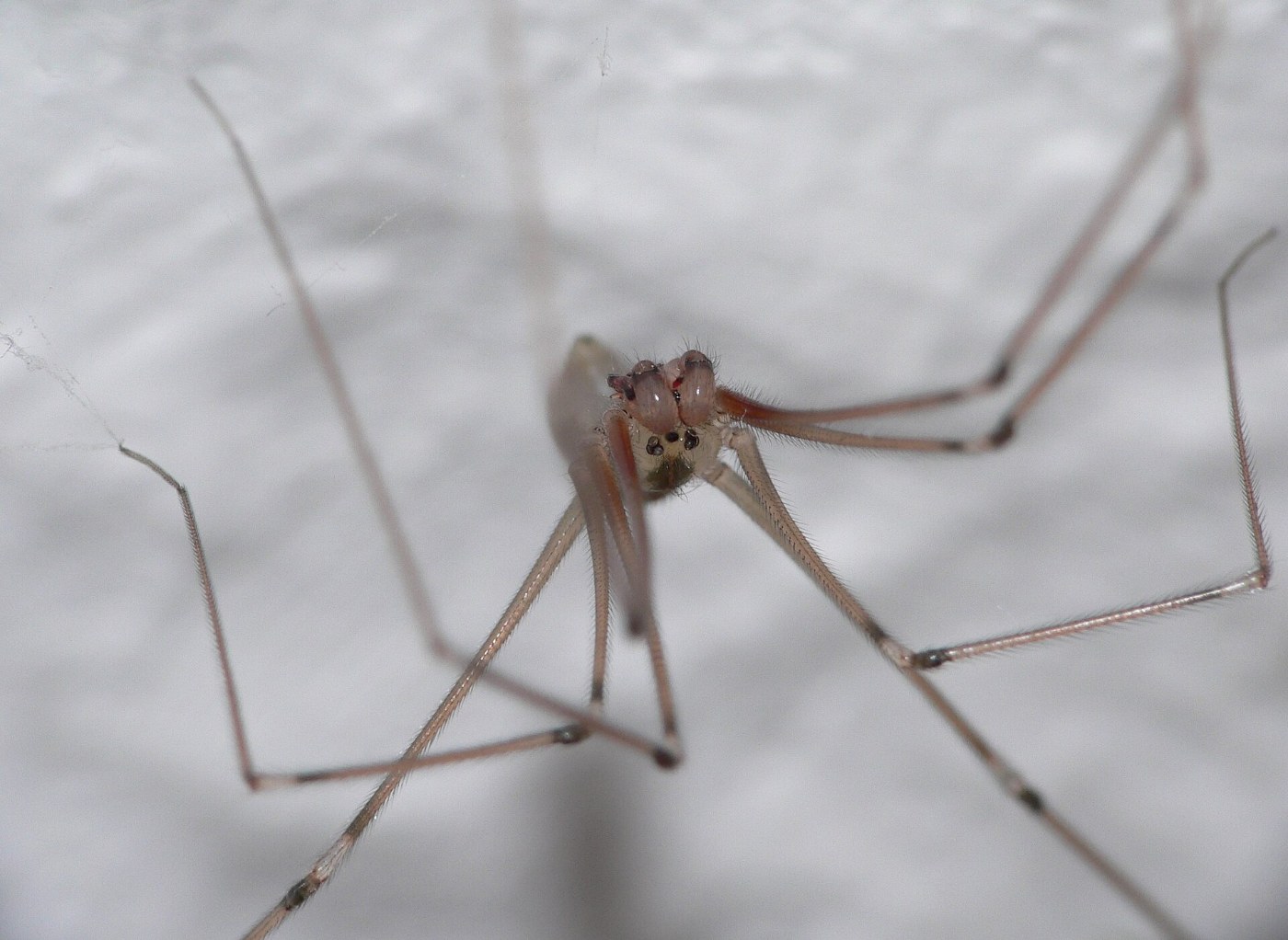
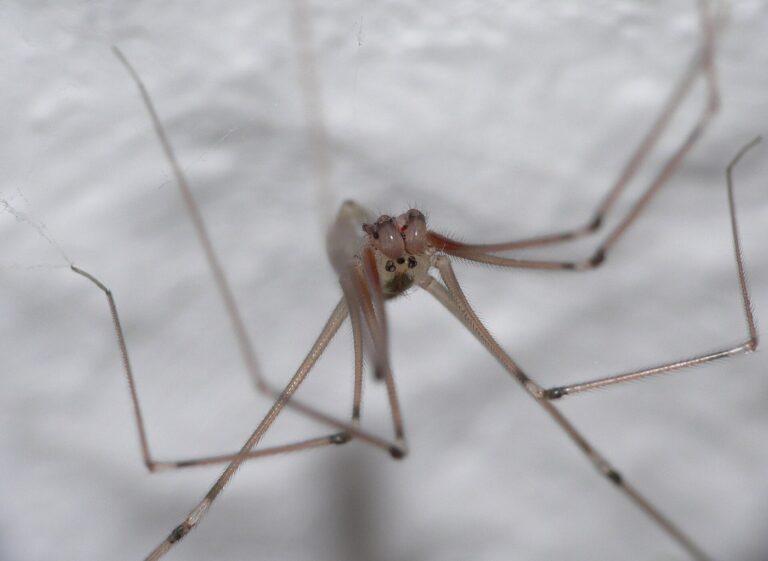
Where and when do you see a daddy long-legs spider? This species is easy to see, all year round.
How do you recognise a daddy long-legs spider?
A small, pale, almost translucent body on extremely long, thin legs. NatureSpot describes it as "pale yellow-brown except for a gray patch in the center of the cephalothorax". Body 7 to 10 mm (male) and 7 to 8 mm (female) — the legs are many times longer. The body lengths come from Spiders of Europe (Nentwig et al., araneae.nmbe.ch); those are European ranges, not Dutch measurements.
What can you confuse a daddy long-legs spider with?
- Psilochorus simoni: the only similar species NatureSpot mentions; smaller and with a rounder, more glossy abdomen.
- Harvestman: not a spider but a different order, with a single undivided body without a waist and without silk glands. It never hangs in a web.
- Crane fly: an insect with wings and six legs, not eight.
Where do you see this species in the Netherlands?
Throughout the country, almost exclusively indoors. The British Arachnological Society even states: "They are only found inside buildings.".
How certain is this? verified chance per source presence reported Links that do not clear the bottom threshold are not published. How we decide that.
NDFF open data, 12 records 2016-2026
Nationwide period: All year round — NatureSpot gives "All year round". Note: the months come from British sources (the British Arachnological Society and NatureSpot). Dutch phenological data per spider species could not be consulted — waarneming.nl and the Dutch Species Register blocked automated access. The climate is comparable, but this is not a Dutch measurement.
NDFF open data, 13 records 2016-2026
Nationwide period: All year round — NatureSpot gives "All year round". Note: the months come from British sources (the British Arachnological Society and NatureSpot). Dutch phenological data per spider species could not be consulted — waarneming.nl and the Dutch Species Register blocked automated access. The climate is comparable, but this is not a Dutch measurement.
NDFF open data, 27 records 2016-2026
Nationwide period: All year round — NatureSpot gives "All year round". Note: the months come from British sources (the British Arachnological Society and NatureSpot). Dutch phenological data per spider species could not be consulted — waarneming.nl and the Dutch Species Register blocked automated access. The climate is comparable, but this is not a Dutch measurement.
NDFF open data
Nationwide period: All year round — NatureSpot gives "All year round". Note: the months come from British sources (the British Arachnological Society and NatureSpot). Dutch phenological data per spider species could not be consulted — waarneming.nl and the Dutch Species Register blocked automated access. The climate is comparable, but this is not a Dutch measurement.
NDFF open data, 29 records 2016-2026
Nationwide period: All year round — NatureSpot gives "All year round". Note: the months come from British sources (the British Arachnological Society and NatureSpot). Dutch phenological data per spider species could not be consulted — waarneming.nl and the Dutch Species Register blocked automated access. The climate is comparable, but this is not a Dutch measurement.
NDFF open data, 13 records 2016-2026
Nationwide period: All year round — NatureSpot gives "All year round". Note: the months come from British sources (the British Arachnological Society and NatureSpot). Dutch phenological data per spider species could not be consulted — waarneming.nl and the Dutch Species Register blocked automated access. The climate is comparable, but this is not a Dutch measurement.
NDFF open data, 20 records 2016-2026
Nationwide period: All year round — NatureSpot gives "All year round". Note: the months come from British sources (the British Arachnological Society and NatureSpot). Dutch phenological data per spider species could not be consulted — waarneming.nl and the Dutch Species Register blocked automated access. The climate is comparable, but this is not a Dutch measurement.
These links come straight from our database, with the chance, the source and the evidence level for each area.
When is the best time?
janfebmaraprmayjunjulaugsepoctnovdec
Green = present · orange = peak period. The bar is generated from our database.
Best period: All year round — NatureSpot gives "All year round". Note: the months come from British sources (the British Arachnological Society and NatureSpot). Dutch phenological data per spider species could not be consulted — waarneming.nl and the Dutch Species Register blocked automated access. The climate is comparable, but this is not a Dutch measurement.
Recent sightings
How to improve your chances
- Go early, pick one spot, and let the animal come to you.
- Wear muted colours, skip the scent, and put your phone on silent.
- Look first for where one habitat turns into another. That is where most of the movement is.
- Be patient. Expect to come back more than once before it works.
🎒 What you need for this
A tripod and a flash or lamp with a diffuser. The legs are so thin that they disappear in low light.
Photography
Photograph against a plain, dark background — aim upwards at an open doorway, for instance. The thin legs are only visible with side light falling on them; backlight makes them disappear. Be careful: at the slightest vibration the spider shakes itself back and forth in its web, and then all you have is motion blur.
🌿 Watching responsibly
Keep your distance, stay on the paths, and never lure animals with food or sound. Leave as soon as an animal becomes uneasy.
Sources: British Arachnological Society, Daddy Long-legs Spider, geraadpleegd 28-10-2026. NatureSpot, Cellar Spider, geraadpleegd 28-10-2026. Spiders of Europe, araneae.nmbe.ch/taxondata/pholcus_phalangioides, geraadpleegd 28-10-2026.
Status: Verified · Last checked: 2026-10-28