Where to see the green huntsman spider in the Netherlands
Rare 🕷️ Spider
Where and when do you see a green huntsman spider? This species is rarely seen, from May to August.
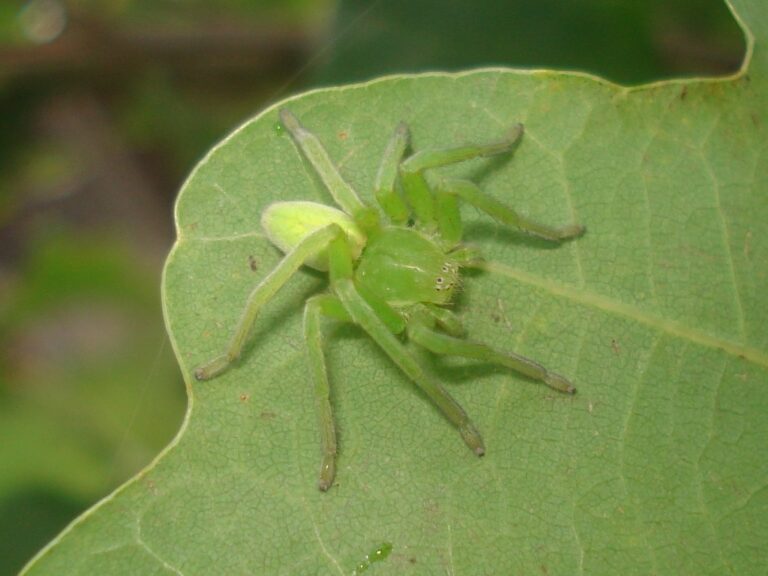
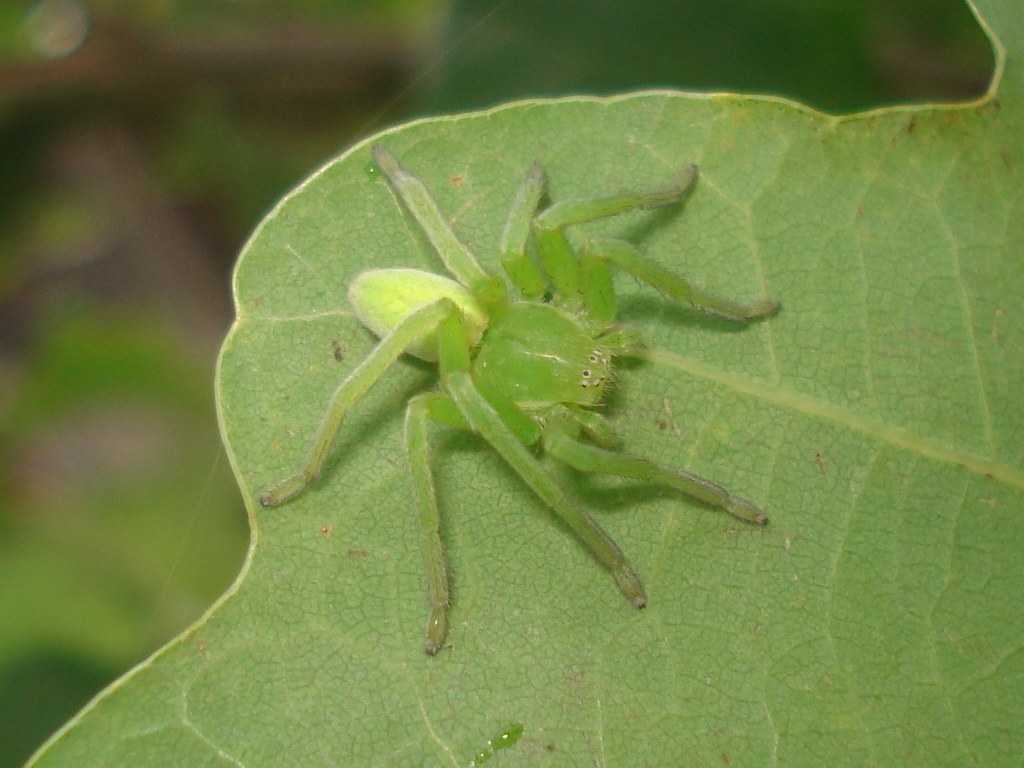
How do you recognise a green huntsman spider?
A bright grass green; in a Dutch account of a find it was described as a poison-green spider, slightly smaller than a small coin. It builds no web. Spiders of Europe gives 12 to 16.6 mm (female) and 7 to 10 mm (male). The body lengths come from Spiders of Europe (Nentwig et al., araneae.nmbe.ch); those are European ranges, not Dutch measurements.
What can you confuse a green huntsman spider with?
- No similar Dutch species was found in the sources consulted. The bright grass green colour combined with the absence of a web is characteristic in the Netherlands.
- Crab spiders (Misumena vatia): those are also green or white, but sit motionless in flowers and have far more strongly broadened front pairs of legs.
Where do you see this species in the Netherlands?
Tirion (1997) calls the species very common in the south-east, rare in the north and on the diluvial soils, and absent from the western Netherlands; Katwijk wrote in 1976 that "deze soort is nog zeldzaam". Current Dutch distribution and trend figures could not be obtained from a primary source.
Habitat: The herb layer of damp, sheltered places near woodland, and light oak coppice. Spiders of Europe: "In vegetation layer of different habitats, prefers sunny and warm conditions".
We have not yet recorded any areas for this species with enough evidence behind them, so we name the habitat type instead.
When is the best time?
Green = present · orange = peak period. The bar is generated from our database.
Best period: The animal overwinters as a half-grown spider and matures in June, according to curator Arthur Decae in Stratiotes. May to August is therefore the practical period. Note: the months come from British sources (the British Arachnological Society and NatureSpot). Dutch phenological data per spider species could not be consulted — waarneming.nl and the Dutch Species Register blocked automated access. The climate is comparable, but this is not a Dutch measurement.
Best time of day: By day, in the sun. It is a day-active hunter that sits head-down on low growth and grasses and jumps on passing insects.
Recent sightings
👁️ Where has this species been seen recently?
Check the current sightings on Waarneming.nl. A useful addition to our own verified information.
How to improve your chances
- Go early, pick one spot, and let the animal come to you.
- Wear muted colours, skip the scent, and put your phone on silent.
- Look first for where one habitat turns into another. That is where most of the movement is.
- Be patient. Expect to come back more than once before it works.
🎒 What you need for this
A macro lens. A beating tray or white umbrella under a bush yields more than peering.
Photography
Green on green is the trap. Look for an animal sitting on a dead leaf, a stem or a flower, or photograph with the sky or a dark woodland edge as a background. Underexpose by half a stop: bright green blocks up quickly in the highlights.
🌿 Watching responsibly
Keep your distance, stay on the paths, and never lure animals with food or sound. Leave as soon as an animal becomes uneasy.
Status: Verified · Last checked: 2026-10-28
More photos