
Where to see the Nathusius' pipistrelle in the Netherlands
With luck 🦇 Mammal (bat) Sensitive species · R2
🛡️ No exact locations, on purpose
This is a sensitive species. We deliberately show no resting places such as setts, burrows or winter roosts, and no photographs in which such a place is recognisable. Why we do that.
Where and when do you see a Nathusius' pipistrelle? With some luck you can see this species, from April to October.
How do you recognise a Nathusius' pipistrelle?
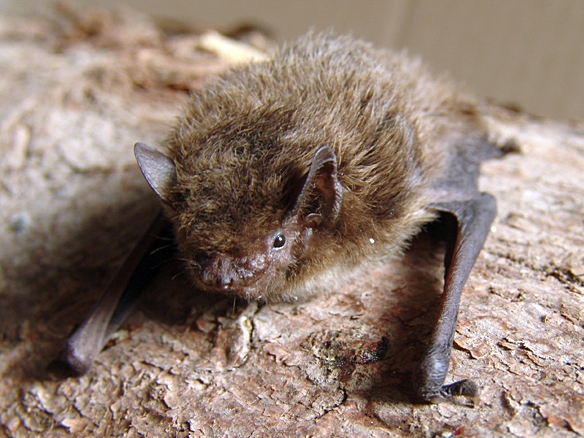
A small bat, slightly larger than the common pipistrelle, with longer, shaggier and red-brown fur, which is where its Dutch name comes from. The wings are broader and the flight is a little slower and straighter than in the common pipistrelle.
What can you confuse a Nathusius' pipistrelle with?
Looks like: Common pipistrelle, Soprano pipistrelle
- Common pipistrelle: The common pipistrelle is smaller, with shorter and darker fur, and flies faster and more erratically.
- Soprano pipistrelle: All three pipistrelles overlap in size; separating them rests on fur colour, muzzle colour and above all the bat detector.
What does a Nathusius' pipistrelle sound like?
Recording: Drahkrub Attribution must include the URL http://de.wikipedia.org/wiki/Benutzer:Drahkrub., CC BY-SA 4.0, via Wikimedia Commons
Where do you see this species in the Netherlands?
Scattered across the country, with the emphasis on wooded areas and the coastal strip; more numerous in late summer because of migration.
📍 Nationaal Park De Biesbosch
presence reported📍 Nationaal Park De Hoge Veluwe
presence reported📍 Nationaal Park Veluwezoom
presence reported📍 Oostvaardersplassen
presence reported📍 Nationaal Park Weerribben-Wieden
presence reported📍 Nationaal Park Dwingelderveld
presence reported📍 Nationaal Park Drents-Friese Wold
presence reported📍 Nationaal Park Zuid-Kennemerland
presence reported📍 Amsterdamse Waterleidingduinen
presence reported📍 Nationaal Park Duinen van Texel
presence reported📍 Nationaal Park Lauwersmeer
presence reported📍 Nationaal Park De Alde Feanen
presence reported📍 Nationaal Park Utrechtse Heuvelrug
presence reported📍 Sint-Pietersberg & Zuid-Limburg
presence reported📍 Kroondomein Het Loo
presence reported📍 Naardermeer
presence reported📍 Onlanden & Leekstermeer
presence reported📍 Gelderse Poort & Millingerwaard
presence reported📍 Planken Wambuis
presence reported📍 Leuvenumse Bossen
presence reported📍 Marker Wadden
presence reported📍 Blauwe Kamer
presence reported📍 Zouweboezem
presence reported📍 Oostelijke Vechtplassen
presence reported📍 Noordhollands Duinreservaat
presence reported📍 Wormer- en Jisperveld
presence reported📍 Ilperveld
presence reported📍 Zuidlaardermeergebied en Hunzedal
presence reported📍 Meijendel & Berkheide
presence reported📍 Voornes Duin
presence reported📍 Kampina & Oisterwijkse Vennen
presence reported📍 De Maashorst
presence reported📍 Loonse en Drunense Duinen
presence reported📍 Schoorlse Duinen
presence reportedThese links come straight from our database, with the chance, the source and the evidence level for each area.
When is the best time?
Green = present · orange = peak period. The bar is generated from our database.
Best period: April to October, with the emphasis on August and September during migration.
Best time of day: Shortly after sunset.
Recent sightings
👁️ Where has this species been seen recently?
Check the current sightings on Waarneming.nl. A useful addition to our own verified information.
Current sightings on Waarneming.nl →
Note: for sensitive species the source already blurs or withholds sightings. We do not reproduce exact locations.
How to improve your chances
- Keep the wind in your face. Most mammals will smell you long before they see you.
- Arrive before sunrise and then stay put. Sitting still beats walking about.
- Wear muted colours, skip the scent, and put your phone on silent.
- Be patient. Expect to come back more than once before it works.
🎒 What you need for this
A bat detector; without one it is hardly separable from the common pipistrelle
Photography
In late summer they hunt at woodland edges and over sheltered banks. Without a bat detector you do not know which pipistrelle you have in front of you, so only photograph once you have established the species by sound
🌿 Watching responsibly
Keep your distance, stay on the paths, and never lure animals with food or sound. Leave as soon as an animal becomes uneasy. This is a sensitive species. We deliberately show no resting places such as setts, burrows or winter roosts, and no photographs in which such a place is recognisable.
Status: Verified · Last checked: 2026-08-07