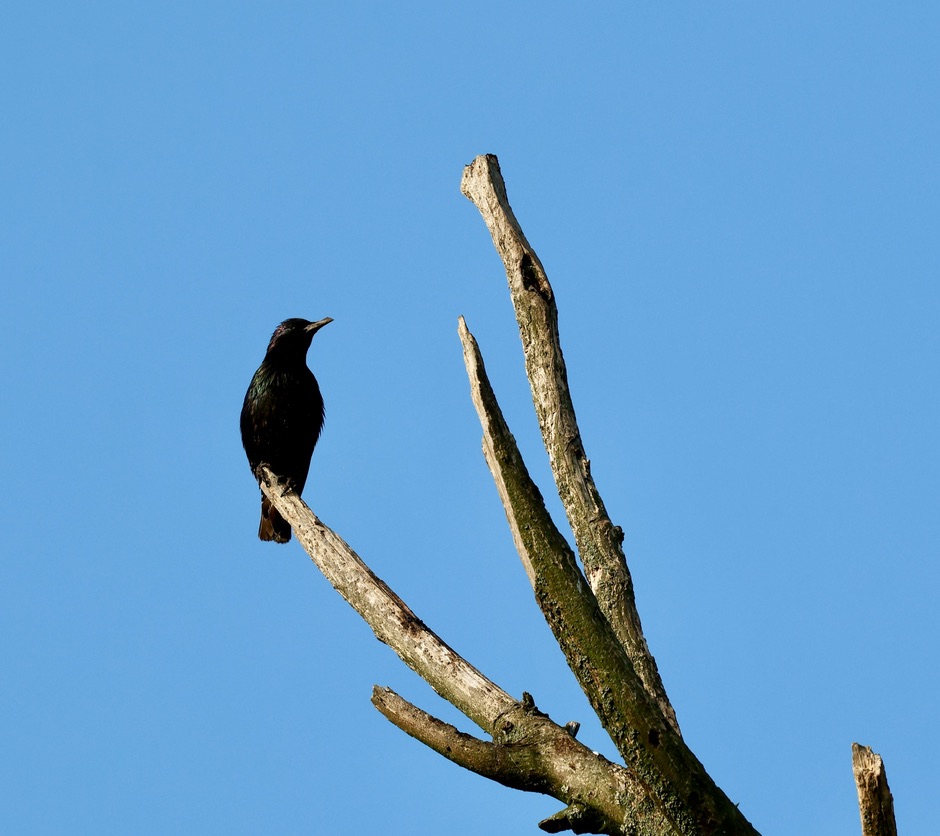
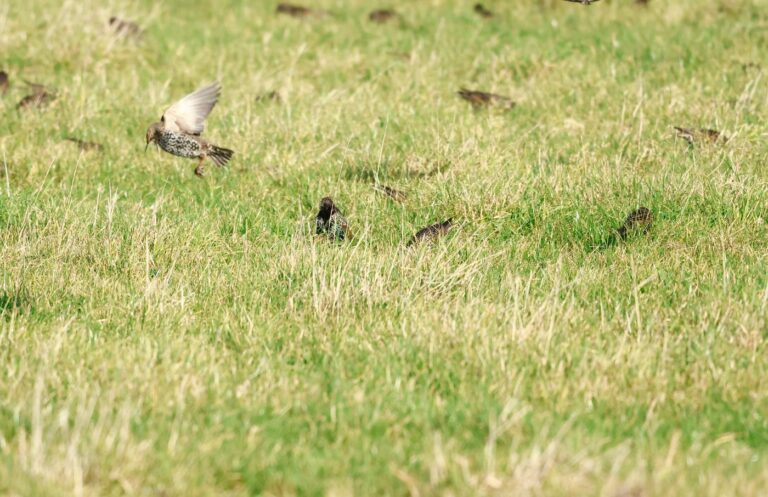
Where and when do you see a Common Starling? This species is easy to see, all year round.
How do you recognise a Common Starling?
Length 19 to 22 cm. Black at a distance, from close up glossy purple and green with fine white spots, above all in winter. It has a pointed yellow bill in the breeding season and walks across grass instead of hopping. In flight its silhouette is triangular, with short, pointed wings.
Wingspan: 38 cm an indication from Wikidata; it varies by individual, sex and subspecies · compare all birds (in Dutch)
What can you confuse a Common Starling with?
Looks like: Common Blackbird
- Common Blackbird: The blackbird hops, has a longer tail and an orange-yellow bill; the starling walks and from close up is glossy purple and green with white spots.
What does a Common Starling sound like?
Where do you see this species in the Netherlands?
Almost the whole of the Netherlands, from farmland to city centre.
Habitat: Open grassland and arable fields to feed on, with cavities in buildings and trees to breed in. In winter it roosts in huge numbers in reedbeds and town trees.
This is a common, widespread species: you can come across it in far more places than the areas listed below. Treat that list as a starting point rather than a full survey.
How certain is this? verified chance per source presence reported Links that do not clear the bottom threshold are not published. How we decide that.
NDFF open data
Nationwide period: Present all year, with October to February the spectacular period: tens of thousands of starlings then gather above their roost and form the rolling flocks known as a black sun.
NDFF open data
Nationwide period: Present all year, with October to February the spectacular period: tens of thousands of starlings then gather above their roost and form the rolling flocks known as a black sun.
NDFF open data
Nationwide period: Present all year, with October to February the spectacular period: tens of thousands of starlings then gather above their roost and form the rolling flocks known as a black sun.
NDFF open data
Nationwide period: Present all year, with October to February the spectacular period: tens of thousands of starlings then gather above their roost and form the rolling flocks known as a black sun.
NDFF open data
Nationwide period: Present all year, with October to February the spectacular period: tens of thousands of starlings then gather above their roost and form the rolling flocks known as a black sun.
NDFF open data
Nationwide period: Present all year, with October to February the spectacular period: tens of thousands of starlings then gather above their roost and form the rolling flocks known as a black sun.
NDFF open data
Nationwide period: Present all year, with October to February the spectacular period: tens of thousands of starlings then gather above their roost and form the rolling flocks known as a black sun.
NDFF open data
Nationwide period: Present all year, with October to February the spectacular period: tens of thousands of starlings then gather above their roost and form the rolling flocks known as a black sun.
NDFF open data
Nationwide period: Present all year, with October to February the spectacular period: tens of thousands of starlings then gather above their roost and form the rolling flocks known as a black sun.
Own field observation, 10 November 2026
Nationwide period: Present all year, with October to February the spectacular period: tens of thousands of starlings then gather above their roost and form the rolling flocks known as a black sun.
NDFF open data, 8.017 records 2016-2026
Nationwide period: Present all year, with October to February the spectacular period: tens of thousands of starlings then gather above their roost and form the rolling flocks known as a black sun.
NDFF open data, 1.197 records 2016-2026
Nationwide period: Present all year, with October to February the spectacular period: tens of thousands of starlings then gather above their roost and form the rolling flocks known as a black sun.
NDFF open data, 2.695 records 2016-2026
Nationwide period: Present all year, with October to February the spectacular period: tens of thousands of starlings then gather above their roost and form the rolling flocks known as a black sun.
NDFF open data, 3.859 records 2016-2026
Nationwide period: Present all year, with October to February the spectacular period: tens of thousands of starlings then gather above their roost and form the rolling flocks known as a black sun.
NDFF open data, 1.594 records 2016-2026
Nationwide period: Present all year, with October to February the spectacular period: tens of thousands of starlings then gather above their roost and form the rolling flocks known as a black sun.
NDFF open data, 2.311 records 2016-2026
Nationwide period: Present all year, with October to February the spectacular period: tens of thousands of starlings then gather above their roost and form the rolling flocks known as a black sun.
NDFF open data, 9.398 records 2016-2026
Nationwide period: Present all year, with October to February the spectacular period: tens of thousands of starlings then gather above their roost and form the rolling flocks known as a black sun.
NDFF open data, 320 records 2016-2026
Nationwide period: Present all year, with October to February the spectacular period: tens of thousands of starlings then gather above their roost and form the rolling flocks known as a black sun.
NDFF open data, 316 records 2016-2026
Nationwide period: Present all year, with October to February the spectacular period: tens of thousands of starlings then gather above their roost and form the rolling flocks known as a black sun.
These links come straight from our database, with the chance, the source and the evidence level for each area.
When is the best time?
janfebmaraprmayjunjulaugsepoctnovdec
Green = present · orange = peak period. The bar is generated from our database.
Best period: Present all year, with October to February the spectacular period: tens of thousands of starlings then gather above their roost and form the rolling flocks known as a black sun.
Best time of day: Morning and evening. The flocks above the roost form in the last half hour before dark.
Recent sightings
How to improve your chances
- Learn the calls first. You will hear most birds before you see them.
- Go in the first hour after sunrise, when the song is at its peak and the wind is still down.
- Use a hide or natural cover. Sitting still gets you more than walking closer.
- Keep the sun behind you. Against the light you see a silhouette and no colour.
Photography
The gloss only appears in low side light; flocks against an evening sky
🌿 Watching responsibly
Keep your distance, stay on the paths, and never lure animals with food or sound. Leave as soon as an animal becomes uneasy.
Sources: Sovon / Vogelbescherming / Zodion / Vlinderstichting; Vogelbescherming Nederland (vogelgids), geraadpleegd 02-11-2026
Status: Verified · Last checked: 2026-08-08