
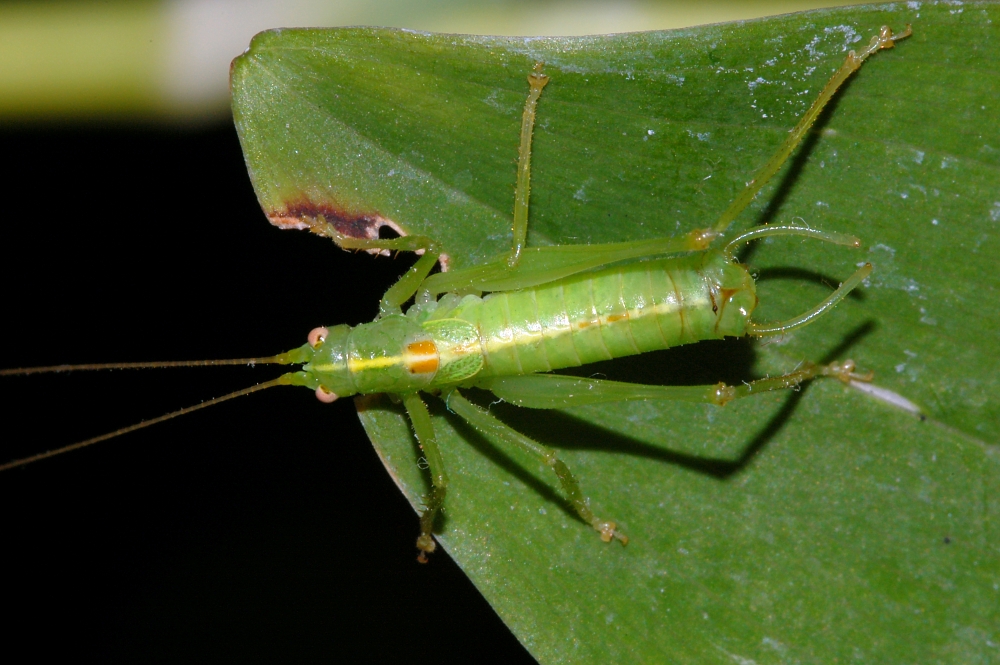
Where to see the Southern Oak Bush-cricket in the Netherlands
With luck 🦗 Grasshopper
Where and when do you see a Southern Oak Bush-cricket? With some luck you can see this species, from July to November.
How do you recognise a Southern Oak Bush-cricket?
A slim, light green bush-cricket of 11 to 16 millimetres with very long, thin antennae. The deciding feature is the wings: in both the male and the female they are reduced to short scales. The Oak Bush-cricket, which it otherwise closely resembles, is normally winged.
What does a Southern Oak Bush-cricket sound like?
Recording: Baudewijn Odé, CC BY-SA 4.0, via Wikimedia Commons
Where do you see this species in the Netherlands?
Only recently in the Netherlands. In 2008, sixteen years after the first record, the species was already known from 168 five-kilometre squares — an exponential increase. So far its preference is strongly for urban areas.
Habitat: Broadleaved trees in town, above all elm, pedunculate oak and common ash. In autumn the animals are often found on the walls of blocks of flats, preferably close to outdoor lighting.
This is a common, widespread species: you can come across it in far more places than the areas listed below. Treat that list as a starting point rather than a full survey.
📍 Nationaal Park Zuid-Kennemerland
presence reported📍 Nationaal Park Duinen van Texel
presence reported📍 Grevelingenmeer
presence reported📍 IJssel-uiterwaarden
presence reported📍 IJsselmeer
presence reported📍 Haringvliet & Hollands Diep
presence reported📍 Eemland
presence reported📍 Leuvenumse Bossen
presence reported📍 Planken Wambuis
presence reported📍 Blauwe Kamer
presence reported📍 Oostelijke Vechtplassen
presence reported📍 Noordhollands Duinreservaat
presence reported📍 Wormer- en Jisperveld
presence reported📍 Ilperveld
presence reported📍 Zuidlaardermeergebied en Hunzedal
presence reported📍 Meijendel & Berkheide
presence reported📍 Voornes Duin
presence reported📍 Kampina & Oisterwijkse Vennen
presence reported📍 De Maashorst
presence reported📍 Strabrechtse Heide & Beuven
presence reported📍 Loonse en Drunense Duinen
presence reported📍 Schoorlse Duinen
presence reportedThese links come straight from our database, with the chance, the source and the evidence level for each area.
When is the best time?
Green = present · orange = peak period. The bar is generated from our database.
Best period: Adults are about from late July; the main time falls in September and October.
Best time of day: After sunset, at lit walls and street lamps.
Recent sightings
👁️ Where has this species been seen recently?
Check the current sightings on Waarneming.nl. A useful addition to our own verified information.
How to improve your chances
- Listen first. Almost every species gives itself away by singing before you spot it.
- Go on a warm, windless afternoon. In cold or wind they fall silent.
- Walk slowly and note where the sound stops. That is where it sits, usually low in the vegetation.
- A bat detector makes audible the species that sing too high for human ears.
🎒 What you need for this
A torch. You need nothing more.
Photography
Walls are a dull background, but a flat one — place the animal sharply in frame with a macro lens at f8 and use a small fill flash with a diffuser, otherwise the wall burns out white. The scale-like wing stumps are the detail that proves the species; make sure they are sharp.
🌿 Watching responsibly
Keep your distance, stay on the paths, and never lure animals with food or sound. Leave as soon as an animal becomes uneasy.
Status: Verified · Last checked: 2026-08-12