
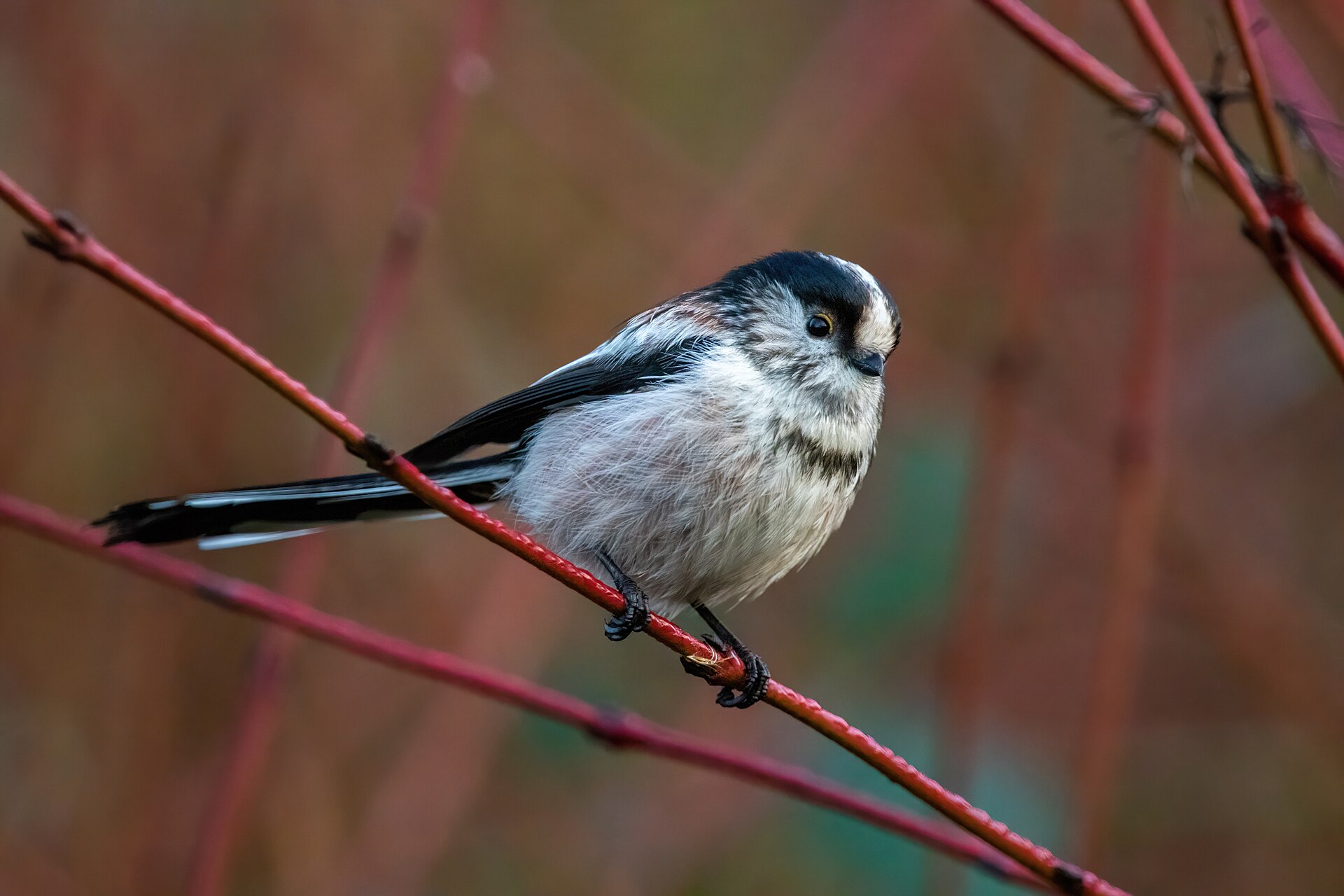
Long-tailed Tit
📷 Alexis Lours, CC BY 4.0 (Wikimedia Commons)

Where to see the Long-tailed Tit in the Netherlands

Aegithalos caudatus · Long-tailed Tit

Easy 🦅 Bird

Where and when do you see a Long-tailed Tit? This species is easy to see, from October to March.

How do you recognise a Long-tailed Tit?

Length 13 to 15 cm. A white and pink ball with a tail longer than the rest of its body. The head is mostly white, with pink on the shoulders and flanks. They are almost never alone: long-tailed tits move through the bushes in parties of five to fifteen, keeping in touch constantly with a thin, persistent piping.

Wingspan: 18 cm an indication from Wikidata; it varies by individual, sex and subspecies · compare all birds (in Dutch)

What does a Long-tailed Tit sound like?

Recording: Jonathon Jongsma, CC BY-SA 3.0, via Wikimedia Commons

Where do you see this species in the Netherlands?

Almost the whole of the Netherlands, in woodland, parks, scrub and gardens with dense growth.

Habitat: Deciduous woodland, scrub and hedgerows with dense bushes. The nest is one of the finest pieces of building in Dutch nature: an oval, closed ball of moss and spider silk, camouflaged with lichens and lined inside with feathers.

This is a common, widespread species: you can come across it in far more places than the areas listed below. Treat that list as a starting point rather than a full survey.

How certain is this? verified chance per source presence reported Links that do not clear the bottom threshold are not published. How we decide that.

📍 Fochteloërveen

With luck chance per source
De Visdief · birdwatching guide to Fochteloërveen
Nationwide period: Present all year, with October to March the best period. The family parties then move through gardens and bushes and come regularly to fat balls.

📍 Blauwe Kamer

presence reported
NDFF open data
Nationwide period: Present all year, with October to March the best period. The family parties then move through gardens and bushes and come regularly to fat balls.

📍 Zouweboezem

presence reported
NDFF open data
Nationwide period: Present all year, with October to March the best period. The family parties then move through gardens and bushes and come regularly to fat balls.

📍 Oostelijke Vechtplassen

presence reported
NDFF open data
Nationwide period: Present all year, with October to March the best period. The family parties then move through gardens and bushes and come regularly to fat balls.
NDFF open data
Nationwide period: Present all year, with October to March the best period. The family parties then move through gardens and bushes and come regularly to fat balls.

📍 Wormer- en Jisperveld

presence reported
NDFF open data
Nationwide period: Present all year, with October to March the best period. The family parties then move through gardens and bushes and come regularly to fat balls.

📍 Ilperveld

presence reported
NDFF open data
Nationwide period: Present all year, with October to March the best period. The family parties then move through gardens and bushes and come regularly to fat balls.
NDFF open data
Nationwide period: Present all year, with October to March the best period. The family parties then move through gardens and bushes and come regularly to fat balls.

📍 Meijendel & Berkheide

presence reported
NDFF open data, 5.485 records 2016-2026
Nationwide period: Present all year, with October to March the best period. The family parties then move through gardens and bushes and come regularly to fat balls.

📍 Voornes Duin

presence reported
NDFF open data, 265 records 2016-2026
Nationwide period: Present all year, with October to March the best period. The family parties then move through gardens and bushes and come regularly to fat balls.
NDFF open data, 3.181 records 2016-2026
Nationwide period: Present all year, with October to March the best period. The family parties then move through gardens and bushes and come regularly to fat balls.

📍 De Maashorst

presence reported
NDFF open data, 2.931 records 2016-2026
Nationwide period: Present all year, with October to March the best period. The family parties then move through gardens and bushes and come regularly to fat balls.
NDFF open data, 1.549 records 2016-2026
Nationwide period: Present all year, with October to March the best period. The family parties then move through gardens and bushes and come regularly to fat balls.

📍 Loonse en Drunense Duinen

presence reported
NDFF open data, 1.576 records 2016-2026
Nationwide period: Present all year, with October to March the best period. The family parties then move through gardens and bushes and come regularly to fat balls.

📍 Schoorlse Duinen

presence reported
NDFF open data, 1.286 records 2016-2026
Nationwide period: Present all year, with October to March the best period. The family parties then move through gardens and bushes and come regularly to fat balls.

These links come straight from our database, with the chance, the source and the evidence level for each area.

When is the best time?

Green = present · orange = peak period. The bar is generated from our database.

Best period: Present all year, with October to March the best period. The family parties then move through gardens and bushes and come regularly to fat balls.

Best time of day: The morning. You usually hear a party before you see it: a thin, persistent piping that moves slowly through the bushes.

Recent sightings

👁️ Where has this species been seen recently?

Check the current sightings on Waarneming.nl. A useful addition to our own verified information.

Current sightings on Waarneming.nl →

How to improve your chances

  • Learn the calls first. You will hear most birds before you see them.
  • Go in the first hour after sunrise, when the song is at its peak and the wind is still down.
  • Use a hide or natural cover. Sitting still gets you more than walking closer.
  • Keep the sun behind you. Against the light you see a silhouette and no colour.

Photography

A party often comes back along the same route

🌿 Watching responsibly

Keep your distance, stay on the paths, and never lure animals with food or sound. Leave as soon as an animal becomes uneasy.

Sources: Sovon / Vogelbescherming / Zodion / Vlinderstichting; Vogelbescherming Nederland (vogelgids), geraadpleegd 02-11-2026
Status: Verified · Last checked: 2026-08-08