
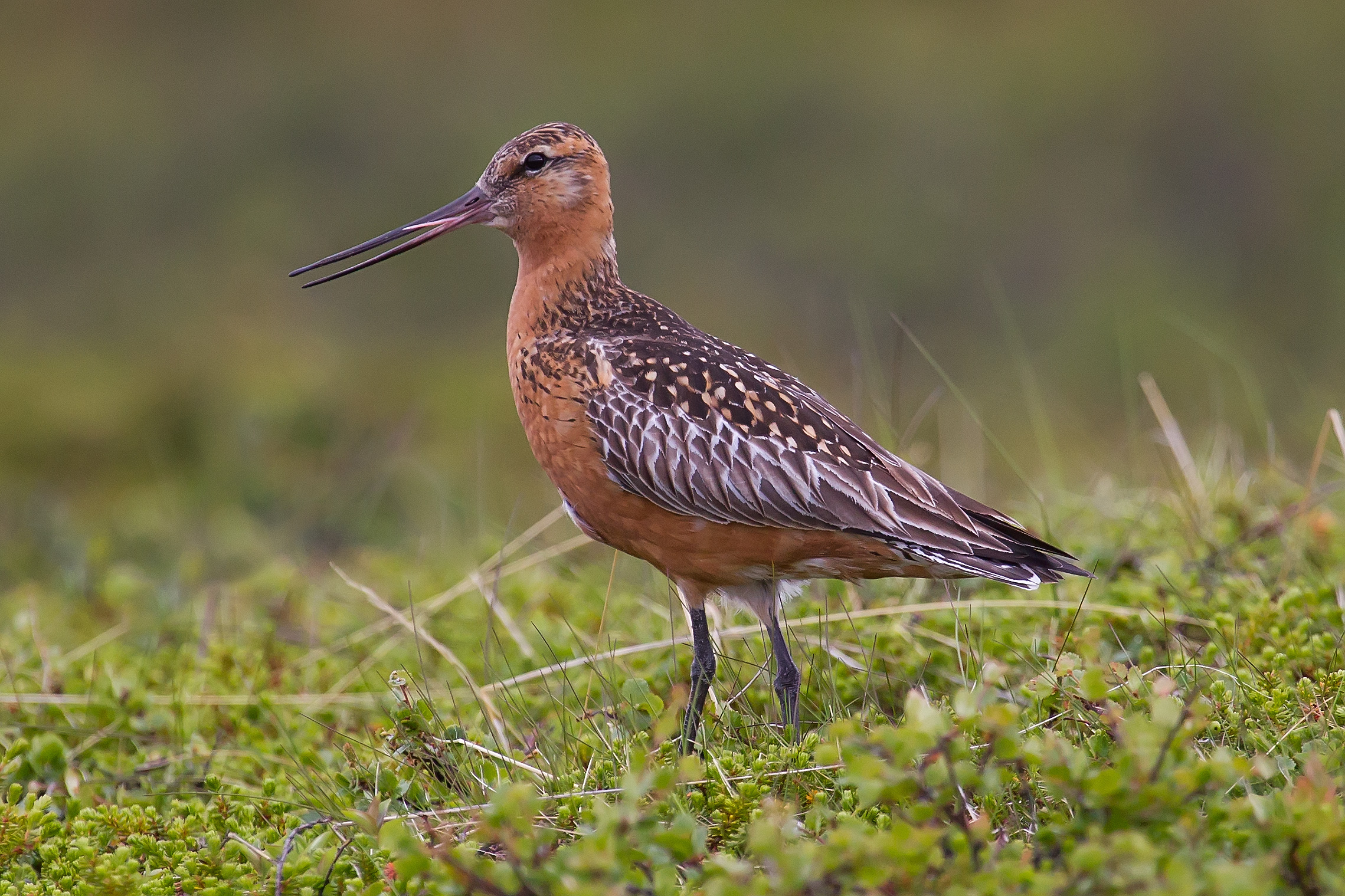
Where to see the Bar-tailed Godwit in the Netherlands
Easy 🦅 Bird
Where and when do you see a Bar-tailed Godwit? This species is easy to see, from July to May.
How do you recognise a Bar-tailed Godwit?
A hefty wader of 37 to 41 cm with a wingspan of 70 to 80 cm. The bill is long and slightly upturned, with a pink base. Compared with the Black-tailed Godwit the legs are clearly shorter, and in flight only the tips of the toes project beyond the tail. The best feature in flight: the Bar-tailed Godwit lacks the white wing bar of the Black-tailed Godwit and has a finely barred tail instead of a black tail band. In summer plumage the male is a deep rust red on head, neck and underparts; the female stays much paler. In winter plumage both are greyish brown and streaked.
Where do you see this species in the Netherlands?
A passage migrant and winter visitor. The Netherlands holds 57,400 to 70,600 wintering birds, almost all of them in the Wadden Sea and the Delta. In May that number rises to 160,000 to 200,000, when birds from West Africa refuel here for the leap to the tundra of northern Scandinavia and Siberia. The species does not breed in the Netherlands.
📍 Wadden Sea
Good chance in season chance per source📍 Nationaal Park Oosterschelde
Good chance in season chance per source📍 Noordhollands Duinreservaat
presence reported📍 Ilperveld
presence reported📍 De Dollard
presence reported📍 Meijendel & Berkheide
presence reported📍 Voornes Duin
presence reported📍 Schoorlse Duinen
presence reported📍 Haringvlietsluizen
presence reported📍 De Putten bij Camperduin
presence reportedThese links come straight from our database, with the chance, the source and the evidence level for each area.
When is the best time?
Green = present · orange = peak period. The bar is generated from our database.
Best period: Present all year except in June. A peak in May during passage, and a second peak in winter.
Best time of day: Around high tide, when the birds crowd together at the roosts.
Recent sightings
👁️ Where has this species been seen recently?
Check the current sightings on Waarneming.nl. A useful addition to our own verified information.
How to improve your chances
- Learn the calls first. You will hear most birds before you see them.
- Go in the first hour after sunrise, when the song is at its peak and the wind is still down.
- Use a hide or natural cover. Sitting still gets you more than walking closer.
- Keep the sun behind you. Against the light you see a silhouette and no colour.
🎒 What you need for this
Telescope. The flocks are often hundreds of metres away and you want to be able to see the bill shape and the tail.
Photography
Photograph from a fixed hide or from the car at a high-tide roost and stay low. Never walk into a flock: flying up costs the birds energy they need for migration. The incoming tide pushes the birds towards you by itself.
🌿 Watching responsibly
Keep your distance, stay on the paths, and never lure animals with food or sound. Leave as soon as an animal becomes uneasy.
Status: Verified · Last checked: 2026-08-08