Where to see the Common Moorhen in the Netherlands
Easy 🦅 Bird
Where and when do you see a Common Moorhen? This species is easy to see, all year round.
How do you recognise a Common Moorhen?
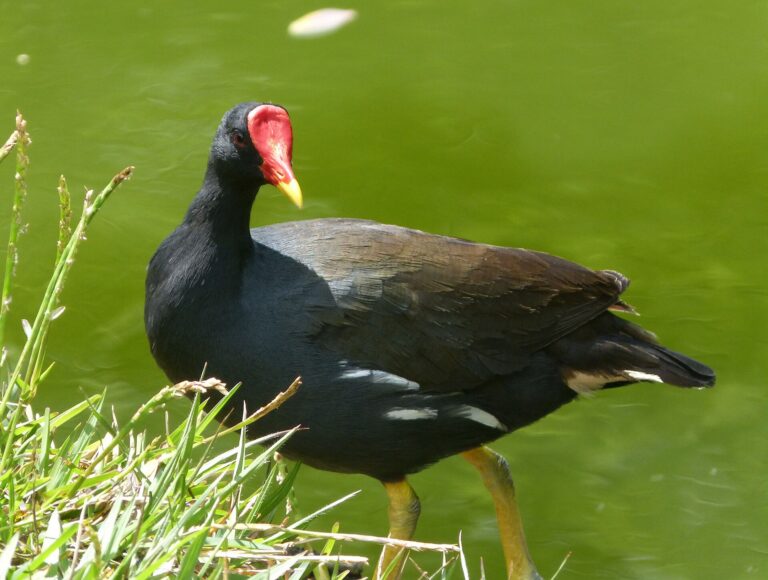
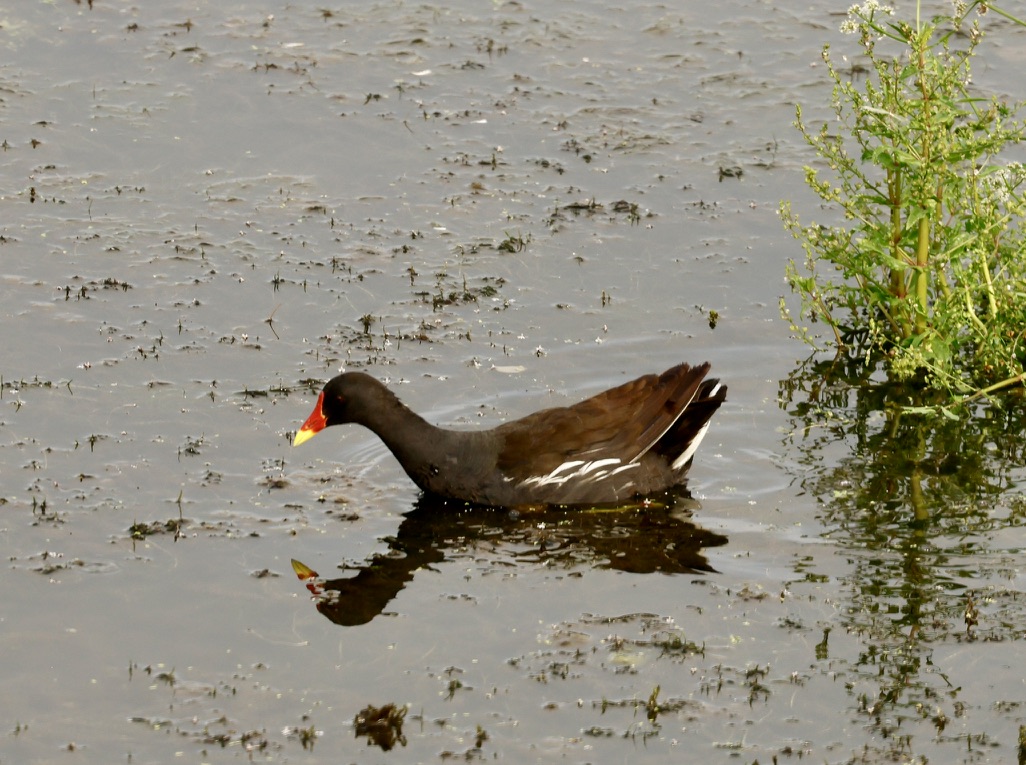
Length 27 to 31 cm, wingspan 50 to 55 cm. Dark slate grey with a brown back, a red bill with a yellow tip and white streaks along the flank. Under the tail are two white patches that it flicks up constantly while swimming. Its feet are strikingly large and greenish yellow, without webbing.
What can you confuse a Common Moorhen with?
Looks like: Eurasian Coot
- Eurasian Coot: jet black with a bright white bill and white frontal shield, and with lobed toes.
What does a Common Moorhen sound like?
Recording: Joost van Bruggen, CC BY-SA 4.0, via Wikimedia Commons
Where do you see this species in the Netherlands?
Almost the whole of the Netherlands, by ditches, ponds, canals and lakes with vegetated banks.
Habitat: Small water bodies with plenty of bankside vegetation. Unlike the Eurasian Coot it likes to stay close to the edge, and it also forages on land and through bushes.
This is a common, widespread species: you can come across it in far more places than the areas listed below. Treat that list as a starting point rather than a full survey.
📍 Blauwe Kamer
presence reported📍 Zouweboezem
presence reported📍 Oostelijke Vechtplassen
presence reported📍 Noordhollands Duinreservaat
presence reported📍 Wormer- en Jisperveld
presence reported📍 Ilperveld
presence reported📍 De Dollard
presence reported📍 Zuidlaardermeergebied en Hunzedal
presence reported📍 Meijendel & Berkheide
presence reported📍 Voornes Duin
presence reported📍 Kampina & Oisterwijkse Vennen
presence reported📍 De Maashorst
presence reported📍 Strabrechtse Heide & Beuven
presence reported📍 Loonse en Drunense Duinen
presence reported📍 Schoorlse Duinen
presence reported📍 Haringvlietsluizen
presence reported📍 De Putten bij Camperduin
presence reportedThese links come straight from our database, with the chance, the source and the evidence level for each area.
When is the best time?
Green = present · orange = peak period. The bar is generated from our database.
Best period: Present all year, with young from March to July. The chicks are black balls of down with a little red bill, and swim behind their parents within a day of hatching.
Best time of day: The morning. Moorhens are shyer than coots and withdraw into the vegetation quickly when disturbed.
Recent sightings
👁️ Where has this species been seen recently?
Check the current sightings on Waarneming.nl. A useful addition to our own verified information.
How to improve your chances
- Learn the calls first. You will hear most birds before you see them.
- Go in the first hour after sunrise, when the song is at its peak and the wind is still down.
- Use a hide or natural cover. Sitting still gets you more than walking closer.
- Keep the sun behind you. Against the light you see a silhouette and no colour.
Photography
Wait by an opening in the reed edge
🌿 Watching responsibly
Keep your distance, stay on the paths, and never lure animals with food or sound. Leave as soon as an animal becomes uneasy.
Status: Verified · Last checked: 2026-08-08
More photos