
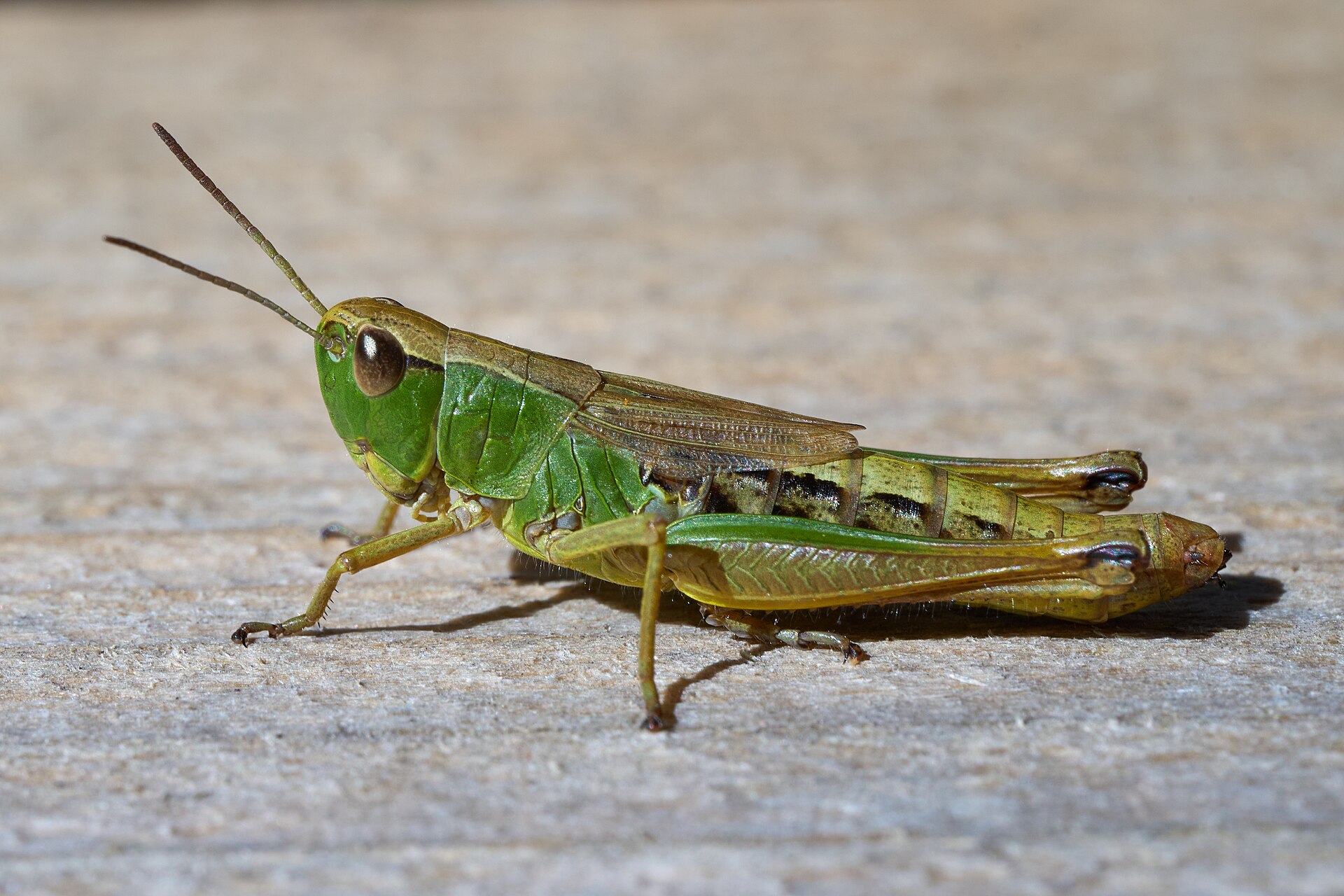
Meadow Grasshopper
📷 Conny Duck, CC BY 4.0 (Wikimedia Commons)

Where to see the Meadow Grasshopper in the Netherlands

Pseudochorthippus parallelus · Meadow Grasshopper

Easy 🦗 Grasshopper

Where and when do you see a Meadow Grasshopper? This species is easy to see, from June to November.

How do you recognise a Meadow Grasshopper?

A grasshopper of 13 to 23 millimetres, green, brown or a mix of green and brown. The keel along the top edge of the side of the pronotum is only weakly curved. The handiest feature is the wings: strongly shortened and pointed in the female, and in the male too they do not quite reach the tip of the abdomen. That is why the meadow grasshopper cannot fly.

What does a Meadow Grasshopper sound like?

Recording: BioAcoustica, CC BY 3.0, via Wikimedia Commons

Where do you see this species in the Netherlands?

Common throughout the Netherlands, on damp as well as dry terrain.

Habitat: Grassy vegetation of almost any kind: meadows, verges, dykes, rank vegetation, woodland edges and gardens. It asks for little as long as there is grass, which makes it one of the few grasshoppers that holds on in intensively used landscape as well.

This is a common, widespread species: you can come across it in far more places than the areas listed below. Treat that list as a starting point rather than a full survey.

How certain is this? verified chance per source presence reported Links that do not clear the bottom threshold are not published. How we decide that.
NDFF open data, 1.013 records 2016-2026
Nationwide period: Adults from June to November; one of the longest seasons of all our grasshoppers.
NDFF open data, 1.359 records 2016-2026
Nationwide period: Adults from June to November; one of the longest seasons of all our grasshoppers.

📍 Deelerwoude

presence reported
NDFF open data, 1.193 records 2016-2026
Nationwide period: Adults from June to November; one of the longest seasons of all our grasshoppers.
NDFF open data, 1.878 records 2016-2026
Nationwide period: Adults from June to November; one of the longest seasons of all our grasshoppers.
NDFF open data, 720 records 2016-2026
Nationwide period: Adults from June to November; one of the longest seasons of all our grasshoppers.

📍 Nationaal Park Veluwezoom

presence reported
NDFF open data, 636 records 2016-2026
Nationwide period: Adults from June to November; one of the longest seasons of all our grasshoppers.
NDFF open data, 551 records 2016-2026
Nationwide period: Adults from June to November; one of the longest seasons of all our grasshoppers.
NDFF open data, 436 records 2016-2026
Nationwide period: Adults from June to November; one of the longest seasons of all our grasshoppers.
NDFF open data, 1.071 records 2016-2026
Nationwide period: Adults from June to November; one of the longest seasons of all our grasshoppers.

📍 Nationaal Park De Meinweg

presence reported
NDFF open data, 446 records 2016-2026
Nationwide period: Adults from June to November; one of the longest seasons of all our grasshoppers.
NDFF open data, 147 records 2016-2026
Nationwide period: Adults from June to November; one of the longest seasons of all our grasshoppers.

📍 Fochteloërveen

presence reported
NDFF open data, 142 records 2016-2026
Nationwide period: Adults from June to November; one of the longest seasons of all our grasshoppers.
NDFF open data, 1.247 records 2016-2026
Nationwide period: Adults from June to November; one of the longest seasons of all our grasshoppers.

📍 Zwin & Zeeuws-Vlaanderen

presence reported
NDFF open data, 141 records 2016-2026
Nationwide period: Adults from June to November; one of the longest seasons of all our grasshoppers.
NDFF open data, 205 records 2016-2026
Nationwide period: Adults from June to November; one of the longest seasons of all our grasshoppers.
NDFF open data, 123 records 2016-2026
Nationwide period: Adults from June to November; one of the longest seasons of all our grasshoppers.

📍 Onlanden & Leekstermeer

presence reported
NDFF open data, 106 records 2016-2026
Nationwide period: Adults from June to November; one of the longest seasons of all our grasshoppers.

📍 Planken Wambuis

presence reported
NDFF open data, 1.001 records 2016-2026
Nationwide period: Adults from June to November; one of the longest seasons of all our grasshoppers.

📍 Grevelingenmeer

presence reported
NDFF open data, 61 records 2016-2026
Nationwide period: Adults from June to November; one of the longest seasons of all our grasshoppers.

📍 IJssel-uiterwaarden

presence reported
NDFF open data, 80 records 2016-2026
Nationwide period: Adults from June to November; one of the longest seasons of all our grasshoppers.

📍 Grensmaas

presence reported
NDFF open data, 35 records 2016-2026
Nationwide period: Adults from June to November; one of the longest seasons of all our grasshoppers.
NDFF open data, 53 records 2016-2026
Nationwide period: Adults from June to November; one of the longest seasons of all our grasshoppers.

📍 Leuvenumse Bossen

presence reported
NDFF open data, 118 records 2016-2026
Nationwide period: Adults from June to November; one of the longest seasons of all our grasshoppers.

📍 Blauwe Kamer

presence reported
NDFF open data
Nationwide period: Adults from June to November; one of the longest seasons of all our grasshoppers.

📍 Oostelijke Vechtplassen

presence reported
NDFF open data
Nationwide period: Adults from June to November; one of the longest seasons of all our grasshoppers.
NDFF open data
Nationwide period: Adults from June to November; one of the longest seasons of all our grasshoppers.

📍 Wormer- en Jisperveld

presence reported
NDFF open data
Nationwide period: Adults from June to November; one of the longest seasons of all our grasshoppers.
NDFF open data
Nationwide period: Adults from June to November; one of the longest seasons of all our grasshoppers.

📍 Voornes Duin

presence reported
NDFF open data, 39 records 2016-2026
Nationwide period: Adults from June to November; one of the longest seasons of all our grasshoppers.
NDFF open data, 632 records 2016-2026
Nationwide period: Adults from June to November; one of the longest seasons of all our grasshoppers.

📍 De Maashorst

presence reported
NDFF open data, 1.696 records 2016-2026
Nationwide period: Adults from June to November; one of the longest seasons of all our grasshoppers.
NDFF open data, 1.534 records 2016-2026
Nationwide period: Adults from June to November; one of the longest seasons of all our grasshoppers.

📍 Loonse en Drunense Duinen

presence reported
NDFF open data, 672 records 2016-2026
Nationwide period: Adults from June to November; one of the longest seasons of all our grasshoppers.

These links come straight from our database, with the chance, the source and the evidence level for each area.

When is the best time?

Green = present · orange = peak period. The bar is generated from our database.

Best period: Adults from June to November; one of the longest seasons of all our grasshoppers.

Best time of day: The warm hours of the day; it also keeps singing in half-cloudy weather.

Recent sightings

👁️ Where has this species been seen recently?

Check the current sightings on Waarneming.nl. A useful addition to our own verified information.

Current sightings on Waarneming.nl →

How to improve your chances

  • Listen first. Almost every species gives itself away by singing before you spot it.
  • Go on a warm, windless afternoon. In cold or wind they fall silent.
  • Walk slowly and note where the sound stops. That is where it sits, usually low in the vegetation.
  • A bat detector makes audible the species that sing too high for human ears.

🎒 What you need for this

Nothing. Walk into a verge and listen for the short rasping phrases.

Photography

The meadow grasshopper cannot fly, which makes it easier to approach than most species. Sit down quietly and photograph at eye level; the shortened, pointed wings of the female are the detail the photograph should turn on.

🌿 Watching responsibly

Keep your distance, stay on the paths, and never lure animals with food or sound. Leave as soon as an animal becomes uneasy.

Sources: NDFF Flora & Fauna Verkenner (open data), geraadpleegd 08-08-2026; Naturalis Biodiversity Center, Insecten van Europa; NDFF Verspreidingsatlas (EIS Kenniscentrum Insecten)
Status: Verified · Last checked: 2026-08-08