
Hearing owls in autumn: where, when and which species
There is one evening a year when the wood suddenly sounds different. The leaves are half down, the wind has dropped, and somewhere among the old beeches a bird opens with a long, quavering hoo… hoo-hoo-hoo-hooooo that you feel in the back of your neck. That is neither coincidence nor luck: owls call considerably more in autumn than in spring. If you want to hear them, don’t head into the wood in March — go now, between mid-October and Christmas.
This article sets out which five owl species you can come across in the Netherlands, what they sound like, where to stand, and why 2026 is an exceptional year — plus what you deliberately don’t do, because owls are exactly the kind of animal where enthusiasm does damage fast.
Why autumn is owl season, and spring is not
The common assumption is that owls call in spring, because that is when they breed. For the Tawny Owl that isn’t true. Tawny Owls do lay early — from February or March, according to Vogelbescherming Nederland — but the calling with which they mark out their territory sits in a completely different part of the year.
Sovon put it concisely in January 2019: Tawny Owls begin “displaying as early as October”, and “in the middle of winter they still call regularly”. Ranger Jacqueline van Dam of Utrechts Landschap wrote in November 2024 why that matters so much in practice: “On this windless evening his call carries a very long way.” A bare wood with no leaves and no wind carries sound over hundreds of metres.
There is a second movement on top of that. Young Tawny Owls hang around near their birthplace for months after fledging, but, as Natuurmonumenten puts it: “By autumn they really do have to leave their familiar surroundings.” So in autumn there are established birds marking their boundaries and young wanderers looking for a gap, at the same time. That produces calling owls.
For the Netherlands there is one dataset that nails this down. René Teixeira and Wim Surminski recorded daily, for eighteen years from January 2000 to March 2018, which Tawny Owls they heard around their house on the edge of Hoogerheide, distinguishing between males, females and young birds. Their conclusion, published in Limosa 91 (2018), is unambiguous: “Calling activity of males and females is highest from September to January (low from May to July).”
They draw the practical consequence themselves: “The survey period used by Sovon falls mainly in the trough of the parent birds’ calling activity, which makes territories hard to detect and invites underestimation.” British guidelines, according to the same publication, advise “surveying above all from October to December, when territorial activity is most intense”.
Two things to be straight about here. This is one observer in one place, not a national monitoring scheme — the shape of the curve is convincing, the precise figures apply to West Brabant. And it concerns the Tawny Owl; for the other four species in this article no such dataset exists.
The Tawny Owl: the sound everyone knows without knowing it
With 5,200 to 6,400 breeding pairs (2018–2020) the Tawny Owl is by far our commonest woodland owl, and according to Sovon it has increased significantly since 1990. It is not on the Red List. It lives, says Vogelbescherming, in “open deciduous or mixed woodland, farmyards, (urban) parks, green residential areas with old trees” — and that last one is why you can hear it from your own back garden just as well as in a nature reserve.
The male’s sound is the one from every horror film: a sustained hoo…, a silence of two to four seconds, and then a rolling hoo-hoo-hoo-hoooooo that quavers at the end. It carries a long way, and it rarely comes from the direction you expect.
Male or female? How to decode the duet
The second sound is the most useful one you can learn, precisely because it sounds so little like an owl. The female answers with a short, high, almost shrill ke-wick — Vogelbescherming writes it as “ke-wik”, Natuurmonumenten as “ku-wiek”. Beginners consistently mistake it for a bird that has been startled.
If you hear both intermingled, you are standing beside a pair defending its territory, and that is the moment to stand perfectly still. Don’t walk towards the sound. An owl that stops calling because you are getting closer is an owl you have disturbed, even if nothing visible happens.
2026 is an exceptional owl year, and that is down to the voles
Owls eat small rodents, and rodents run in cycles. How many acorns and beechnuts fall in a wood determines how many mice and voles there are a year later — the chain we worked through in our article on the mast year.
That effect became visible this year. Sovon Vogelonderzoek Nederland, STONE Steenuilenoverleg Nederland and Vogelbescherming Nederland reported on 13 June 2026: “Reports are coming in from all over the country that there are a great many mice and voles this year. Common voles, bank voles and wood mice are at a peak.” The bank vole and the wood mouse are exactly the species on the menu in a wood.
The consequences were extreme. For the Short-eared Owl, over a hundred breeding attempts were reported in 2026, more than 75 pairs in Friesland alone — while Sovon puts the normal Dutch breeding population for 2025 at 15 to 30 pairs. For the Common Kestrel, 66 territories were reported in the Hoeksche Waard against an average of 28 over the preceding five years, and counters recorded “209 young in the boxes, almost twice as many as the average over the past five years” — including one clutch of eight eggs.
What that means for this autumn: unusually many young owls are flying around looking for a place of their own. Your chances of hearing one are better this year than in an average year.
The Long-eared Owl: why we name no roost
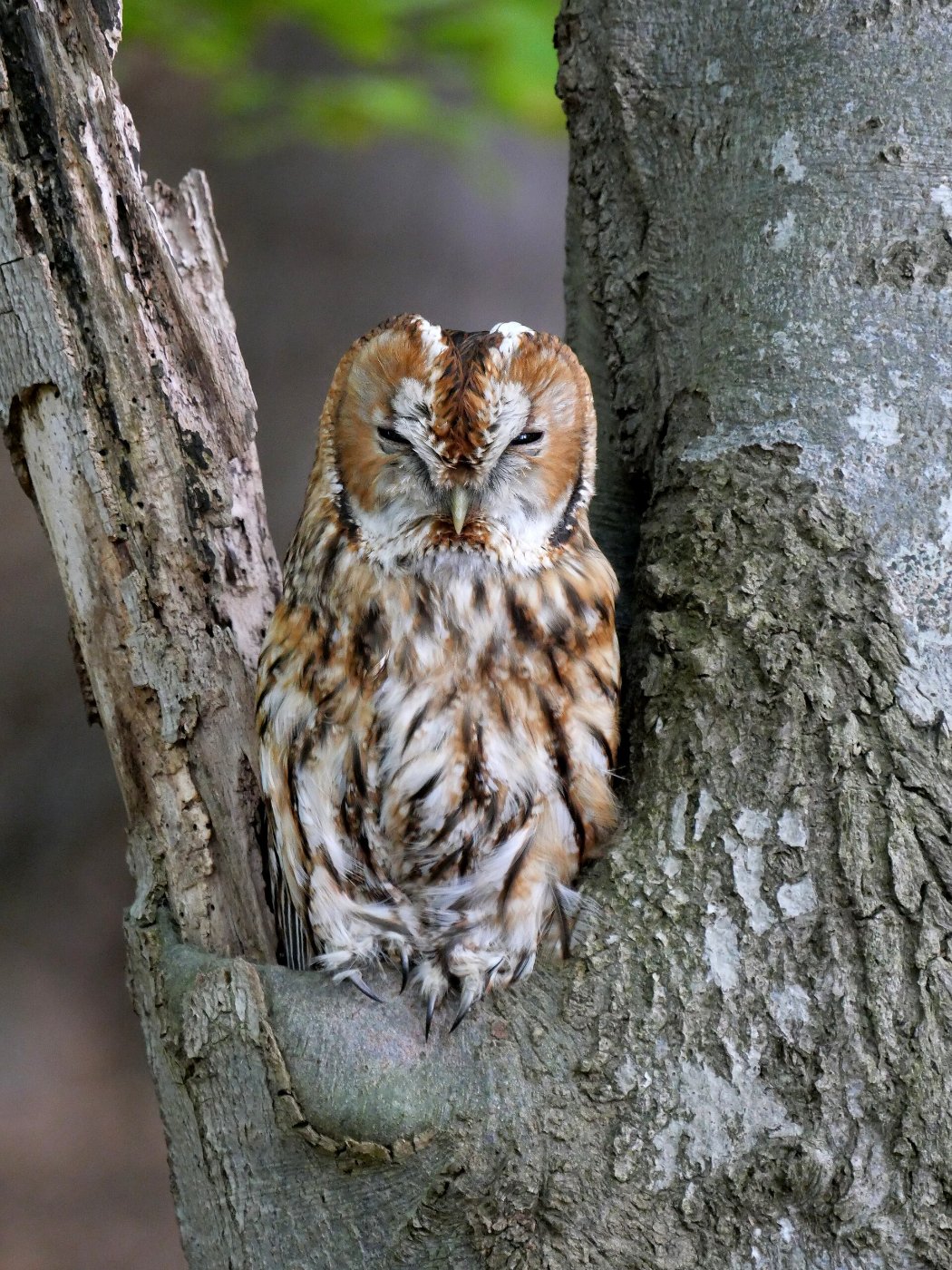
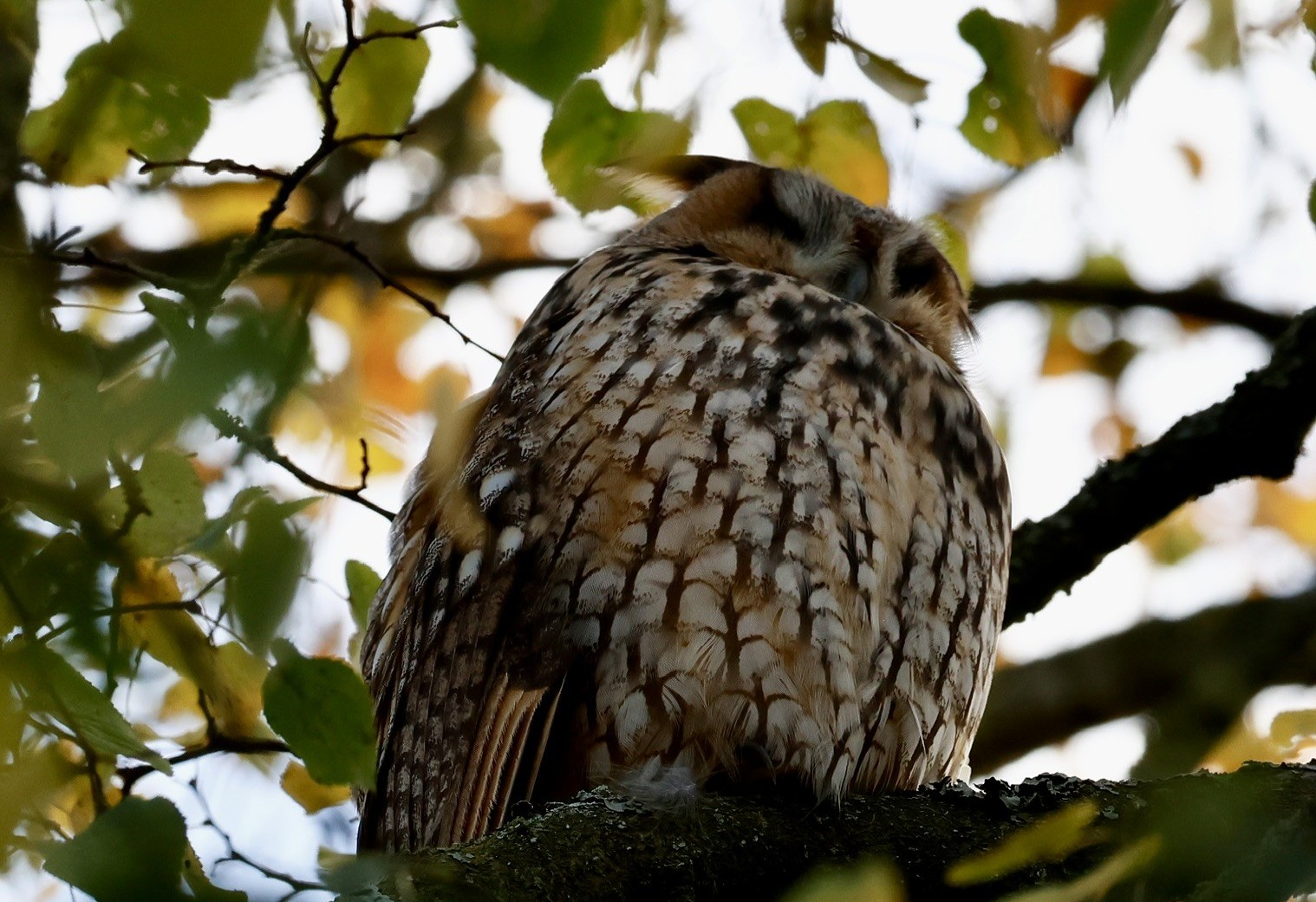
The Long-eared Owl (2,100–3,000 breeding pairs, 2018–2020) does something in winter that no other Dutch owl does: it sleeps in company. Vogelbescherming: “From autumn onwards Long-eared Owls gather in groups and occupy fixed roosts.” At such a spot you see “a few to sometimes dozens of Long-eared Owls together” — often in a conifer, often in the middle of a village, often the same tree year after year.
That makes it the most spectacular owl sighting in the Netherlands, and at the same time the most vulnerable. On the NDFF’s Sensitive Species List the Long-eared Owl carries the heaviest condition there is: all records are blurred, not just breeding records. The reason is precisely this behaviour.
That is why we name no Long-eared Owl roost on this site, and no area where one might be either. Vogelbescherming explains in its own words why that is reasonable: “Even though a Long-eared Owl often sleeps close to people, it likes peace and is easily disturbed”, and: “Sometimes a location is kept private, because obviously it isn’t the idea that ten birdwatchers end up standing in somebody’s garden. (…) If the roost tree is in a garden: stay on public ground.” See also our page on responsible wildlife watching.
The Long-eared Owl’s sound is, incidentally, the hardest of all five: a low, soft, almost toneless hoo from the male that you can no longer hear at ten metres. The shrill begging call of fledged young — a sound like a squeaking garden gate — is far more noticeable in summer.
The Barn Owl: screeching over open country
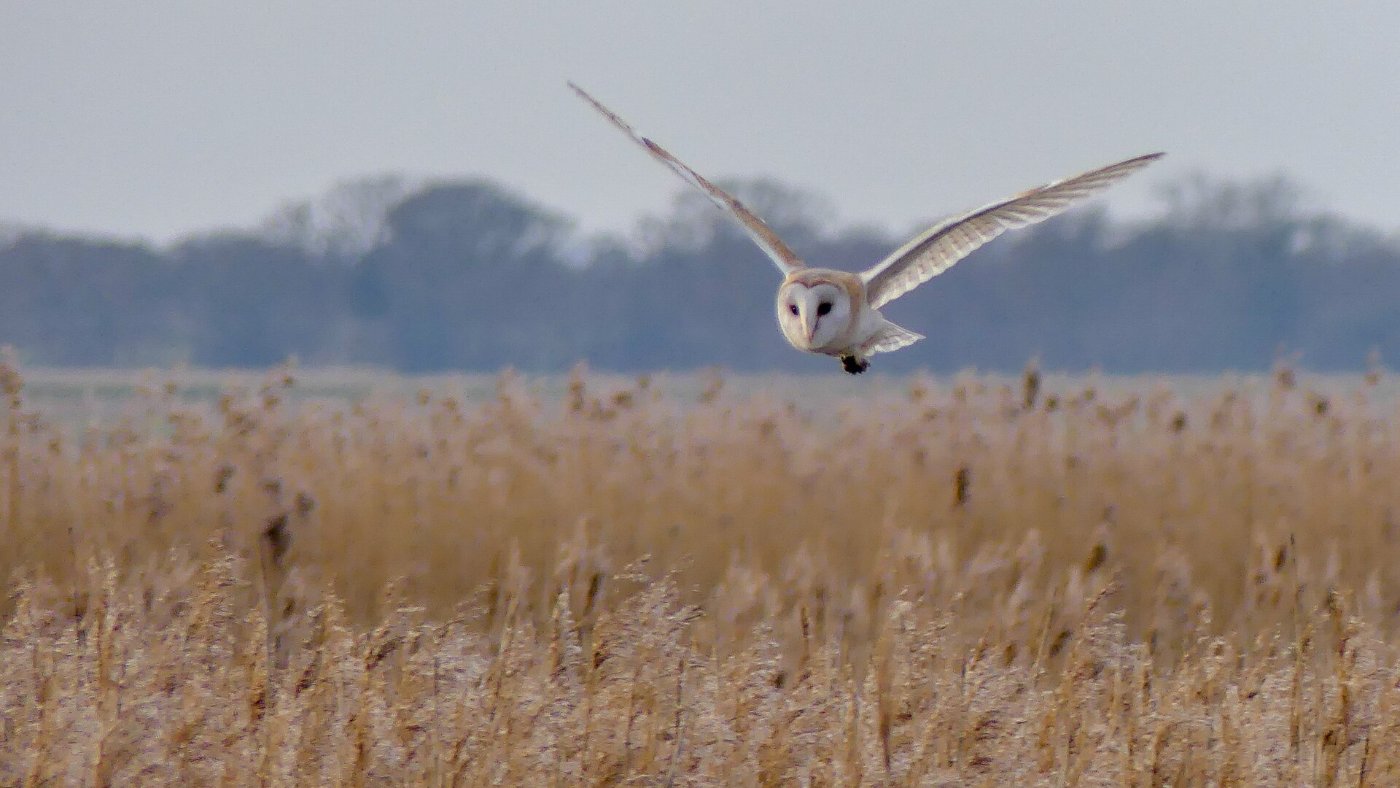
If you hear an owl scream rather than call, you have probably got a Barn Owl. Vogelbescherming describes the sound as a “ghostly screech and hiss”, both in flight and at the nest. There is no melody and no rhythm; it sounds as though something is breaking.
The Barn Owl does not belong in woodland but in “half-open to open farmed landscape”: grassland and arable with hedgebanks, tree lines and rough ditch edges. It hunts in a “slow searching flight with shallow wingbeats low over the land”, sometimes from a low perch. Common voles are its main food, which is why numbers fluctuate with the vole years: Vogelbescherming puts 2025 at roughly 2,250 to 2,450 breeding pairs.
Your best chance is a quiet country lane in the hour after sunset, car pulled over and window open. Barn Owl nests sit in barns, church towers and boxes — we never name those, and on the Sensitive Species List the Barn Owl is protected on breeding records for that same reason.
The Little Owl: small, bold, and in the spotlight this year
With 8,000 to 9,500 breeding pairs (2018–2020) the Little Owl is our most numerous owl, but also the one we have lost most of: in the 1950s there were an estimated 25,000. It is no coincidence that 2026 has been declared Year of the Little Owl by Vogelbescherming Nederland, Sovon Vogelonderzoek Nederland and the national Little Owl working group STONE.
The figure that explains that choice is regional: on sandy soils the species has been growing for twelve years at 1.8 per cent a year, while on clay soils it has been shrinking over the same period at 3.6 per cent a year. Same country, opposite directions.
If you want to see one: the Little Owl is not a woodland bird but a farmyard bird, of small-scale farmland with pollarded trees, hedges and short grass, and it stays “in the immediate vicinity of the breeding site all year round”. It likes to sit on a post a metre high and, unlike the other four, it is also active in the late afternoon. Its call is a plaintive, rising kiew-kiew-kiew.
The Short-eared Owl: the owl you see by day
The Short-eared Owl is the odd one out — it hunts in daylight, over open ground, with a swinging, almost butterfly-like flight. That gets it regularly mistaken for a Common Buzzard, whereas its wings are much narrower and its flight far more irregular.
It is also our rarest: 15 to 30 breeding pairs in 2025, “critically endangered” on the Red List, and in significant decline since 1990. The vole year 2026 with its hundred-plus breeding attempts was therefore an outlier, not a recovery — Sovon recorded comparable peaks in 2014, 2019 and 2023. In winter an estimated 100 to 500 birds are present in the Netherlands, according to Sovon — an estimate covering the winters of 2012/13 to 2014/15 — mainly in open dunes, salt marshes and polders.
Where to hear owls in the Netherlands
For the Tawny Owl the rule is simple: old deciduous woodland with thick trees, preferably with clearings in between. That points straight at the Veluwe and the ice-pushed ridges.
One thing first, because it shapes your whole evening: the areas below are not open at night. Natuurmonumenten puts it like this: “You may visit Natuurmonumenten’s areas between sunrise and sunset.” Staatsbosbeheer takes the same line: “Most areas are open from sunrise to sunset.” So your usable window is in the last of the light. Further down you’ll read how to get the most out of it.
- Leuvenumse Bossen — old, varied and quiet, with plenty of thick trees along the paths; in our view the best starting point for the last hour of light.
- Veluwezoom National Park and Deelerwoude — old beech and oak avenues, and in the same weeks roaring red deer as well.
- De Hoge Veluwe National Park and Planken Wambuis — De Hoge Veluwe is a paid park with its own opening hours, Planken Wambuis belongs to Natuurmonumenten and closes at sunset. Check for both, before you set off, when the day ends there.
- Utrechtse Heuvelrug National Park — close to the Randstad and well stocked with Tawny Owls.
- Dwingelderveld National Park and Drents-Friese Wold National Park — woodland against open heath, the best combination for several species in one evening.
- Zuid-Kennemerland National Park — dune woodland, plus open dunes for a chance of a Short-eared Owl by day.
Kroondomein Het Loo is largely out in this period: the reserve closes annually from 15 September to 25 December inclusive. A number of designated gravel roads do stay open, provided you keep strictly to those paths — consult the official map before you go. For Barn Owl and Little Owl, incidentally, you needn’t enter a nature reserve at all — small-scale farmland with pollarded willows and old barns works better than any national park.
The best moment: weather, wind and time of day
Sovon sums it up briefly: “the first couple of hours after sunset are the best time to go and listen”. Within that, three things make the difference.
And there lies the tension in this subject: the best listening hours begin exactly when most nature reserves close. In practice you solve it like this. Be in place well before sunset, because Tawny Owls often start calling in the last of the daylight. Leave the area at sunset and carry on listening from the public road, a cycle path or a wood edge — sound carries perfectly well there and you disturb nobody. If you do want to be in the wood after dark, join an evening excursion run by the site manager; Natuurmonumenten organises these in the Leuvenumse Bossen among other places.
- Windless. Rustling branches mask exactly the frequency band a Tawny Owl calls in. At force 4 you won’t hear it at fifty metres.
- Dry and clear. Rain damps sound and keeps birds quiet.
- No full moon needed. That is a persistent story; for hearing it makes no difference at all, and for seeing a little moonlight is pleasant.
Give it time, too. Twenty minutes standing still in one place yields more than an hour of walking: your ears adjust, and the wood gets used to you. Pick a spot with open space around you — an avenue or a wood edge — so sound can reach you from several directions.
Finding an owl by day: let the other birds do the work
By day a Tawny Owl sits concealed, according to Natuurmonumenten in “hidden places, such as dense spruces or tree cavities”. You rarely find it by looking. You find it by listening for birds that are annoyed.
Vogelbescherming puts it exactly so: “Noisy carrying-on by jays and tits sometimes gives away a Tawny Owl’s roost.” A Eurasian Jay screeching in one place for minutes on end, with tits and blackbirds around it, almost always means there is a predator there. The same behaviour gives away a red fox or a pine marten, incidentally. Those alarm calls are worth learning; we cover them in our article on recognising woodland birds by sound.
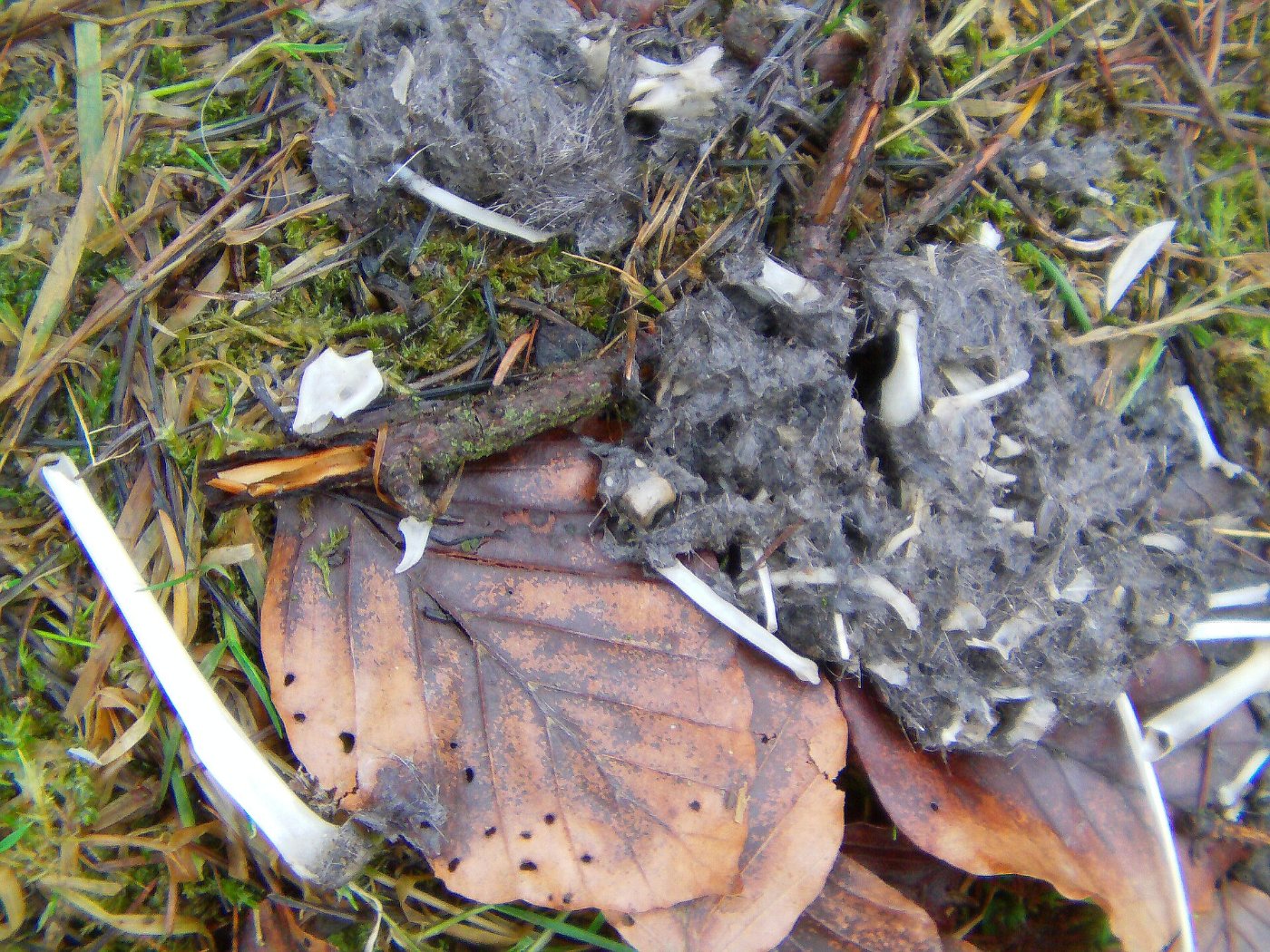
The second clue is on the ground. Pellets collect under a regular roost: indigestible remains the owl brings back up. Zodion Zoogdieronderzoek Nederland explains it plainly: “Owls often swallow their prey whole. The parts that are indigestible stay behind in the stomach and after a while are brought back up.” Such a pellet contains “for instance a little skull and hairs of a common vole, a leg of a wood mouse or the wing case of a beetle”. If you find a handful of fresh pellets together, you are standing under a regular roost — and then the right response is: make a note, and don’t go and stand under it again.
What you don’t do: luring owls with sound
The quickest way to make an owl respond is to play back its own call. It works, and that is exactly why it is a problem: the bird believes there is an intruder in its territory and spends energy on a fight that doesn’t exist — in the season when it is settling its boundaries.
Sovon permits playback under conditions for targeted survey work, but states those conditions strictly: “Watch for any reaction from the birds and then stop playing sound, certainly on a strong reaction. Frequent and prolonged playback can disturb and is strongly discouraged.” Sovon itself acknowledges that “this carries a risk of disturbance”. For a recreational evening there is no reason whatsoever to take that risk.
On top of that comes the legal side. Harm Dotinga wrote on behalf of Vogelbescherming that all Dutch owls are strictly protected, and that “the deliberate disturbance of birds”, among other things, is prohibited. With one exception that fairness requires naming: the prohibition does not apply where the disturbance “has no material effect on the conservation status of the bird species concerned”. Nests of Barn Owl, Eurasian Eagle-owl, Little Owl and Long-eared Owl are also protected year-round, because those species return to the same place every breeding season; for the Tawny Owl that depends on the ecological circumstances.
In practice it comes down to four things: play no sound, shine no light at a calling bird, don’t walk towards the sound, and don’t share the location of a nest or roost — not even in a group chat. For the full line see responsible wildlife watching.
What to take, and what else you’ll hear on the way
Not much is needed: a torch with a red light, warm clothes for the standing still, and shoes that don’t crunch. Binoculars help in the last of the light but are useless after dark; a phone with a recording function is more use afterwards than a camera.
Count on hearing more than owls in October. A roe deer barks short and hoarse, and it sounds alarmingly close. A red fox screams in autumn with a shriek that people consistently take for a human being. And a group of wild boar rooting under the oaks makes precisely as much noise as you are hoping is not boar. In the same weeks masses of birds are also passing overhead at night — see our article on bird migration in September.
Frequently asked questions
When is the best time to hear owls in the Netherlands?
For the Tawny Owl: from late September into January, in the first two hours after sunset, in windless, dry weather. Research in Limosa (2018) found the highest calling activity from September to January and the trough from May to July.
Which owl am I hearing if it sounds like “hoo-hoo-hoo”?
That is almost certainly a male Tawny Owl. If a short, high ke-wick answers it, that is the female of the same pair.
How many owl species breed in the Netherlands?
Vogelbescherming names six: Barn Owl, Eurasian Eagle-owl, Long-eared Owl, Tawny Owl, Little Owl and Short-eared Owl. In numbers: Little Owl 8,000–9,500, Tawny Owl 5,200–6,400, Long-eared Owl 2,100–3,000, Barn Owl around 2,250–2,450 and Short-eared Owl 15–30 pairs.
May I play owl calls to lure an owl in?
Don’t. Sovon strongly discourages “frequent and prolonged playback” because it disturbs, and deliberate disturbance of birds is prohibited by law.
Why don’t you name a place where Long-eared Owls roost?
Because the Long-eared Owl is on the NDFF’s Sensitive Species List with the heaviest condition: all records are blurred, precisely because of those communal roosts in inhabited areas. So we name no location and no area.
Is 2026 a special year for owls?
Yes. Because of the vole peak, Sovon, STONE and Vogelbescherming reported over a hundred Short-eared Owl breeding attempts in June 2026, against a normal population of 15 to 30 pairs. Kestrels also did exceptionally well. That means a lot of young birds looking for a territory this autumn.
Can I see an owl during the day?
The Short-eared Owl hunts in daylight over open ground, and the Little Owl is also active in the late afternoon. A roosting Tawny Owl is easiest to find by day by watching for screeching jays and tits: that behaviour, according to Vogelbescherming, sometimes gives away its roost.
Further reading at the source
- Teixeira & Surminski, “Roepactiviteit van Bosuilen geeft inzicht in hun inventarisatiecriteria”, Limosa 91 (2018): 123–127 — eighteen years of daily observations, the calling peak from September to January. In Dutch.
- Sovon, “Voor Bosuilen is het al lang Nieuwjaar” (2 January 2019) — display from October onwards, listening in the first hours after sunset. In Dutch.
- Vogelbescherming Nederland, bird guide: Bosuil (Tawny Owl) — numbers, sound, habitat and food. In Dutch.
- Jeanet van Zoelen, “Bosuil in de buurt!”, Vogelbescherming (31 January 2022) — finding a roosting Tawny Owl via alarming jays and tits. In Dutch.
- Sovon, STONE and Vogelbescherming, “Het is een uitstekend jaar voor muizen en vogels profiteren daarvan”, Nature Today (13 June 2026) — the 2026 vole peak and its consequences for Short-eared Owl and Kestrel. In Dutch.
- Sovon, species page: Velduil (Short-eared Owl) — 15–30 breeding pairs (2025), Red List status and the peaks in vole years. In Dutch.
- Sovon, species page: Bosuil (Tawny Owl) — 5,200–6,400 breeding pairs and the increase since 1990. In Dutch.
- Vogelbescherming Nederland, bird guide: Ransuil (Long-eared Owl) — roosts from autumn onwards, numbers and food. In Dutch.
- Jeanet van Zoelen, “Ransuilentijd!”, Vogelbescherming (15 November 2023) — group size at roosts and dealing with locations kept private. In Dutch.
- Vogelbescherming Nederland, bird guide: Kerkuil (Barn Owl) — screech and hiss, hunting flight, habitat and 2025 numbers. In Dutch.
- Vogelbescherming Nederland, “2026 is het Jaar van de Steenuil” (11 December 2025) — 25,000 pairs in the 1950s against 8,000–9,500 now, and the difference between sand and clay. In Dutch.
- Vogelbescherming Nederland, bird guide: Steenuil (Little Owl) — call, farmyard way of life and perches. In Dutch.
- Sovon, “Verantwoord tellen” — the conditions under which playback is permitted and why prolonged playing is discouraged. In Dutch.
- Harm Dotinga, “Hoe zijn de Nederlandse uilen juridisch beschermd?”, Vogelbescherming (13 December 2018) — six species, the ban on deliberate disturbance, nests protected year-round. In Dutch.
- Natuurmonumenten, “Bosuil” — young owls leaving by autumn, roosts in dense spruces and tree cavities. In Dutch.
- Jacqueline van Dam, “Bosuil”, Utrechts Landschap (8 November 2024) — the call on a windless evening, branchers and the fifty days until departure. In Dutch.
- Zodion Zoogdieronderzoek Nederland, “Handleiding braakballen uitpluizen” — how a pellet forms and what you find in one. In Dutch.
- NDFF, Sensitive Species List — the basis for our rule not to name Long-eared Owl roosts or owl nests. In Dutch.
- Tawny Owl — identification, habitat and where it occurs in the Netherlands.
- Long-eared Owl, Barn Owl, Little Owl and Short-eared Owl — the four other owls from this article, each with its own page.
- A mast year in the wood — why an autumn full of acorns determines how many mice and owls there will be next year.
- Recognising woodland birds by sound — the alarm calls that lead you to a roosting owl.
- Which woodpecker is this? — the other sound puzzle of the bare wood.
- Bird migration in September — what else is flying over your head at night.
- Seeing red deer during the rut and the fallow deer rut — the same evenings, a different sound.
- Wood mouse and bank vole — what is in the pellets.
- Eurasian Jay, red fox, pine marten and roe deer — the other sounds of an autumn evening.
- Responsible wildlife watching — our rules on distance, sound and sharing locations.
- Leuvenumse Bossen, Deelerwoude and Veluwezoom National Park — old woodland to go and stand and listen in.
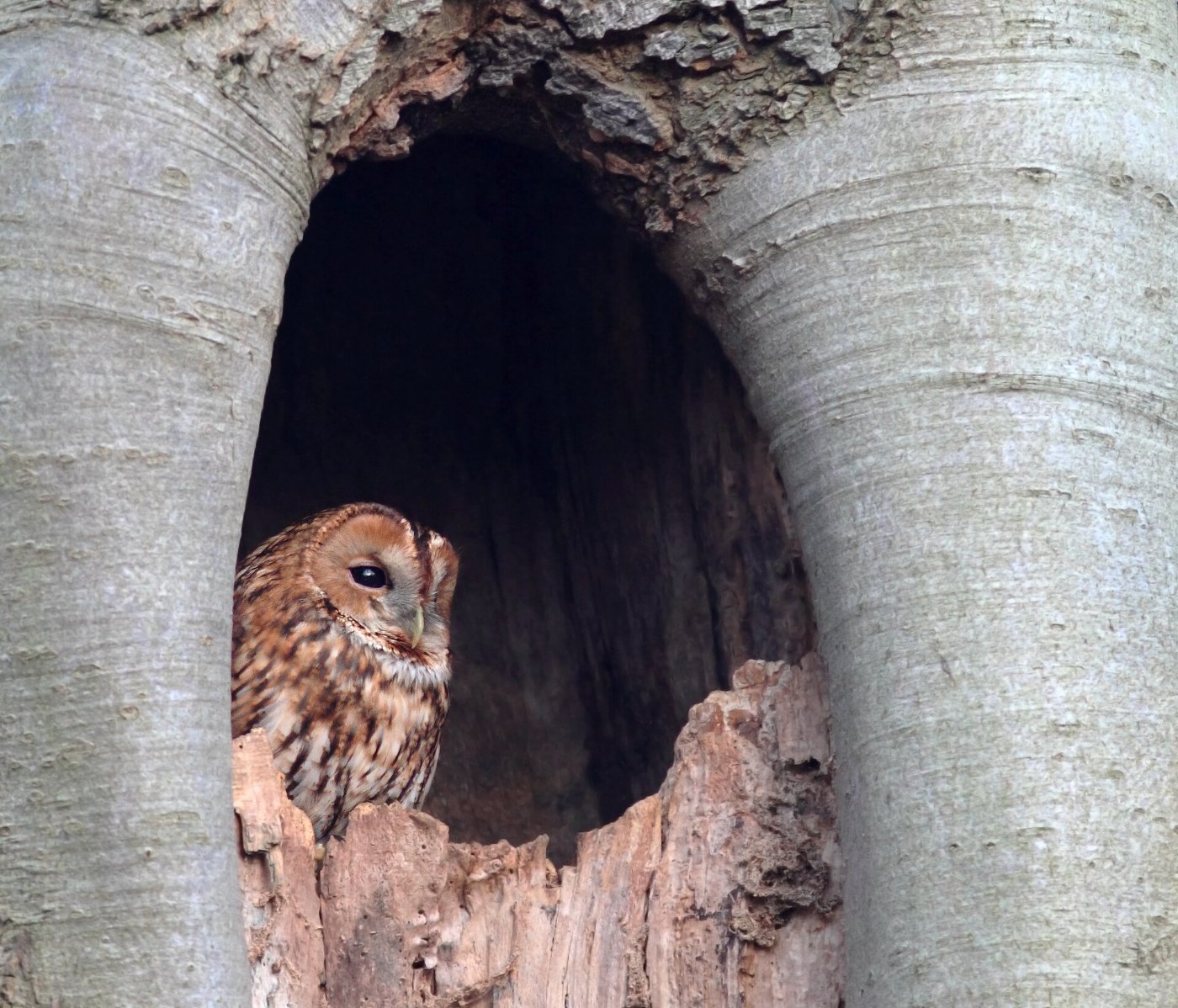
Featured photo: Tawny Owl in a cavity in an old beech — Bouke ten Cate, CC BY 4.0 (Wikimedia Commons).