
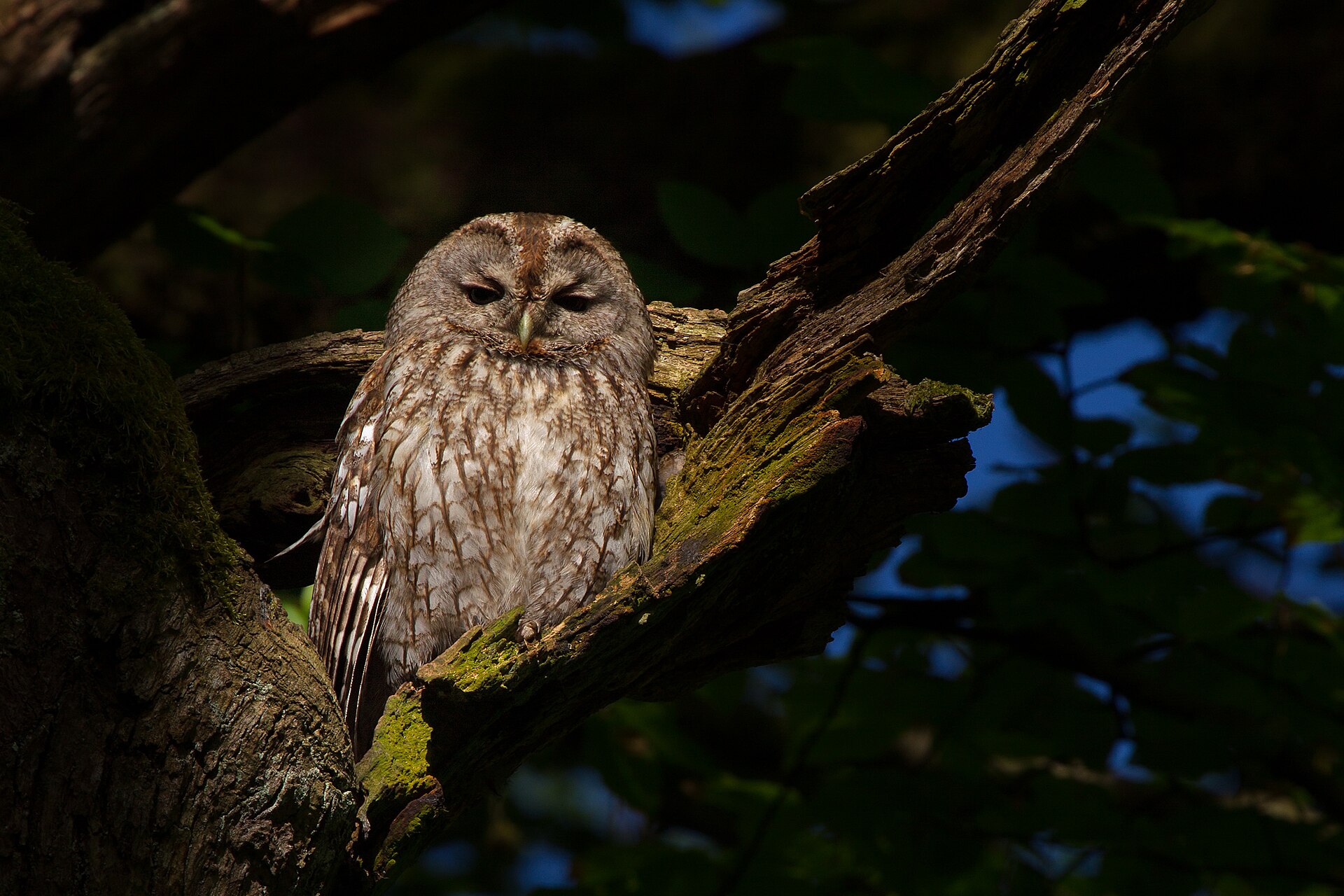
Tawny Owl
📷 Andreas Trepte, CC BY-SA 2.5 (Wikimedia Commons)

Where to see the Tawny Owl in the Netherlands

Strix aluco · Tawny Owl

With luck 🦅 Bird

Where and when do you see a Tawny Owl? With some luck you can see this species, all year round.

How do you recognise a Tawny Owl?

About the size of a crow, with a large round head without ear tufts, dark eyes and broad wings. It comes in three colour forms: grey, dark brown and rusty red. 40 to 42 centimetres long, wingspan 93 to 98 centimetres. By day it rests against a tree trunk, where it is almost impossible to pick out from the bark.

What can you confuse a Tawny Owl with?

Looks like: Long-eared Owl, Barn Owl

  • Long-eared Owl: smaller and slimmer, with long ear tufts and orange-yellow eyes; the Tawny Owl has a round head without tufts and dark eyes.
  • Barn Owl: a white heart-shaped face and an almost white underside.

What does a Tawny Owl sound like?

Recording: Guido Gerding, CC BY-SA 3.0, via Wikimedia Commons

Where do you see this species in the Netherlands?

Spread across the whole of the Netherlands as a fairly scarce breeding bird, present all year. The most recent national estimate comes to 5,200 to 6,400 breeding pairs (2018-2020).

How certain is this? verified chance per source presence reported Links that do not clear the bottom threshold are not published. How we decide that.
NDFF open data, 1.116 records 2016-2026
Nationwide period: Present all year. The calling season falls in autumn and late winter, when territories are marked out; the clutch is sometimes laid as early as February, usually in March.

📍 Nationaal Park De Meinweg

presence reported
NDFF open data, 459 records 2016-2026
Nationwide period: Present all year. The calling season falls in autumn and late winter, when territories are marked out; the clutch is sometimes laid as early as February, usually in March.
Staatsbosbeheer, which manages much of the Heuvelland
Nationwide period: Present all year. The calling season falls in autumn and late winter, when territories are marked out; the clutch is sometimes laid as early as February, usually in March.

📍 Naardermeer

presence reported
NDFF open data, 370 records 2016-2026
Nationwide period: Present all year. The calling season falls in autumn and late winter, when territories are marked out; the clutch is sometimes laid as early as February, usually in March.
NDFF open data, 338 records 2016-2026
Nationwide period: Present all year. The calling season falls in autumn and late winter, when territories are marked out; the clutch is sometimes laid as early as February, usually in March.

📍 Nationaal Park Utrechtse Heuvelrug

With luck chance per source
Utrechts Landschap
Nationwide period: Present all year. The calling season falls in autumn and late winter, when territories are marked out; the clutch is sometimes laid as early as February, usually in March.
NDFF open data, 224 records 2016-2026
Nationwide period: Present all year. The calling season falls in autumn and late winter, when territories are marked out; the clutch is sometimes laid as early as February, usually in March.

📍 Nationaal Park Veluwezoom

presence reported
NDFF open data, 221 records 2016-2026
Nationwide period: Present all year. The calling season falls in autumn and late winter, when territories are marked out; the clutch is sometimes laid as early as February, usually in March.
NDFF open data, 190 records 2016-2026
Nationwide period: Present all year. The calling season falls in autumn and late winter, when territories are marked out; the clutch is sometimes laid as early as February, usually in March.
NDFF open data, 177 records 2016-2026
Nationwide period: Present all year. The calling season falls in autumn and late winter, when territories are marked out; the clutch is sometimes laid as early as February, usually in March.

📍 Deelerwoude

presence reported
NDFF open data, 159 records 2016-2026
Nationwide period: Present all year. The calling season falls in autumn and late winter, when territories are marked out; the clutch is sometimes laid as early as February, usually in March.
NDFF open data, 132 records 2016-2026
Nationwide period: Present all year. The calling season falls in autumn and late winter, when territories are marked out; the clutch is sometimes laid as early as February, usually in March.

📍 Kroondomein Het Loo

presence reported
NDFF open data, 105 records 2016-2026
Nationwide period: Present all year. The calling season falls in autumn and late winter, when territories are marked out; the clutch is sometimes laid as early as February, usually in March.

📍 Planken Wambuis

presence reported
NDFF open data, 938 records 2016-2026
Nationwide period: Present all year. The calling season falls in autumn and late winter, when territories are marked out; the clutch is sometimes laid as early as February, usually in March.

📍 Blauwe Kamer

presence reported
NDFF open data
Nationwide period: Present all year. The calling season falls in autumn and late winter, when territories are marked out; the clutch is sometimes laid as early as February, usually in March.

📍 Oostelijke Vechtplassen

presence reported
NDFF open data
Nationwide period: Present all year. The calling season falls in autumn and late winter, when territories are marked out; the clutch is sometimes laid as early as February, usually in March.
NDFF open data
Nationwide period: Present all year. The calling season falls in autumn and late winter, when territories are marked out; the clutch is sometimes laid as early as February, usually in March.

📍 Wormer- en Jisperveld

presence reported
NDFF open data
Nationwide period: Present all year. The calling season falls in autumn and late winter, when territories are marked out; the clutch is sometimes laid as early as February, usually in March.

📍 Ilperveld

presence reported
NDFF open data
Nationwide period: Present all year. The calling season falls in autumn and late winter, when territories are marked out; the clutch is sometimes laid as early as February, usually in March.
NDFF open data
Nationwide period: Present all year. The calling season falls in autumn and late winter, when territories are marked out; the clutch is sometimes laid as early as February, usually in March.

📍 Landgoed Ennemaborg

presence reported
NDFF open data
Nationwide period: Present all year. The calling season falls in autumn and late winter, when territories are marked out; the clutch is sometimes laid as early as February, usually in March.

📍 Meijendel & Berkheide

presence reported
NDFF open data, 3.156 records 2016-2026
Nationwide period: Present all year. The calling season falls in autumn and late winter, when territories are marked out; the clutch is sometimes laid as early as February, usually in March.
NDFF open data, 645 records 2016-2026
Nationwide period: Present all year. The calling season falls in autumn and late winter, when territories are marked out; the clutch is sometimes laid as early as February, usually in March.

📍 De Maashorst

presence reported
NDFF open data, 593 records 2016-2026
Nationwide period: Present all year. The calling season falls in autumn and late winter, when territories are marked out; the clutch is sometimes laid as early as February, usually in March.
NDFF open data, 446 records 2016-2026
Nationwide period: Present all year. The calling season falls in autumn and late winter, when territories are marked out; the clutch is sometimes laid as early as February, usually in March.

📍 Loonse en Drunense Duinen

presence reported
NDFF open data, 775 records 2016-2026
Nationwide period: Present all year. The calling season falls in autumn and late winter, when territories are marked out; the clutch is sometimes laid as early as February, usually in March.

📍 Schoorlse Duinen

presence reported
NDFF open data, 1.639 records 2016-2026
Nationwide period: Present all year. The calling season falls in autumn and late winter, when territories are marked out; the clutch is sometimes laid as early as February, usually in March.

These links come straight from our database, with the chance, the source and the evidence level for each area.

When is the best time?

Green = present · orange = peak period. The bar is generated from our database.

Best period: Present all year. The calling season falls in autumn and late winter, when territories are marked out; the clutch is sometimes laid as early as February, usually in March.

Best time of day: At night. The hour after sunset gives you the best chance of hearing one; by day it sits hidden against a trunk, resting.

Recent sightings

👁️ Where has this species been seen recently?

Check the current sightings on Waarneming.nl. A useful addition to our own verified information.

Current sightings on Waarneming.nl →

How to improve your chances

  • Learn the calls first. You will hear most birds before you see them.
  • Go in the first hour after sunrise, when the song is at its peak and the wind is still down.
  • Use a hide or natural cover. Sitting still gets you more than walking closer.
  • Keep the sun behind you. Against the light you see a silhouette and no colour.

🎒 What you need for this

Binoculars; mostly your ears.

🌿 Watching responsibly

Keep your distance, stay on the paths, and never lure animals with food or sound. Leave as soon as an animal becomes uneasy.

Sources: Vogelbescherming Nederland (vogelgids) en Sovon Vogelonderzoek Nederland (soortpagina en telrichtlijn), geraadpleegd 12-08-2026; NDFF Flora & Fauna Verkenner (open data)
Status: Verified · Last checked: 2026-08-08