
Bird migration in September: what comes over and where to stand
Bird migration is at its busiest over your head in September, and you miss most of it. Not because you are too late, but because you look outside at the wrong moment. Migration is not a continuous stream you can switch on when it suits you — it is a series of bursts, and the weather decides when those fall.
So this article is not about which birds migrate. That is a list, and lists don’t help you if you have an hour tomorrow morning. It is about the question that does matter: what does today’s weather mean for what passes over tomorrow, and where do you go to stand? With the source attached, as always.
What leaves in September — and what you have just missed
The first wave has already gone. The insect eaters leave earliest, because they have to be away before the food runs out. The cuckoo is the most extreme: Vogelbescherming Nederland writes that by July all the adults are already on the way back. The Common Swift follows in early August — it is here so briefly you can barely call it a summer bird. The Willow Warbler goes in the same weeks, and that happens almost unnoticed: our half a million-odd breeding birds leave at night and in silence.
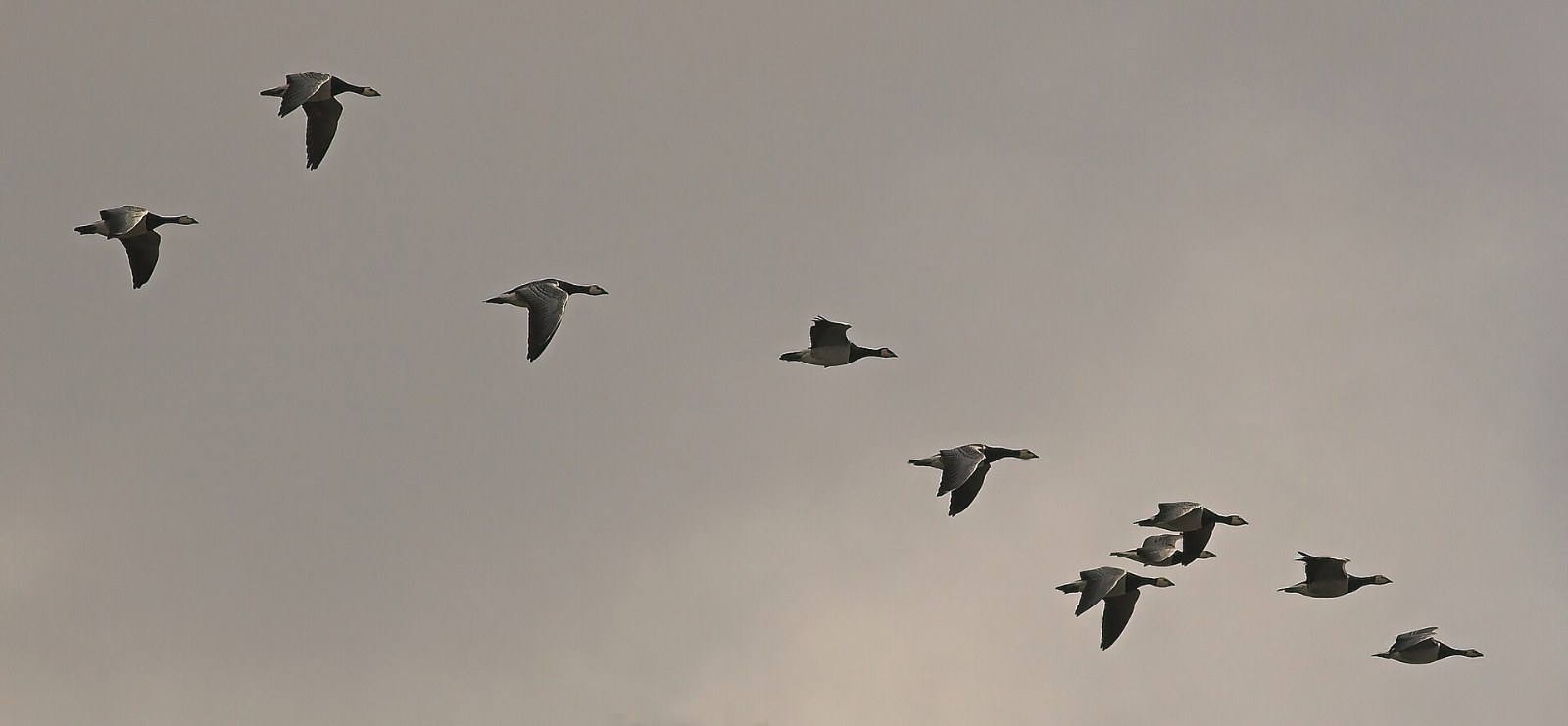
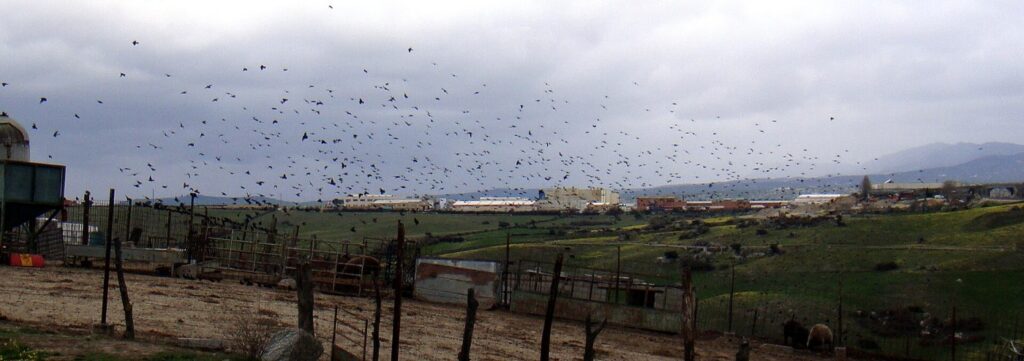
What still goes in September goes more visibly. Barn Swallows and House Martins gather on wires and above reedbeds before they leave. Waders shift south along the coast. And then, somewhere in the middle of the month, the part that really matters begins: the songbird migration out of Scandinavia and Russia that runs across our country and doesn’t peak until October.
Which is also the honest expectation this article comes with. September is the build-up. Bird migration peaks in October — those are Vogelbescherming’s own words. Anyone who starts watching in September is exactly in time to learn it before the climax arrives.
Where the Common Swift goes — and how fast
A moment on that swift that left in early August, because for no other Dutch migrant do we know it so precisely. Researchers fitted Dutch swifts with geolocators, minuscule light loggers, and the results are in Limosa.
What those twelve birds — good for sixteen complete routes — showed: the autumn migration of a Dutch Common Swift averages 8,914 kilometres and takes 45 days on average. That works out at 220 kilometres a day over the whole journey, but on the days when flying actually happens at 420 kilometres a day. In spring it is faster still: then they average 782 kilometres on travel days, and cover the same distance in thirty days.
And they don’t sit still in Africa. Besides the Congo basin they make long excursions to the south-east of the continent, as far as Malawi and Mozambique. The whole period away from the Netherlands averages 214 days — a good seven months. A Common Swift screaming over your street in June is really only passing through.
That is the scale this article is about. What crosses over your head in September is not an outing.
The weather decides what you see tomorrow
The most important sentence in this whole article comes from Vogelbescherming: “In bad weather most migrants wait before flying. If a period of clearer weather then sets in during autumn, preferably with a tailwind from the north or east, that is the signal for the birds to migrate (on).”
There are two things in that which together explain almost everything. First: migrants wait. In rain, fog and headwinds they stay put, sometimes for days, and pile up. Second: when it clears and the wind turns to north or east, they all leave at once. That is why migration comes in waves and not evenly.
For you that means something counter-intuitive. The day after a few days of foul weather is almost always better than the fourth fine day in a row. By that fourth day everyone has already gone.
Four weather types and what they produce
Below are the four situations that matter in practice, all traceable to what Vogelbescherming writes about wind and migration.
Clearing after bad weather, wind from north or east. This is the starting gun. Birds leave en masse. But note the downside: in sunny weather with a tailwind they fly high, and then you see little from the ground. Big volume, moderate viewing.
Clearing with a moderate south-westerly. A headwind, in other words. Vogelbescherming is explicit here: those “do however cause them to fly low and be more easily observed”. Fewer birds than in a north-easterly wave, but you do see them. For anyone watching rather than counting, this is often the finest day.
Easterly wind on the coast, cloudy with the occasional shower. Songbirds are then pushed towards the coastal strip and concentrate at places like Westkapelle and Breskens.
Strong north-westerly. That blows seabirds towards the coast. A completely different spectacle — more on that below.
Funnelling: why birds follow coasts and dykes
Migrants don’t fly over the country in an even blanket. The landscape steers them. The Trektellen manual puts it like this: “A ridge, a river, a valley or a woodland edge can set a course, change a course or even cause funnelling.”
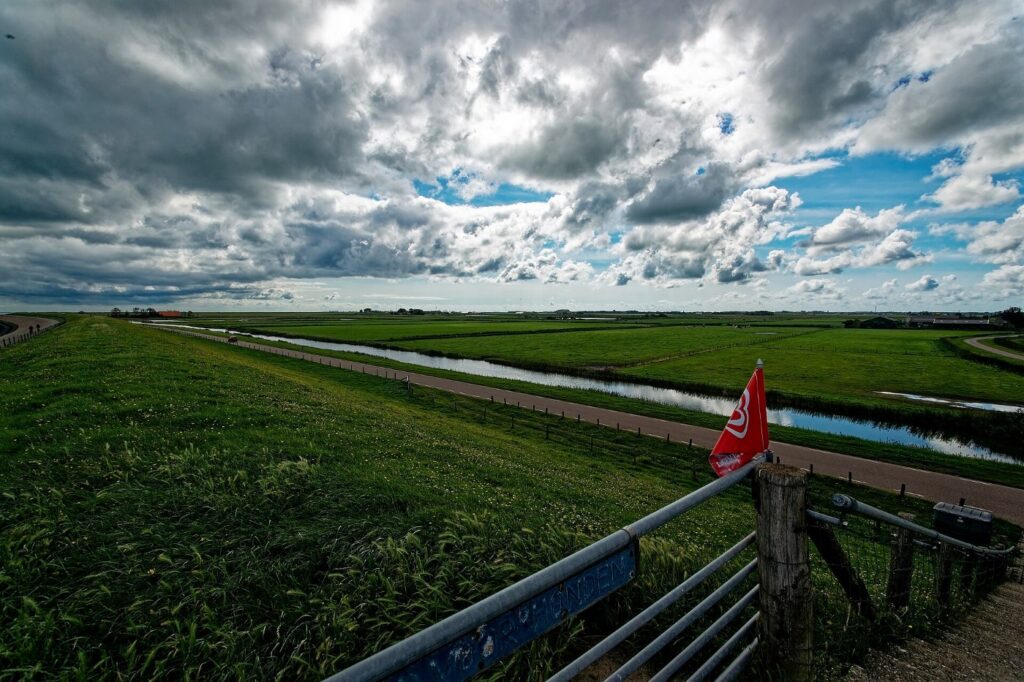
Funnelling is the word it turns on. Birds unwilling to cross a large body of water follow the coastline until there is a crossing. Birds meeting a ridge bend away along the flank. At those pivot points the stream becomes narrow and dense — and that is where the counting stations stand. It is no accident that the station on the IJmeerdijk faces due north and the one at Breskens due west: that is the direction the funnelling runs there.
The practical translation: a random meadow yields little, even on a good migration day. A dyke, a coastline, the high edge of a ridge or a narrow point between two waters yields many times as much on the same day.
The daily rhythm: who passes when
It isn’t evenly spread within a single day either. Trektellen summarises the daily window like this: migration can be observed “from half an hour before sunrise to half an hour after sunset”. Within that window each group has its own hour.
- Songbirds — early morning. The first hour and a half after sunrise belongs to chaffinches, Meadow Pipits, starlings and, later in autumn, Redwings. If you have one hour, put that hour here.
- Birds of prey — around the middle of the day. They wait until the sun has warmed the ground and there are thermals.
- Waders — towards evening. Northern Lapwings and European Golden Plovers get going late.
That also explains why two people at the same counting station on the same day have completely different stories. The morning man saw thousands of chaffinches, the afternoon man three buzzards.
Birds of prey: watch the thermals
Birds of prey migrate on soaring power. They use thermals — warm, rising air — to gain height without flapping, then glide to the next bubble. No thermals, no migration: on a grey, cool day they stay put.
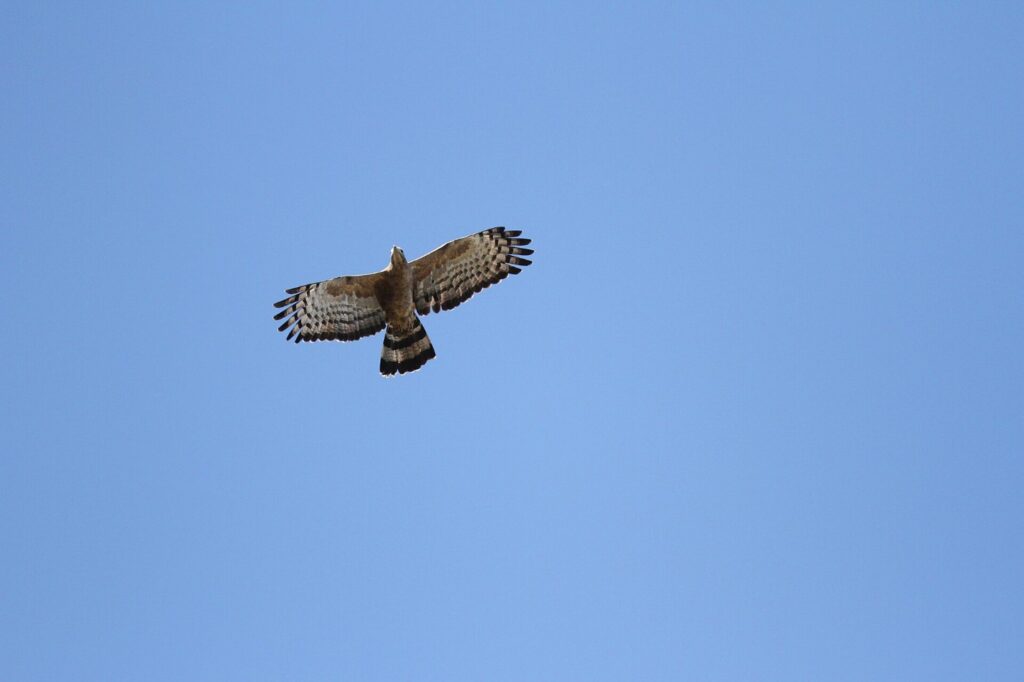
That makes their weather preference precisely the opposite of the songbirds’. For raptor migration you want a cloudless blue day, and then you go and stand high in the landscape. Vogelbescherming names the Veluwe and the Sallandse Heuvelrug as examples, and describes what comes past: “Dozens of buzzards, but also honey buzzards, red kite and osprey.”
The European Honey Buzzard is the species with the tightest window. Vogelbescherming gives its autumn migration as “late July to mid-September” — anyone still wanting to see it has about two weeks after this piece is published. The Common Buzzard and the Eurasian Sparrowhawk continue well into October, and the Osprey and the Red Kite sit in between.
Seabird migration: what a north-westerly brings in
Seabirds normally migrate far out from the coast, beyond the reach of a telescope from the beach. Until there is a firm north-westerly: that blows them in towards the coast. That is the moment when species like the Northern Gannet are suddenly visible from the dune front.
Seawatching is the most weather-dependent form of migration watching there is, and at the same time the least comfortable: you are by definition standing in the wind and usually in the rain. Take it as a bonus when the weather calls for it, not as a plan for a fixed Saturday.
Night migration: you never see most of it
An honest caveat belongs here. Many songbirds migrate at night, and Vogelbescherming simply states that as a result “only a small part is counted”. What passes a counting station by day is therefore not the migration — it is the visible remainder of it.
How massive that is, we have known since radar was turned on it. Researchers at the University of Amsterdam analysed six years of radar images over North Holland, up to a kilometre in altitude. On autumn nights an average of 43 birds per square kilometre flew there; by day in spring the average was four. More than ten times as many, then, and in the dark at that. Their conclusion is brief: “Nocturnal migration in autumn is the most massive.”
Another figure that sticks: the overwhelming majority of that migration takes place below two hundred metres. That is lower than most people think, and it is precisely why the siting of wind turbines is nowadays tested against this radar data.
You can also simply hear night migration. On a clear, windless night in October, out in the garden, the calls of passing Redwings are audible: a thin, high tseep out of the dark. It may well be the cheapest bird experience the Netherlands has to offer, and no binoculars are involved.
What October adds
September is the build-up, October the climax. Vogelbescherming lists what passes over then: “Starlings, meadow pipits, wheatears, hundreds or even thousands of chaffinches and redwings at once. But also geese, lapwings, golden plovers, buzzards.” Alongside those they name the species migration counters are really after: Ring Ouzels, Horned Larks, Red Crossbills, Grey Wagtails and Great Grey Shrikes.
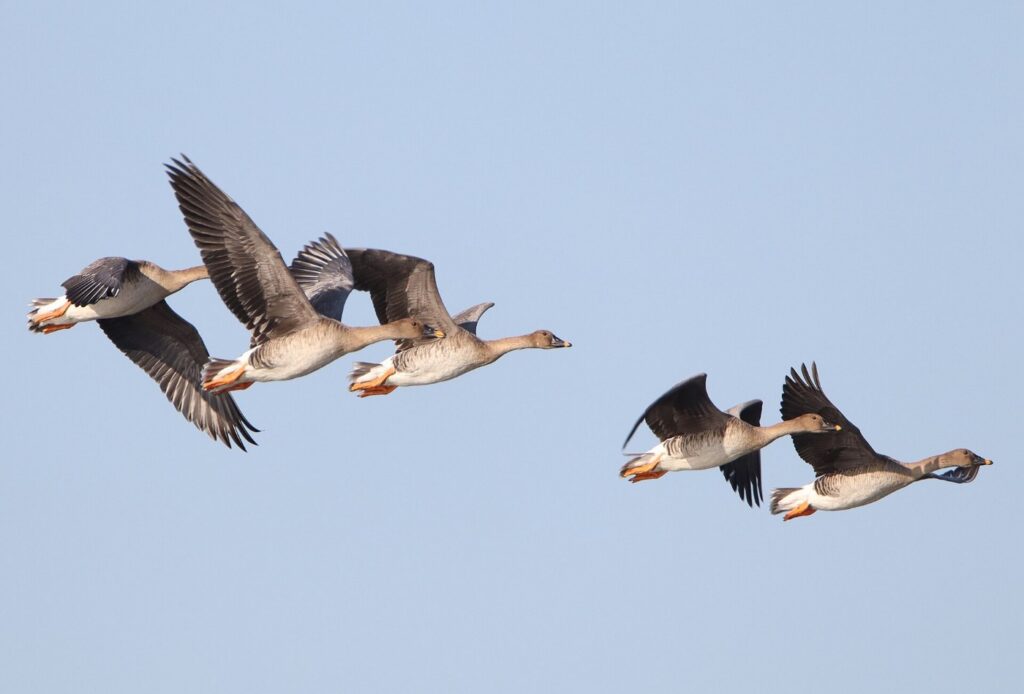
Two groups deserve separate mention, because they mark the end of the season rather than the beginning. The Common Cranes come from October onwards and continue into December; there is a separate article about them on this site, including the weather pattern to watch for. And the geese — Greater White-fronted Goose, Barnacle Goose, Greylag Goose — arrive with the first real cold and stay all winter. Start in September and you see the whole season pass by.
Where to go and stand
According to Vogelbescherming there are more than 175 favourable places on the map in the Netherlands to watch migration. A number of them are classics, and these are named: Westkapelle, Breskens, Stavoren, the dunes near The Hague, IJmuiden, the IJmeerdijk near Almere, Kamperhoek, the Elterberg and the Hamert.
Choose on the basis of the wind, not of distance:
- Easterly wind? Head for the coast. The songbirds are pushed that way.
- Cloudless and warm? Go high and inland, for the raptors on the thermals.
- Strong north-westerly? The dune front, and dress for it.
- Grey and windless? Stay home, or go to an area where there is something to see even without migration.
Areas on this site that lend themselves to that last category: the Oostvaardersplassen, the Lauwersmeer, the Fochteloërveen and the Marker Wadden deliver a full morning even on a mediocre migration day.
What to take, and what to look up first
A pair of binoculars is enough. A telescope only helps with seawatching and with high raptors, and isn’t needed for your first few outings. Take more clothing than you think you need: you are standing still, often on a dyke or a dune top, and you cool down faster than on a walk.
More important than the equipment is five minutes of preparation. On trektellen.nl bird study groups across the country report what is passing, by station and by day. Vogelbescherming points to it itself. Look there the evening before: if there’s nothing at the stations in your region, it isn’t you. If it’s running there, you know at once which way to go.
Euro Birdwatch: Saturday 3 October
Once a year the counting stations are expressly meant for visitors. Euro Birdwatch falls on the first Saturday of October — in 2026 that is 3 October. Volunteers count simultaneously across Europe; in the 2025 edition that was more than 27,000 counters in 34 countries, together good for nearly three million birds.
The Dutch figures immediately show how decisive the weather is. In 2024, 383,904 birds of 204 species were counted here, in 2023 more than 340,500 of 214 species — and in 2025 the counter stopped at 50,941 birds of 174 species. The same counters, the same stations, a factor of seven in difference. That is not measurement error; that is wind.
The Common Starling is almost always top. In 2024, 131,383 were counted.
For anyone doing it for the first time, this is the easiest way in: there is someone standing next to you who knows what is passing over and says so out loud. That teaches you more in one morning than a winter with a book.
How we know all this
Almost everything in this article rests on the work of volunteers. That is not a subordinate clause, it is the foundation.
Ringing. More than five hundred ringers affiliated with the Vogeltrekstation together ring around 300,000 birds a year in the Netherlands. Every ring carries a unique number, and every recovery — a bird caught, photographed or found dead elsewhere — yields one line on a map. Enough lines, and you have a migration route. That is how we know not only where they go, but also whether that is shifting.
Counting. At more than 175 places there are migration counters, often the same people at the same station, year after year. Because they count at fixed stations in fixed ways, their figures are comparable across decades. That makes trektellen.nl not a collection of loose observations but a measurement series.
Radar and loggers. To these, the past twenty years have added technology no individual could ever match: weather radars that make night migration visible, and geolocators weighing less than a gram that record one swift’s route for a whole year.
The three complement one another. The radar counts what passes but doesn’t know the species; the ring knows exactly which individual but says nothing about numbers; the counter sees the species and the number, but only by day and only when visible. So anyone claiming that “fewer and fewer birds are passing over” does have to say which of the three they mean.
Keeping your distance, during migration too
Migration watching is one of the few forms of wildlife watching where disturbance barely plays a part: the birds are en route, high up, and you are standing still in one place. Even so, one thing does apply. Staging birds — groups that have come down to rest and feed — must not be flushed. A group of geese or waders taking off because someone comes too close burns reserves meant for the next leg.
Keep to the path, keep your distance, and leave a resting group in peace. There is more about that on responsible wildlife watching.
Frequently asked questions
When does bird migration reach its peak?
In October. Vogelbescherming says it plainly: “Bird migration peaks in October.” September is the build-up, with the last summer birds leaving and the first northern songbirds arriving.
In what weather is it best to go and watch?
After a spell of bad weather, on the first day it clears. If you mainly want many birds, a tailwind from north or east is best — but then they fly high. If you want to see them well, a moderate south-westerly is more favourable: in a headwind they fly low.
What time should I be there?
For songbirds, from half an hour before sunrise; the first hour and a half is the busiest. Birds of prey come around the middle of the day, when there are thermals. Waders migrate towards evening.
What is funnelling?
The compression of the migration stream by the landscape. A coastline, a ridge, a river or a woodland edge forces birds off course, making them concentrate at particular points. Counting stations stand at exactly those points.
Do I need a telescope?
No. Binoculars are enough for songbird and raptor migration. A telescope is only needed for seawatching and for identifying high raptors.
Why do I see nothing while others count thousands of birds?
Three possible causes, in order of likelihood: wrong time of day, wrong place (no funnelling), or wrong weather. Check trektellen.nl the evening before to see what the stations in your region are reporting — then you know whether it’s the conditions or the location.
Can I hear night migration?
Yes. On a clear, windless night in October the calls of passing Redwings can be heard from the garden. By far the greatest part of night migration is never counted, precisely because it happens in the dark.
How far does a migrating bird fly in a day?
That varies greatly by species. For the Dutch Common Swift it is known most precisely: geolocator research showed an autumn migration averaging 8,914 kilometres, covered in 45 days — 220 kilometres a day over the whole journey, and 420 kilometres on the days when flying really happens.
How high do migrating birds fly?
Lower than most people think. Six years of radar research over North Holland shows that mass bird migration takes place below two hundred metres. With a tailwind and sunny weather they fly higher and you actually see less from the ground.
When is Euro Birdwatch?
On the first Saturday of October, so in 2026 on Saturday 3 October. Bird study groups all over the country count simultaneously that day, and counting stations are then ideal to join.
Am I disturbing migrating birds by going to watch?
Not birds passing over — those are high and en route. Staging groups, yes: they are resting and feeding for the next leg, and taking off costs them reserves. Keep your distance and keep to the path.
Further reading at the source
- Vogelbescherming — Vogeltrek: gejaagd door de wind: how wind and clearing skies determine when birds leave, why headwinds make them fly low, and what a north-westerly does to seabirds. In Dutch.
- Vogelbescherming — Vogeltrek naar climax: that migration peaks in October, which species pass over then, and the list of more than 175 favourable watching places. In Dutch.
- Vogelbescherming — Vogeltrek kijken: practical advice per weather type, the high points for raptor migration, and the pointer to trektellen.nl. In Dutch.
- Vogelbescherming — Vroege wegtrekkers sluipen het land uit: the departure periods of cuckoo, swift, willow warbler and icterine warbler. In Dutch.
- Vogelbescherming — Euro Birdwatch: the date, the participation figures per year and the numbers of birds and species counted. In Dutch.
- Klaassen et al. in Limosa (2014) — Trekroutes en overwinteringsgebieden van Nederlandse gierzwaluwen (pdf): the geolocator data from twelve birds, with distances, speeds and wintering areas. In Dutch.
- University of Amsterdam (2024) — Radars laten vogeltrek en risico op aanvaring met windturbines zien: six years of radar research over North Holland, with densities per square kilometre and flight altitude. In Dutch.
- Vogeltrekstation — Wat we doen: more than 500 ringers and around 300,000 birds ringed a year in the Netherlands. In Dutch.
- Trektellen — Handleiding voor het tellen van zichtbare landtrek (pdf): the daily window, the definition of funnelling and the viewing directions of the counting stations. In Dutch.
- Trektellen.nl: the daily counts per station — the place to look the evening before.
- When do the cranes pass over? — the sequel to this article, for October through December.
- All species — from Common Swift to Great Grey Shrike, with identification, sound and where they occur.
- All areas — where to go in the Netherlands, with the best period for each area.
- Wildlife calendar — what there is to see each month.
- Responsible wildlife watching — keeping your distance, recognising disturbance and what you’d better not do.