
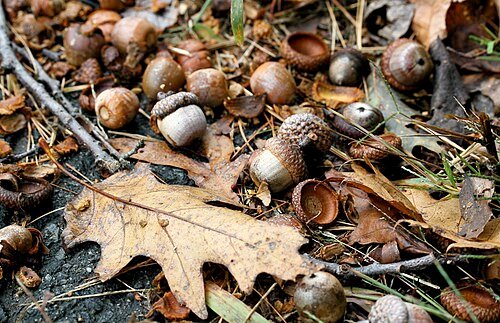
A mast year in the wood: why an autumn full of acorns decides what you see
If you walk through an oak wood in October and it crunches under every step, you are standing in a mast year. That is a year in which oaks and beeches fruit en masse, and it is far more than a pleasant autumn phenomenon: a mast year determines for months ahead which animals you see in the wood, how many there are, and which predators follow them. The acorns falling now are the reason you will hear more owls next spring.
Below is how that works, with the figures that genuinely exist for the Netherlands — and with what you can see of it yourself, from the jay that starts hauling in September to the bramblings scratching under the beeches in November.
What a mast year is exactly
“Mast” is the old word for the fruits of woodland trees: acorns, beechnuts, chestnuts. Pigs used to be driven into the wood to eat them, and that is where the term comes from. A mast year is a year in which those trees fruit exceptionally heavily — and they don’t do it individually but more or less simultaneously, across large areas.
The difference between a good and a bad year is enormous. On the Veluwe the yield has been estimated for decades, and those estimates run from almost nothing to well over five million kilos. For a mouse, a jay or a wild boar that is the difference between a winter you get through easily and a winter you may not survive.
How much falls: the Veluwe mast survey
The Netherlands has one place where this is systematically recorded: the Veluwe. Researchers from Wageningen University & Research and the Faunabeheereenheid Gelderland carry out an annual mast survey there, the results of which De Natuurkalender publishes. The method is simple: “Spread across the Veluwe, after flowering, counts are made of how much fruit is hanging on the trees.”
The most recently published survey is that of 27 September 2025. Arnold van Vliet (WUR) and Gerrit Jan Spek (FBE Gelderland) then arrived at “an estimated 5.4 million kilos of acorns and beechnuts”, of which some 4.7 million kilos were acorns from native oaks. For the beeches the picture was different: only 27 per cent of the trees flowered, but it was “the thirteenth year in a row” that beechnuts appeared at all.
For comparison: in 2022 the same researchers arrived at 4.4 million kilos of acorns and 1.3 million kilos of beechnuts, with the note that “the drought also had a depressing effect on the acorn yield”. This year’s survey had not yet appeared at the time of writing; it usually comes at the end of September. So whether 2026 becomes a mast year you’ll read shortly at Nature Today — or you look at the ground yourself, because you can see it there too.
Why there isn’t a mast year every year — and when the acorns fall
A tree that fruits pays dearly for it. De Natuurkalender summed it up like this: “It costs a tree a lot of energy to produce acorns. That is why trees produce very little or even no fruit in the year after a mast year.” So a peak year is often followed by a lean one, and only when the reserves are back up can it happen again.
The weather plays a part as well. For the beech, plenty of pollen in spring can translate into plenty of nuts in autumn, and “a warm, dry summer in the preceding year also gives a good chance of a good beech mast year”. For oaks in dry areas the yield depends mainly on the amount of water.
The timing of the fall is no accident either. From De Natuurkalender’s long series comes a strikingly firm relationship: “The temperatures in the months March to August determine more than 80 per cent of the moment at which acorns fall from the trees.” Warm summer, early fall. In 2025 that was clearly noticeable — because of an extremely warm spring and summer it was “one of the earliest years ever”. So you needn’t wait until late October: by mid-September the ground under the oaks can already be strewn.
The jay: thousands of acorns per bird
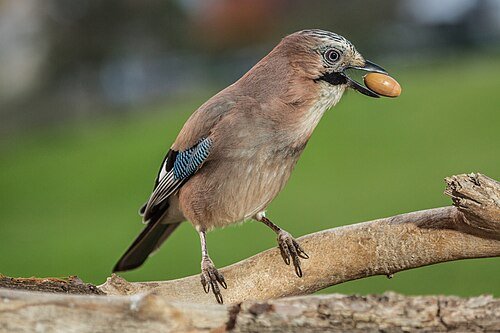
The first on the scene for the acorns is almost always the Eurasian Jay. Vogelbescherming Nederland puts it bluntly: “As early as September the jay starts its seasonal labour: collecting acorns. Masses of acorns, each jay some 5,000.” Per trip, “3 to 5 go into the throat pouch, the largest stays in the bill”.
Those acorns are not eaten but hidden, one by one, in the ground — not a larder in one place but thousands of small caches, spread over a large area, for which “flights of kilometres are sometimes made”. And it manages to find them again: “Even under a layer of snow the jay usually manages to find the acorns again.”
There is a detail here you can check in the wood yourself. A jay that notices it is being watched no longer trusts the spot: “If a jay knows it is being watched while hiding, it comes back later to hide the acorn somewhere else.” So stay seated and don’t move, or you are watching a relocation instead of a store being built.
What it forgets becomes woodland. According to Vogelbescherming, if it gets a little forgetful in spring, “the seedlings put it on the track of the hiding place”, and the sapling it leaves can grow into a mature oak. That makes the jay one of the most important planters of oak woodland in the Netherlands. Finding one is not difficult: its best-known call is “a loud, hoarse screech”, and in September and October it flies strikingly often in a straight line across clearings, with an acorn in its bill.
The red squirrel: hiding, and not finding some of it again
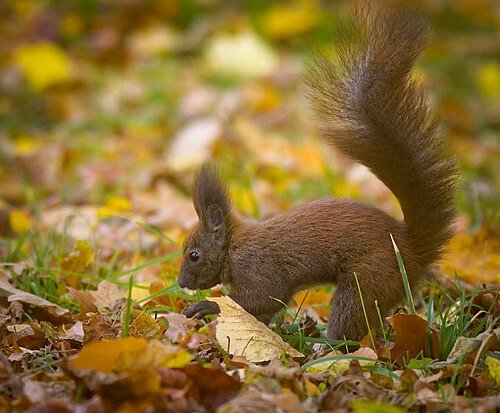
The red squirrel does something similar, but less methodically. The Zoogdiervereniging — split up as of this year, see the note at the bottom — described it like this: “For squirrels the autumn months are very busy”, because on top of all their usual activities they “now also have to collect food to get through the winter”.
They bring in more than just nuts: “Besides nuts they also collect pine cones and certain kinds of fungi. The squirrels hide the fungi in a dry place above ground; the rest shallowly in the soil or in the litter layer. They put one to five items together at a time.”
Two things from that matter for spotters. First: “Squirrels do not hibernate” — you can see them all year, even in frost. Second, they work with “a combination of memory and smell, but normally they fail to find some of it again”. So the squirrel plants woodland too, albeit by accident.
October and November are the months when you see it on the ground most often, and the first hour after sunrise is the best moment. Pay just as much attention to what it leaves behind: gnawed pine cones and broken-open nutshells on a stump are a more reliable sign than a glimpse of red in a tree. In a few areas you may also come across the grey squirrel, a non-native that has no established foothold in the Netherlands.
Wild boar, red deer and roe deer: mast as winter feed
For the wild boar, mast is not a side dish but the main course of autumn. Researcher Sip van Wieren (WUR) wrote a piece about it in 2021 with exactly the right title: When the acorns fall, the wild boar come into view on the Veluwe again.
His conclusion about the population is remarkable: “When there is little mast, a great deal of mortality occurs (especially in the younger age classes) which can be rapidly compensated by large litters with a high survival chance during good mast years.” And his conclusion about that is equally clear: “It appears that the amount of mast is a more important factor in determining the dynamics of the boar population than culling.” So anyone wanting to understand why there are far more boar in one year than another needs to look at the trees.
At De Hoge Veluwe National Park, where some fifty boar live, the park itself points to the signs: “You come across the churned-up ground everywhere in the Park, and especially in autumn, when the boar are busy building up a fat reserve for the winter.” That churned-up soil is often all you see — and at the same time the best indication of where to be the next morning.
The large grazers benefit too. The mast survey notes explicitly that in a good mast year “plenty of food is available for large game, such as wild boar, red deer, cattle and roe deer”, and that this reduces damage to the roots of young trees. For the red deer it coincides with the end of the rut: after weeks of roaring the stags have lost a lot of weight and badly need the following weeks to recover — see the article on seeing red deer and the rut for the timing per area. For the fallow deer it is slightly different: in October it is right in the middle of the fallow deer rut. And the roe deer, which you can see well on the Veluwezoom, simply eats along with whatever is lying there.
Mice and voles, and the owls that follow
This is the part of the story you don’t see, and that matters most. Mice and voles respond at lightning speed to a good mast year, and that effect runs on far into the following year.
On 13 June 2026 Sovon Vogelonderzoek Nederland, STONE Steenuilenoverleg Nederland and Vogelbescherming Nederland jointly published a report that 2026 is an excellent year for mice and voles. The explanation came straight after: “Since plenty of acorns and beechnuts were available last year, these mice have had enough to eat.” In the wood that mainly concerns the wood mouse and the bank vole. In the south-east Achterhoek it was reported that “the peak year 2019 is being surpassed”. That closes the chain: the mast of 2025 is in the voles of 2026.
Where there are many rodents, rodent eaters come. That same report noted that the number of breeding Short-eared Owls looks like going “well over a hundred breeding attempts”, against a previous record of 75 pairs in 2019. Kestrels, Little Owls, Barn Owls and White Storks responded too. How strong that dependence is, Vogelbescherming shows with a figure from a kestrel box: of the 680 rodents brought to it, 567 were voles. The list of rodent eaters is long — Barn Owl, Tawny Owl, Little Owl, Long-eared Owl, Common Kestrel, Common Buzzard and Hen Harrier are on it — and the red fox and the pine marten notice the difference as well.
For anyone wanting to get into the wood in October the Tawny Owl is the most interesting, for a reason few people know. In a short contribution in Limosa, Teixeira and Surminski (2018) established that “calling activity of males and females is highest from September to January (low from May to July)”. They do it “above all in fine, calm weather at all hours of the night”. The official survey period runs from January to July and thus falls, the authors write, precisely in “the trough of calling activity”. Translated practically: a windless, clear October evening in old woodland is the best moment of the year to hear a Tawny Owl. The Leuvenumse Bossen, the Deelerwoud and Planken Wambuis are suitable for that. It holds for more woodland birds, incidentally, that in this season you hear them before you see them — see recognising woodland birds by sound.
Bramblings under the beeches
Beechnuts draw a completely different crowd than acorns. The species to watch for is the Brambling, the northern cousin of the Common Chaffinch. Vogelbescherming: “In October and November large groups of bramblings pass through the Netherlands”, and “they come to the ground under trees with plenty of seed. Most favoured of all is the beech.” If there is mast, it stays in the wood; in a lean beech year it shifts to the bird table — see feeding garden birds.
The numbers can become absurd. In beech woods “roosts of several million bramblings” have sometimes been described, and in a Belgian garden 30,000 bramblings were even counted in 2011. But it isn’t like that every year: “The number of garden bramblings varies quite a lot from year to year. Some winters they barely show themselves, in other years you trip over them.” What it comes down to is where the beeches have fruited that year — and that may just as easily be Germany or Denmark as the Netherlands.
You identify them most easily by sound: “They call a nasal kyeep, especially when they want to land or are already on the ground.” Look for a group of finches scratching low over the woodland floor that shows an orange breast and a white rump when it takes off. In the same beech wood, have a look for the Hawfinch too — a species of the same places, and with its heavy bill not to be confused with a brambling.
How to tell for yourself whether it’s a mast year
You don’t need a monitoring network to make a good assessment. Watch for four things:
- The ground under the oak. If it crunches under every step, it’s on. If there’s a handful per square metre, it’s a middling year.
- Cups without acorns. Plenty of empty cups and gnawed acorns indicate that a lot is also being taken away.
- Jay traffic. Straight, purposeful flights across clearings, several per quarter of an hour, mean there is something to be had.
- Churned-up soil. Fresh rooting under the oaks, especially in the morning, shows that the boar have drawn the same conclusion.
Above all, look up before it falls: in August the acorns already hang visibly in the crown. That is exactly what the researchers on the Veluwe do.
Where to look in October
For the complete story — oaks, beeches, jays, squirrels and boar — the Veluwe is the obvious choice. De Hoge Veluwe and Veluwezoom National Park both have old oak avenues and beech woodland. Kroondomein Het Loo is precisely not an option in this period: it is closed annually from 15 September through 25 December.
Outside the Veluwe, old estate woodlands are often better than large nature reserves, simply because that is where the thickest beeches stand: the Utrechtse Heuvelrug, the Dwingelderveld, the Drents-Friese Wold and Zuid-Kennemerland. The best time is the same everywhere: the first hour after sunrise, when squirrels are active, jays are working hardest and the night’s rooting is still fresh.
What a mast year means for the wood itself
What a mast year does for the trees is, in the Netherlands, most clearly described from the animal side. The mast survey points out that a good year reduces damage to the roots of young trees, simply because the animals then have enough else to eat. And jay and squirrel do work on top of that which no human can match: they bury seeds in the soil and forget some of them — for the jay, the seedlings even put it “on the track of the hiding place” in spring, and the sapling that remains can, according to Vogelbescherming, grow into a mature oak.
So a mast year is both a feast and an investment. What you hear crunching under your shoes in October is the beginning of the wood of fifty years from now.
Watching responsibly in the mast season
Three things to bear in mind, in addition to what is on responsible wildlife watching.
Leave the acorns where they are. What you take away, a mouse, a jay or a boar can no longer eat — and the mast survey shows how much those animals depend on it in autumn. If you do want to gather acorns, do it outside nature reserves and first check what the site manager says about it; the rules differ by area.
Keep your distance from boar with piglets. In De Hoge Veluwe’s words: “Sows with young piglets normally take flight when they detect people, but in some cases they can behave aggressively. So always keep your distance and never stand between the mother boar and her piglets.” That goes double in a mast year, when they forage in a concentrated way under the oaks and you may therefore approach them more closely than you intended.
Check for ticks. The RIVM reports that ticks are “most active from March through October, with a peak in the summer months”, and that there are “well over a million tick bites in people” in the Netherlands every year. The advice: “So check your body and your clothing for ticks and tick bites immediately after you have been out in green space.” Ticks become active above seven degrees, so a mild October day counts too.
Frequently asked questions
What is a mast year?
A year in which woodland trees such as oak and beech fruit exceptionally heavily — acorns and beechnuts — and do so more or less simultaneously across a large area. “Mast” is the old word for those woodland fruits.
How often does a mast year occur?
There is no fixed cycle. A peak year exhausts the tree, which is why there is often very little fruit the year after; besides that, weather and water availability determine a great deal. On the Veluwe the yield varies strongly, with outliers above five million kilos.
Is 2026 a mast year?
That was not yet known at the time of writing. The annual mast survey on the Veluwe usually appears at the end of September via Nature Today. In 2025 it concerned an estimated 5.4 million kilos of acorns and beechnuts.
Why do I see far more mice and owls in some years?
Because wood mice and bank voles benefit from a good mast year and peak in numbers the year after. In June 2026 Sovon, STONE and Vogelbescherming pointed explicitly to the link with the many acorns and beechnuts of the previous year, and at the same time reported a record number of breeding Short-eared Owls.
When do the acorns fall?
Usually from mid-September into October, but the moment shifts with the weather: the temperatures from March through August determine more than eighty per cent of when acorns fall. After a warm summer it can start as early as mid-September.
Where is the best place to watch for squirrels in autumn?
In old woodland with oaks, beeches and conifers, in the first hour after sunrise. Pay just as much attention to signs — gnawed pine cones and broken-open shells on a stump — as to the animal itself.
Does a jay really hide thousands of acorns?
According to Vogelbescherming Nederland each jay collects “some 5,000” per autumn, hiding them one by one in the ground. What it fails to find again can grow into an oak.
Further reading at the source
- Nature Today — Ruim vijf miljoen kilo eikels en beukennootjes op de Veluwe vallen zeer vroeg (Arnold van Vliet, WUR & Gerrit Jan Spek, FBE Gelderland, 27 September 2025). In Dutch.
- Nature Today — Na slecht mastjaar weer veel eikels en beukennootjes (FBE Gelderland & WUR, 19 September 2022). In Dutch.
- Nature Today — Tijd voor rijpe eikels, maar hoeveel? (De Natuurkalender, 7 September 2012). In Dutch.
- Nature Today — Het is een uitstekend jaar voor muizen en vogels profiteren daarvan (Sovon, STONE and Vogelbescherming, 13 June 2026). In Dutch.
- Nature Today — Eekhoorns druk met het aanleggen van voedselvoorraden (Vilmar Dijkstra, Zoogdiervereniging, 10 October 2019). In Dutch.
- Vogelbescherming Nederland — De flamboyante gaai (26 September 2024). In Dutch.
- Vogelbescherming Nederland — bird guide: gaai. In Dutch.
- Vogelbescherming Nederland — Duizenden kepen onder de beuken (Robert Kwak, 30 October 2018). In Dutch.
- Vogelbescherming Nederland — Muizen en muizeneters (19 February 2026). In Dutch.
- Sip van Wieren (WUR) — Als de eikels vallen, dan komen ook de wilde zwijnen op de Veluwe weer in beeld (Jacht & Beheer 179, November 2021). In Dutch.
- Teixeira & Surminski — Roepactiviteit van bosuilen (Limosa, 2018, via Sovon). In Dutch.
- Het Nationale Park De Hoge Veluwe — Wild zwijn. In Dutch.
- RIVM — Tekenbeten en lyme. In Dutch.
- Eurasian Jay — the bird that opens the mast season
- Feeding garden birds — what to put out and what not to, and why the Brambling skips the bird table in a good beech year.
- Red squirrel — where and when you see it
- Wild boar — signs, behaviour and areas
- Tawny Owl and Brambling — two species that stand out in October
- When is the fallow deer rut — and where do you see it best?
- Where can you see red deer in the Netherlands — and when is the rut?
- Recognising woodland birds by sound: five species you hear but don’t see
- Bird migration in September: what is flying over the Netherlands now
- Which woodpecker is this? — identification by drumming and call
- Responsible wildlife watching — distance, disturbance and what we don’t publish
Note on the sources: as of 5 July 2026 the Zoogdiervereniging has been split into two independent organisations — Zoogdierbescherming Nederland for protection, and Zodion Zoogdieronderzoek Nederland for monitoring and research. Older items from the Zoogdiervereniging, such as the 2019 squirrel report, can now be found via Zodion.
Featured photo: fallen acorns on the woodland floor — Muffet, CC BY 2.0 (Wikimedia Commons).