Where to see the Little Owl in the Netherlands
With luck 🦅 Bird Sensitive species · R3
🛡️ No exact locations, on purpose
This is a sensitive species. We deliberately show no nest sites, and during the breeding season (March to July) we are extra careful about exact spots. Why we do that.
Where and when do you see a Little Owl? With some luck you can see this species, all year round.
How do you recognise a Little Owl?
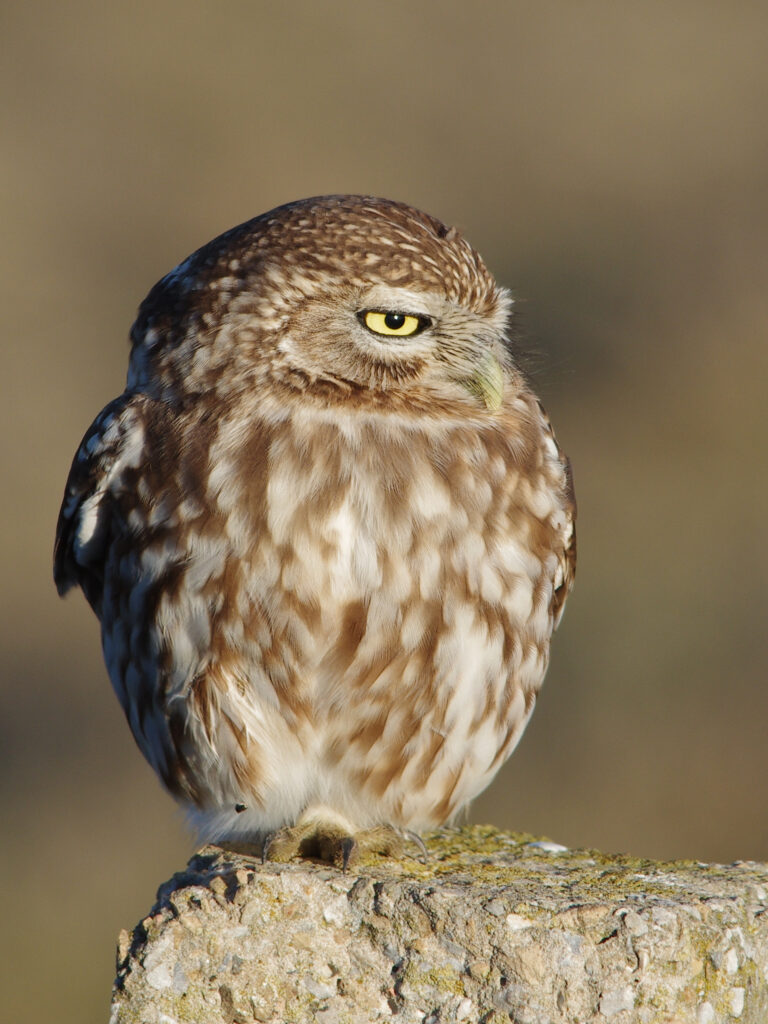
Barely bigger than a blackbird, but looking bulkier through its puffed-up feathers. Brown to greyish brown with white streaks, with bright yellow eyes under pale eyebrows that give it a stern look. Length 21 to 23 centimetres, wingspan 54 to 58 centimetres.
What can you confuse a Little Owl with?
Looks like: Barn Owl
- Barn Owl: larger, with a white heart-shaped facial disc and an almost white underside.
What does a Little Owl sound like?
Recording: Joost van Bruggen, CC BY-SA 4.0, via Wikimedia Commons
Where do you see this species in the Netherlands?
Small-scale farmland, especially in the east and south of the country. With 8,000 to 9,500 breeding pairs (2018 to 2020) it is our most numerous owl.
📍 Nationaal Park De Biesbosch
Rare chance per sourceThese links come straight from our database, with the chance, the source and the evidence level for each area.
When is the best time?
Green = present · orange = peak period. The bar is generated from our database.
Best period: Present all year. The breeding season runs from mid-April to mid-May, with sometimes a second clutch into mid-June. In spring the display call is heard most often.
Best time of day: Mainly dusk, but it is the least nocturnal of our owls: by day it regularly sits resting in full view on a post, fence or roof edge.
Recent sightings
👁️ Where has this species been seen recently?
Check the current sightings on Waarneming.nl. A useful addition to our own verified information.
Current sightings on Waarneming.nl →
Note: for sensitive species the source already blurs or withholds sightings. We do not reproduce exact locations.
How to improve your chances
- Learn the calls first. You will hear most birds before you see them.
- Go in the first hour after sunrise, when the song is at its peak and the wind is still down.
- Use a hide or natural cover. Sitting still gets you more than walking closer.
- Keep the sun behind you. Against the light you see a silhouette and no colour.
🎒 What you need for this
Binoculars; never stake out a breeding site
🌿 Watching responsibly
Keep your distance, stay on the paths, and never lure animals with food or sound. Leave as soon as an animal becomes uneasy. This is a sensitive species. We deliberately show no nest sites, and during the breeding season (March to July) we are extra careful about exact spots.
Status: Verified · Last checked: 2026-08-08
More photos