
Wild animals are not equally visible all year. This calendar shows, month by month, which species are worth going out for in the Netherlands, in order of how good your chances are.
Wildlife calendar
What can you see in December?
Wild animals are not equally visible all year. This calendar shows, month by month, which species are actually worth going out for.
December
3 of 66 speciesIn order of how good your chances are.
December is the quietest month to be out in the field, and at the same time the month with the highest numbers. The light is short and low, most people stay indoors, and the water is full of birds spending the winter here. There is little point in walking far; there is every point in standing in one good place and waiting.
The water is where it happens
The geese that arrived in November are now here in full force: Greater White-fronted Geese and Barnacle Geese in the polders, with sometimes a Tundra Swan or Whooper Swan among them. On open water sit the winter ducks that December is all about: the Smew, the Goosander and the Common Goldeneye. If it freezes for a few days they concentrate on the last ice-free patches and you get surprisingly close.
The White-tailed Eagle is a winter animal
The White-tailed Eagle is at its most visible in December, for a simple reason: where thousands of geese and ducks are gathered, it is too. You don't have to look for it — you look for the panic. If a whole field of geese goes up at once, look at what is coming over low. The same goes for the Great Grey Shrike on open heath: it always sits on the highest point available.
The migration isn't finished
Common Cranes keep passing into December, though the peak is over by then. And the Short-eared Owl, rare in summer, can actually be found in winter: Sovon estimates the number of winterers in the Netherlands at one hundred to five hundred birds, mainly in open dunes, salt marshes and polders. Unlike the other owls it hunts in daylight, so this is the owl you can simply see on a winter walk.
Owls just carry on calling
That it is cold does not mean it is silent. Sovon writes that Tawny Owls still call regularly in the middle of winter, and the dataset in Limosa shows the calling peak running on into January. A clear, windless December evening in old deciduous woodland is therefore just as good as an October one — see hearing owls in autumn.
On the Wadden the white pups are born
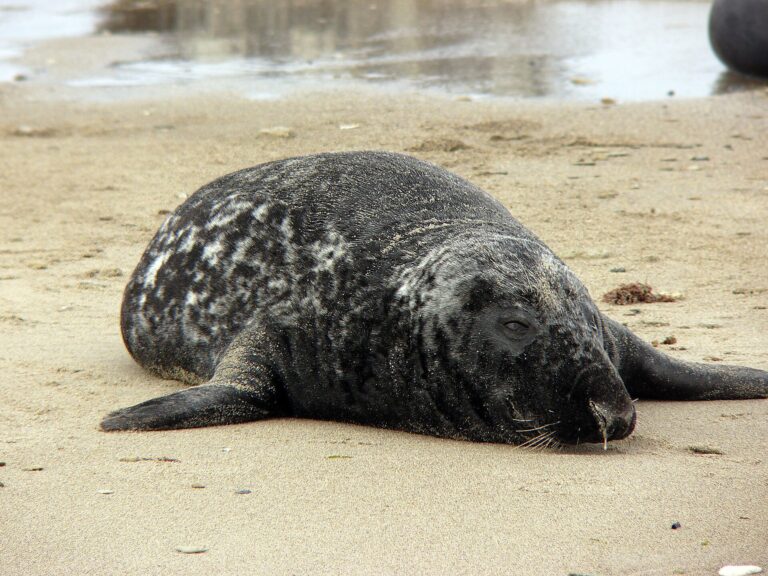
December falls in the middle of the pupping season of the grey seal: between mid-November and mid-January the white pups come into the world on the sandbanks and quiet beaches. That coat is not waterproof, so for the first weeks they stay on dry land. Watching is fine, but at a distance and preferably from the water — where and how is in seal watching on the Wadden Sea. If a pup is lying alone on the beach, stay away and phone: a pup lying alone is usually not orphaned.
Signs become readable
December is the best month of the year for tracks and signs. Wet ground, frost and the occasional snow hold prints you never see in summer. Under an owl's regular roost lie pellets; along a bank stand the prints of a red fox or a European badger. If you find a handful of fresh pellets together, make a note and don't go and stand under it again.
Where to go
For geese, White-tailed Eagle and winter ducks: the Oostvaardersplassen, Lauwersmeer, the Biesbosch and the Gelderse Poort. For Short-eared Owl and Great Grey Shrike head for open terrain: Dwingelderveld or the dunes of Zuid-Kennemerland. The shrike is also on the heaths of the Veluwezoom, where the leaves are off and the red deer herds gather. And watch the date: Kroondomein Het Loo is closed through 25 December and opens again after that. And this is the last month for the red deer in the open field: the walking route to the De Zeearend hide closes on 1 January until mid-May — see Red deer in the Oostvaardersplassen.
Practicalities
It gets dark around half past four, so an evening outing literally fits in after work. Dress for standing still, not for walking: gloves you can hold binoculars in, and something warm underfoot if you stand in one place for more than half an hour. How we handle distance and disturbance is on responsible wildlife watching. And December is the month when the feeding station makes the difference: what to put out, where to put it and how to keep it clean is in feeding garden birds.
- All species in English
- Areas in English
- Wildlife in the Netherlands, the English starting point.