

Feeding garden birds: what works, what doesn’t, and when to pay attention
Somewhere in your garden or on your balcony there is a feeder full of sunflower hearts, or you are thinking of hanging one up. And then comes the question almost everyone asks and almost nobody answers: is this actually all right? Are you helping them, or making them dependent? Feeding garden birds is the most everyday piece of nature management in the country, and at the same time the part about which the most nonsense circulates.
The short answer: yes, you can, and all year round. But not everything on the shop shelf is suitable, where you put it matters more than the food itself, and the most important part of the whole story is something almost no feeding page writes about: keeping it clean. Below is what works, what doesn’t, where it stops, and which birds you can expect in which season.
Is it all right to feed garden birds? Yes — and that is a change
Vogelbescherming Nederland is unambiguous about this. On its page about when to feed what, it says it in five words: “Garden birds can be fed all year round.” Its official position on feeding states that the organisation takes a positive view of “feeding (garden) birds in moderation, outside and during the breeding season”, and that feeding is an accessible form of experiencing nature.
That is a shift from what many people grew up with. Traditionally people fed in winter and not otherwise; by now people feed all year, and that is not discouraged. What is discouraged is excess. Overfeeding causes fouling and vermin, and birds can fall ill at a feeding station. That is why Vogelbescherming calls hygienic feeding “of the greatest importance”.
And there is a condition attached that is easily overlooked: the feeder is the finishing touch, not the start. The organisation urges people to lay out the garden itself “with native, organic plants, shrubs and trees”, so that garden birds find natural food there. A garden with one feeder and otherwise paving stays a garden with one feeder; a garden with a hawthorn, some ivy and a corner that hasn’t been raked is a garden where birds have something to look for themselves.
After 23 years, the House Sparrow is no longer number one
On 1 February 2026 Vogelbescherming announced the result of the National Garden Bird Count, and it produced a first. The Great Tit took first place from the House Sparrow, which had held it for 23 years in a row. More than 136,000 people took part and together counted around 1.9 million birds.
The House Sparrow was seen 9 per cent less than the year before: in fewer gardens, and in smaller groups. Vogelbescherming is careful with the explanation — the precise cause of that decline needs further research — but does point to the layout of gardens and public space. Timo Roeke of Vogelbescherming sums it up in one sentence: “Lots of stone, few plants or exotic ones. A House Sparrow can’t live on that.”
One year’s count is not a trend, and the longer run is less clear-cut than that single figure. The House Sparrow is on the Red List of Dutch breeding birds and has declined nationally by more than fifty per cent since the 1980s. But Sovon gives two trend qualifications side by side: from 1990 onwards a significant decrease of less than five per cent a year, and over the last twelve years a significant increase of less than five per cent a year. So the sparrow is creeping up from a low level. That doesn’t undo the loss, but “in decline” is too gloomy as a description of this moment — and a trend without a period attached says very little.
Two other garden birds did better in the same count: the Blue Tit was seen in 9 per cent more gardens, and the starling in 10 per cent more gardens and in groups 5 per cent larger.
Do garden birds become dependent on a full feeder?
This is the question where it usually gets stuck, and the answer is better researched than you’d think. Supplementary food makes up on average about twenty per cent of a garden bird’s diet. Birds don’t get so spoiled that they can no longer fend for themselves: they simply find the remaining eighty per cent on their own. Vroege Vogels (BNNVARA) states this explicitly, based on Vogelbescherming.
That doesn’t mean dependence is never an issue. The Vroege Vogels photo and video code contains a conditional rule that draws exactly the right distinction. Offering food is fine: “Offering food or drinking water can, if correctly applied, be a positive method”. But if animals do become dependent on that food for their survival, for instance with winter feeding, then “one must of course also keep it up after taking the desired shots, until this intervention becomes unnecessary again”.
Those two statements don’t contradict each other; they are about different situations. A Great Tit at a feeder in an ordinary garden tops up twenty per cent of its diet and otherwise looks after itself. A bird living entirely off your fat ball during a long frost in a bare landscape is in a different situation. The rule of thumb that follows is a modest one: don’t start feeding in a week when you can’t keep it up afterwards, and during a frosty spell put out slightly less every day rather than a great deal once.
When to feed: all year is fine, but the food changes
There is no start date and no stop date. What does change is what garden birds need through the year — and that is the difference between useful feeding and feeding because the bag isn’t empty yet.
Autumn. Birds move towards buildings and eat berries from garden shrubs. Fat balls, peanuts and half a rotten apple work well; start now and within a few weeks you’ll have regulars for the winter.
Winter. Energy-rich: seed mix, fruit, fat balls, peanuts. In light frost put out fresh drinking water; in hard frost specifically no open warm water.
Spring and summer. Now it tips over. “In spring and summer birds need animal protein above all”, writes Vogelbescherming — protein for the young, calcium for the eggs, and garden birds get those mainly from insects, caterpillars and worms. Adding mealworms is fine, and finely crushed, thoroughly boiled eggshell for the calcium; never milk. In summer a shallow dish of fresh water is worth more than food.
What to give, and what to leave on the shelf
Vogelbescherming keeps a fairly short list, and it is more useful than the pet shop shelves suggest.
Yes to
- Organic bird food made specially for garden birds.
- Scattered food on a bird table or on the ground.
- Feeder food — but then genuinely in a feeder.
- Fruit.
- Peanuts. The rule is one sentence long and it is strict: “Unroasted (and unsalted) peanuts always in peanut feeders”.
- Fat products, with a practical limitation attached: “Fat products for garden birds (but don’t hang them in the sun)”.
- Bird peanut butter.
- Mealworms, fresh or freeze-dried. Especially for the European Robin, the Blue Tit, the Short-toed Treecreeper and the Eurasian Wren. Don’t leave dead worms lying about.
No to
- Bread and anything else with salt in it. “No products containing salt, such as bread”. This is the most commonly made mistake, and it is not harmless.
- Milk.
- Butter and margarine. “No butter or margarine, this has a laxative effect”.
- Cooked leftovers. “No cooked leftovers. They spoil quickly”.
- Too much. “Don’t feed excessively, this can attract vermin and causes the spread of disease”.
- Mouldy fat. On fat balls and bird peanut butter in mild, wet weather: “Remove them if mould appears on them”.
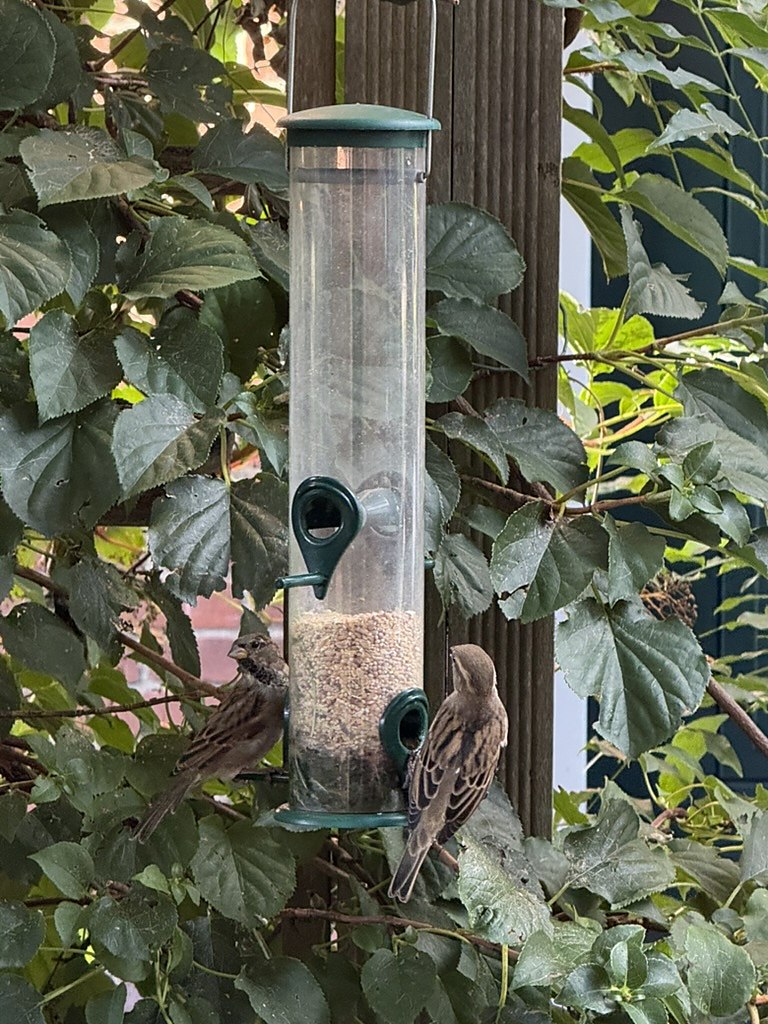
The net is more dangerous than the fat
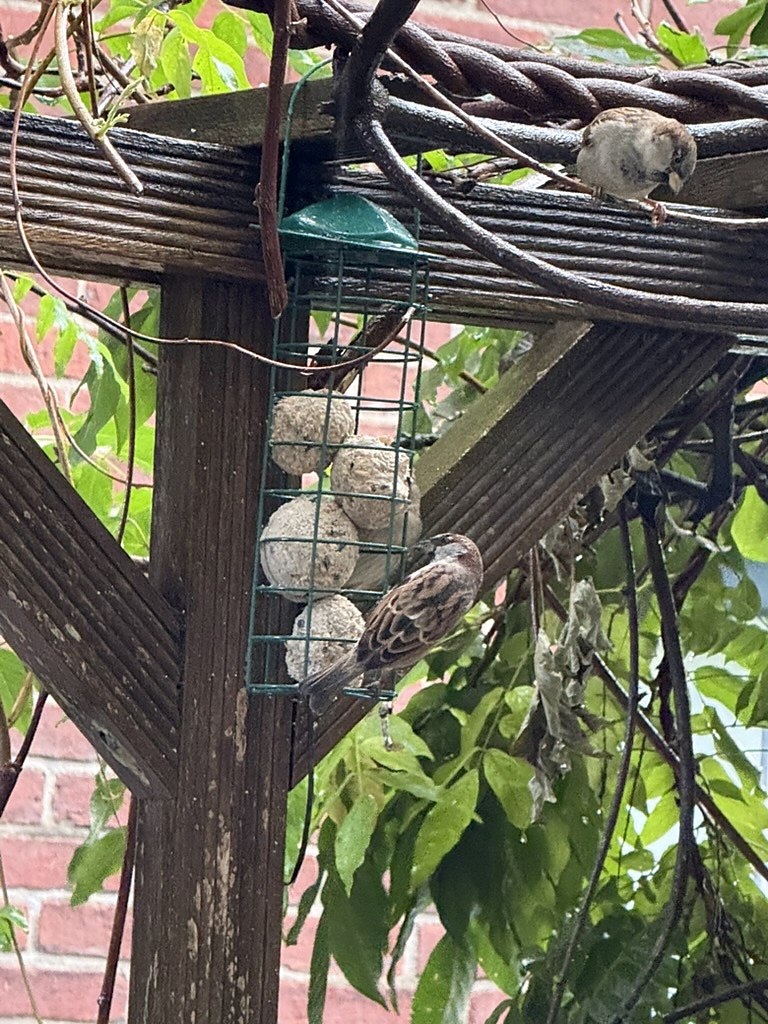
This is the one point in this article where a bird dies on the spot, and it appears on almost no packaging. Fat balls and peanuts are sold as standard in a plastic net. That net has to come off. Vogelbescherming puts it without ceremony: “No fat balls or peanuts in a (plastic) net, birds can get entangled in it”. A tit that catches a toe behind the nylon does not get free again.
A fat ball belongs in a metal fat-ball cage, peanuts in a peanut feeder. That cage has a second advantage you get for free: pigeons, crows and gulls struggle with feeders and cages. Put the food in a cage that large birds can’t get into and the small garden birds do get their turn — and that is exactly where the average feeding station comes unstuck.
Hygiene: the part almost nobody writes down
A feeding station brings garden birds together at a density they never reach in the field. That is exactly why there is something to see, and exactly why you have to keep it clean. Vogelbescherming published six concrete points on this on 10 December 2025 (Jeanet van Zoelen), all six doable in five minutes a week.
- Measure it out. Put out what will be eaten before evening, so nothing is left overnight. Wet food that stands for a long time becomes unhygienic.
- Clean regularly. Sweep out or shake out bird houses, tables and feeders. A feeder keeps seed dry, but rain and wind still get in; throw away clumping seed. Many feeders can go in the dishwasher.
- Change the water. At least once a week. That also stops tiger mosquitoes breeding in the dish.
- Disinfect now and then. Pour boiling water over feeding and watering spots from time to time.
- Watch the fat products. Those spoil faster in mild, wet weather. You can tell by a nasty smell, a black or white film, or seeds starting to sprout. Then remove them at once.
- Move the bird table. Put it somewhere else occasionally, so pathogens don’t build up in one place.
On top of that come mice and rats. They become a plague if food is left out overnight or if they can reach your supply. Keep bird food in a metal bin, take food off the ground at night, and put a catch tray under the feeder.
Disease at the feeding station: trichomonosis, and what to do
The most important disease around Dutch feeding stations is trichomonosis, known colloquially in Dutch as “het geel” (the yellow), caused by the parasite Trichomonas gallinae. Roy Slaterus and Margriet Montizaan described the Dutch situation in De Levende Natuur of March 2024.
The parasite causes yellowish growths and nodules in the mouth cavity. These make eating difficult and weaken the bird; with heavy growths breathing also becomes difficult, and organs such as the liver can be affected. Not every infected bird shows those growths. Three things from that article adjust the common picture.
- In the Netherlands it is above all a problem of the European Greenfinch. In Great Britain it caused mass mortality among greenfinches and chaffinches; in the Netherlands the Common Chaffinch appears to have been little affected so far. The authors do add the question of how long that will remain the case.
- The peak is in spring and summer, not in winter. That is counter-intuitive: precisely in the months when people think feeding is “not necessary”, hygiene matters most. Both young and adult birds are affected.
- Feeding stations in gardens are where you see it — partly because sick birds stand out there, partly because the infection risk is probably higher there, since the disease spreads through contact between birds and via contaminated food and drinking water.
The authors’ advice is brief: clean food and water containers daily and dry them thoroughly, move them, and stop feeding temporarily if birds are sick. Vogelbescherming attaches a period to that: if you see sick or dead garden birds, stop feeding entirely for at least two weeks and remove the food. A sick bird looks puffed up and dull, behaves strikingly tame and often has a dirty bill. Leave it alone — it is hard to catch, and the animal ambulance may not take it because of the infection risk. If you see several sick or dead birds, report it to the Dutch Wildlife Health Centre.
Finally, on bird flu, exactly as cautiously as the source: in December 2025 Vogelbescherming wrote that no cases are yet known in garden birds, but that it is probably a matter of time. One rule there is unconditional: if your garden borders water, don’t feed waterbirds — no geese, swans, ducks or gulls — and don’t touch sick or dead birds.
Where you put it, and why one spot doesn’t work
The most common layout mistake isn’t the food but the concentration: everything at one point. Vogelbescherming advises spreading it over different places and forms — open on the ground, under a hedge, on a bird table, in a seed feeder and hanging as a fat ball. Garden birds have differing preferences: a Common Blackbird scratching about on the ground and a Blue Tit hanging upside down on a fat ball don’t use the same spot.
Two additions for winter. If there is snow, clear a patch of ground: the robin and the Dunnock look for small soil creatures there. And leave fallen leaves in the borders, with evergreen shrubs or ivy as shelter and roosting cover — that is where the blackbird earns its living.
For water: a flat, wide dish for drinking and bathing, cleaned every day. In the absence of open water birds eat snow or frost. You can put out lukewarm water a few times a day, but never add salt or sugar. Don’t make holes in the ice — that isn’t necessary and disturbs life below the surface.
One side effect comes with the territory: a predictable concentration of small garden birds attracts a Eurasian Sparrowhawk. That is not a sign you are doing something wrong — it is the same mechanism as with a starling murmuration, and the reason to put the feeder near cover rather than in the middle of the lawn.
Which garden birds to expect
These garden birds turn up in almost every Dutch garden with food, though the mix differs by region and by garden.
- House Sparrow — in small groups, in dense hedges, all day. 14 to 16 centimetres. The male has a grey cap with chestnut sides and a black bib, the female is plain light brown with a clear brow stripe behind the eye. There are 600,000 to 1,000,000 breeding pairs in the Netherlands (2018–2020); in winter there are 2 to 3 million birds.
- Great Tit and Blue Tit — the regulars at feeder and fat ball, busiest from October to March.
- European Robin — curious and almost tame, on the ground and at mealworms.
- Common Blackbird — on the lawn and in the fallen leaves; fruit and halved apples.
- Common Chaffinch and European Greenfinch — seed eaters with a heavy conical bill; the greenfinch likes to dominate the feeder. These are also the two species to watch for trichomonosis.
- Dunnock and Eurasian Wren — small and inconspicuous, both on the ground and at mealworms.
- Common Starling — in groups, and clearly more numerous in the 2026 count than the year before.
- Great Spotted Woodpecker — hangs on fat balls and peanut feeders. Which woodpecker you have exactly is covered in Which woodpecker is this?
- Eurasian Jay — in gardens at the woodland edge, in autumn mainly busy with its acorn store.
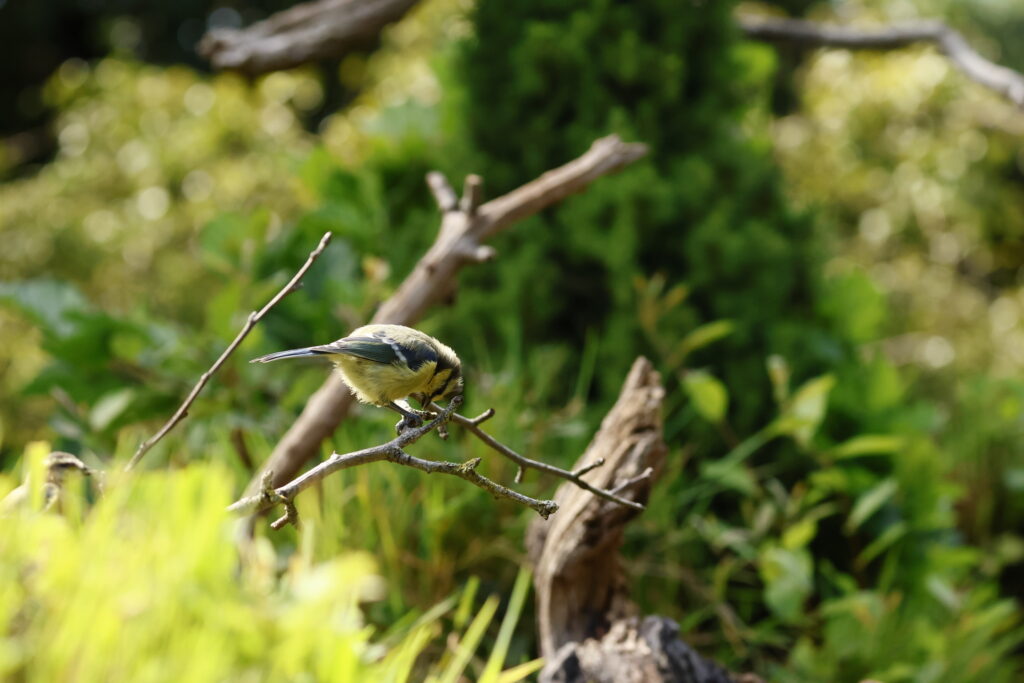
Gardens backing onto old deciduous woodland gain garden birds you otherwise rarely see: the Eurasian Nuthatch, the Short-toed Treecreeper, the Marsh Tit and the Willow Tit. You’ll hear those before you see them; recognising woodland birds by sound helps with that. And a red squirrel that has found the peanut feeder is not a problem, though it is a drain on your supply.
The winter visitors that move into the garden when it turns cold
In frost, snow or after a poor berry crop, birds that normally stay in woods and fields move in towards buildings, and then something other than the usual garden birds suddenly appears at the feeder. That is the moment a garden becomes more interesting than a nature reserve.
- Brambling — normally lives on beechnuts, and there are plenty this year. The Veluwe mast survey of 13 October 2026 comes out at an estimated 1.3 million kilos of beechnuts, the fourteenth year in a row with a beech crop. The chance of the Brambling needing your bird table is therefore smaller than in a lean beech year — look for it on the woodland floor under an old beech this autumn instead. If the beech crop is poor, it appears on the ground under the bird table, among the chaffinches. How that crop works is covered in the article on the mast year.
- Eurasian Siskin — hangs in a birch or on an alder, and in hard cold will also come to the feeder.
- Fieldfare and Redwing — they don’t come for seed but for fruit: rowan, hawthorn, a rotten apple on the lawn. In the 2026 count the Fieldfare went from 868 to 7,759 individuals — exactly the kind of outlier a severe week produces.
- Hawfinch — scarcer, but a real possibility at sunflower hearts; note the enormous bill.
Which species arrive this winter, and why their numbers vary so much from year to year, is covered in Winter visitors from the north. And for anyone who confuses a Song Thrush with a Redwing: the Redwing has a creamy-white brow stripe.
Where feeding stops: the field and the photograph
Everything above is about your own garden. Outside that garden different rules apply, and the distinction isn’t arbitrary: it lies not in the food but in what the animal gets used to. A Great Tit at a feeding board learns that there is food at that place; its attitude towards people doesn’t change. A fox, wild boar or wolf that gets food from a person learns that people mean food, and starts seeking people out instead of avoiding them. That ends badly for the animal. The national intervention guidelines accompanying the 2025 Wolf Plan say it in six words: “Do not lure or feed. Beware of habituation.” The escalation ladder that follows ends with a permit procedure to remove a problem wolf from the population.
So: you don’t feed mammals in the field, you don’t feed waterbirds in town, and you never lure for a photograph. The Golden Rules of the Vroege Vogels code are one line on this: “Do not offer food specially for the photograph.” Vogelbescherming applies the same standard in its own photography guideline: “Feeding: in moderation and hygienically.”
Three questions resolve almost every doubtful case. Is the animal getting used to a place or to people? Is it happening at your home or in the field? And are you doing it for the animal or for your photograph? There is more about that on Responsible wildlife watching. One practical consequence: if you take a photo at your own feeding station, say in the caption that it is a feeding station. That is not a confession but information.
From feeding station to record
A feeding station is the cheapest bird hide in the Netherlands, and what you see there is useful. What is present in an ordinary garden is exactly the kind of data national counts lack: submitting it on Waarneming.nl takes a minute per species.
And take part in the National Garden Bird Count, the country’s largest piece of citizen science — in 2026 more than 136,000 participants and around 1.9 million birds counted. You watch out of the window for half an hour and note the highest number of each species you see at the same time. Vogelbescherming gives the next edition as Friday 29 to Sunday 31 January; the page doesn’t state a year, so check that shortly before the count. It is the last weekend of January, which is also the period when your feeding station is busiest.
If you want to go further after that: the wildlife calendar for November, December and January show what is happening outside the garden in the same weeks.

Frequently asked questions
Is it all right to feed garden birds all year round?
Yes. Feeding birds in the garden is fine year-round; Vogelbescherming Nederland writes literally: “Garden birds can be fed all year round.” What changes is not whether you feed but what you give: fat-rich in the winter half of the year, animal protein and calcium in the breeding season, and in summer mainly water. The condition is hygiene, and that matters more in summer than in winter.
Do garden birds become dependent if I feed them?
No, not in an ordinary garden. Supplementary food is on average about twenty per cent of the diet; they find the rest themselves. Only during a prolonged frost can a bird really lean on your food, and then carrying on until the frost ends is a reasonable starting point — that is also how the Vroege Vogels photo and video code puts it.
Why is bread not allowed?
Because of the salt: “No products containing salt, such as bread”. The same objection applies to cooked leftovers, which also spoil quickly, and to butter and margarine, which have a laxative effect.
Does the net have to come off a fat ball?
Yes, always. “No fat balls or peanuts in a (plastic) net, birds can get entangled in it”. Use a metal fat-ball cage; peanuts go in a peanut feeder.
How often should I clean the feeding station?
The water dish daily, the water changed at least once a week, and bird houses and feeders swept or shaken out regularly — many feeders can go in the dishwasher. Pour boiling water over it now and then, and move the bird table occasionally so pathogens don’t build up in one place. With trichomonosis the advice is stricter: clean daily and dry thoroughly.
What do I do if there’s a sick bird at the feeder?
Stop feeding entirely for at least two weeks and remove the food. A sick bird is puffed up, dull and strikingly tame, often with a dirty bill. Leave it alone. If you see several sick or dead birds, report it to the Dutch Wildlife Health Centre.
Which of the garden birds is the most common?
Since the 2026 National Garden Bird Count that is the Great Tit, which took first place from the House Sparrow after 23 years; the House Sparrow was seen 9 per cent less that year. Whether feeding helps the House Sparrow has not been demonstrated — Vogelbescherming’s position is that the cause of the decline needs further research, and it points to the layout of gardens and public space. So food is not a replacement for a garden with something to find in it, but an addition to one.
Further reading at the source
- Vogelbescherming Nederland — Wanneer voer je wat? — feeding all year, and what in each season. In Dutch.
- Vogelbescherming Nederland — Wat is goed voer? — the do and don’t list, including the net. In Dutch.
- Vogelbescherming Nederland — Hoe voer je vogels? — placement, spreading and the water dish. In Dutch.
- Vogelbescherming Nederland — Hygiënisch vogels bijvoeren: 6 tips (Jeanet van Zoelen, 10 December 2025). In Dutch.
- Vogelbescherming Nederland — Zieke vogel in de tuin? Dit kun je doen (27 May 2026) — the minimum two-week period, and how to recognise a sick bird. In Dutch.
- Vogelbescherming Nederland — Standpunt Vogels voeren — why feeding in moderation is recommended. In Dutch.
- Vogelbescherming Nederland — Veelgestelde vragen wintervogels — frost, water, holes in ice and sick birds. In Dutch.
- Vogelbescherming Nederland — Nationale Tuinvogeltelling 2026: huismus verliest koppositie aan koolmees (1 February 2026). In Dutch.
- Vogelbescherming Nederland — Nationale Tuinvogeltelling — participant numbers and the next dates. In Dutch.
- Vogelbescherming Nederland — bird guide: huismus — numbers, Red List, identification and causes of the decline. In Dutch.
- Sovon Vogelonderzoek Nederland — House Sparrow trend data — the two trend qualifications with their periods. In Dutch.
- Roy Slaterus & Margriet Montizaan — Het geel treft wilde vogels (De Levende Natuur 125-2, March 2024, via Sovon). In Dutch.
- Nature Today / De Natuurkalender — 14de jaar op rij beukennootjes, en het zijn er veel (Arnold van Vliet, Wageningen University & Research, and Gerrit Jan Spek, Faunabeheereenheid Gelderland, 13 October 2026) — 2.8 million kilos against an average of 4.7 million, of which 1.3 million kilos of beechnuts. In Dutch.
- Vroege Vogels (BNNVARA) — Vogels voeren in de winter — the twenty per cent, and why birds don’t become dependent. In Dutch.
- Vroege Vogels (BNNVARA) — Foto- en videocode — offering food, keeping it up, and not luring for the photograph. In Dutch.
- Dutch Wildlife Health Centre — where to report sick or dead wild birds. In Dutch.
- Winter visitors from the north — which birds arrive in October and November, and why their numbers differ from year to year.
- Mast year: acorns and beechnuts — why the Brambling is in your garden in some winters and not in others.
- Responsible wildlife watching — where feeding stops, and the three questions that resolve the doubtful cases.
- Recognising woodland birds by sound — for the species you hear before you see them in a woodland garden.
- Which woodpecker is this? — identification by drumming and call, for the woodpecker on your fat ball.
- Seeing a starling murmuration in the Netherlands — why a predictable group of small birds attracts a bird of prey.
- Species pages for the regulars: House Sparrow, Great Tit, Blue Tit, European Robin, Common Blackbird, Common Chaffinch, European Greenfinch, Dunnock, Eurasian Wren, Common Starling, Great Spotted Woodpecker and Eurasian Jay.
- And for the woodland-edge species: Eurasian Nuthatch, Short-toed Treecreeper, Marsh Tit and Willow Tit.
- The winter visitors that may join in: Brambling, Eurasian Siskin, Fieldfare, Redwing, Song Thrush and Hawfinch.
- Eurasian Sparrowhawk and red squirrel — the two uninvited guests at a well-run feeding station.
- Wildlife calendar October, November, December and January — what is happening outside the garden in the same weeks.
- Bird migration in September — how the season began that is now arriving in your garden.