
Where to see the Eurasian Collared Dove in the Netherlands
Easy 🦅 Bird
Where and when do you see a Eurasian Collared Dove? This species is easy to see, all year round.
How do you recognise a Eurasian Collared Dove?
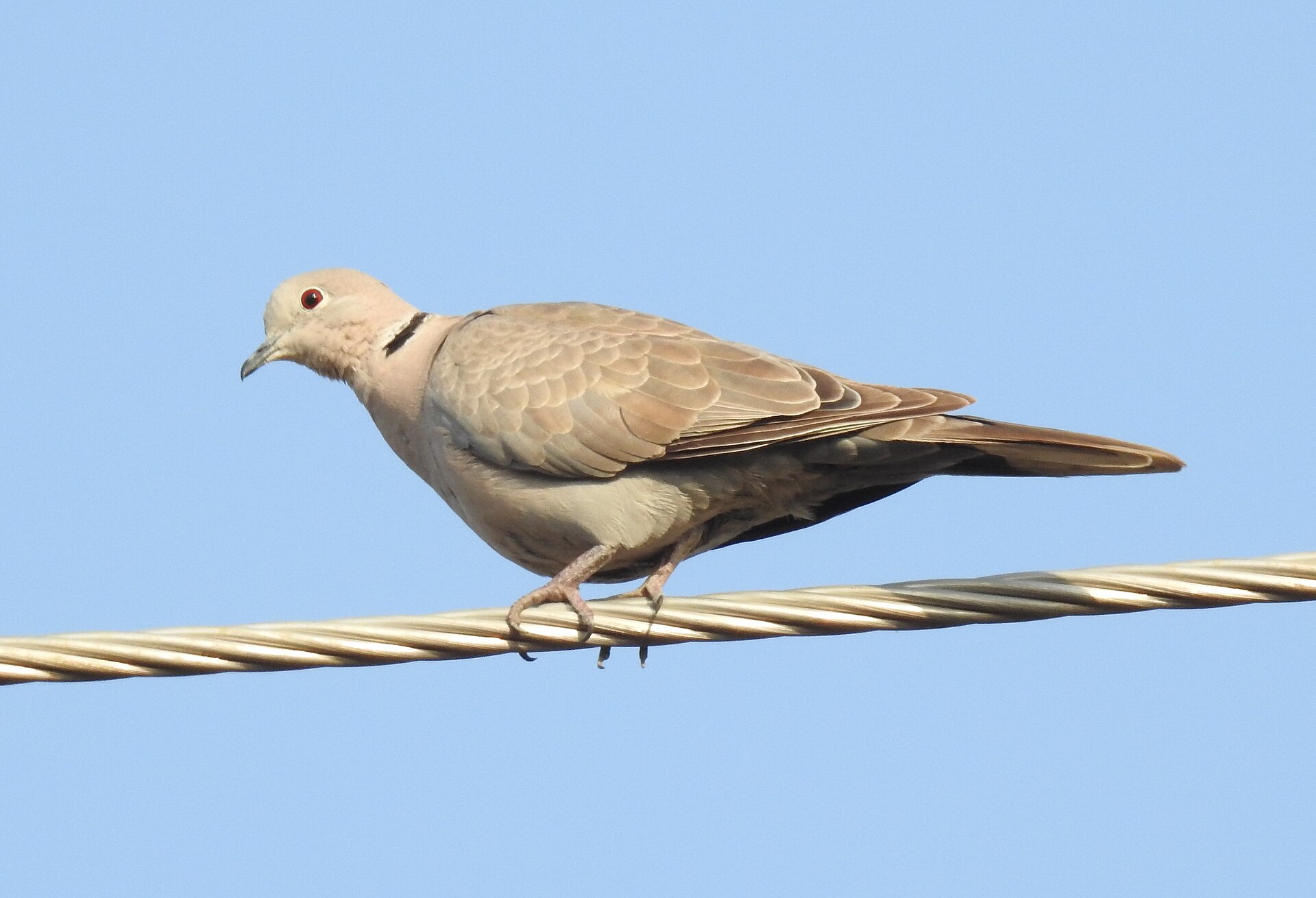
Length 31 to 33 cm. Slender and sandy-coloured with a narrow black collar on the back of the neck and a long tail with plenty of white underneath. Its call is a monotonous coo-coooo-coo in three syllables, repeated endlessly — for many people the sound of a suburb in summer.
Wingspan: 30 cm an indication from Wikidata; it varies by individual, sex and subspecies · compare all birds (in Dutch)
What can you confuse a Eurasian Collared Dove with?
Looks like: European Turtle Dove, Common Wood Pigeon
- European Turtle Dove: the turtle dove has a black-and-white striped neck patch and a reddish brown, black-spotted back; the collared dove is a plain sandy colour with a narrow black collar.
- Common Wood Pigeon: much bulkier and blue-grey, with white neck patches and a white wing bar.
What does a Eurasian Collared Dove sound like?
Recording: Warper up, CC BY-SA 3.0, via Wikimedia Commons
Where do you see this species in the Netherlands?
Almost the whole of the Netherlands, nearly always in the immediate surroundings of buildings.
Habitat: Villages, towns, gardens and farmyards with trees to nest in and paved places to look for seed. Pure woodland or open countryside it avoids.
This is a common, widespread species: you can come across it in far more places than the areas listed below. Treat that list as a starting point rather than a full survey.
📍 Blauwe Kamer
presence reported📍 Zouweboezem
presence reported📍 Oostelijke Vechtplassen
presence reported📍 Noordhollands Duinreservaat
presence reported📍 Wormer- en Jisperveld
presence reported📍 Ilperveld
presence reported📍 De Dollard
presence reported📍 Zuidlaardermeergebied en Hunzedal
presence reported📍 Meijendel & Berkheide
presence reported📍 Voornes Duin
presence reported📍 Kampina & Oisterwijkse Vennen
presence reported📍 De Maashorst
presence reported📍 Strabrechtse Heide & Beuven
presence reported📍 Loonse en Drunense Duinen
presence reported📍 Schoorlse Duinen
presence reportedThese links come straight from our database, with the chance, the source and the evidence level for each area.
When is the best time?
Green = present · orange = peak period. The bar is generated from our database.
Best period: Present all year. It breeds almost year-round, with clutches from February into October; in winter it often looks for seed at feeding places.
Best time of day: All day. Collared doves are hardly shy and are visible all year.
Recent sightings
👁️ Where has this species been seen recently?
Check the current sightings on Waarneming.nl. A useful addition to our own verified information.
How to improve your chances
- Learn the calls first. You will hear most birds before you see them.
- Go in the first hour after sunrise, when the song is at its peak and the wind is still down.
- Use a hide or natural cover. Sitting still gets you more than walking closer.
- Keep the sun behind you. Against the light you see a silhouette and no colour.
Photography
Sits still for a long time on roofs and wires; the easiest bird to portrait
🌿 Watching responsibly
Keep your distance, stay on the paths, and never lure animals with food or sound. Leave as soon as an animal becomes uneasy.
Status: Verified · Last checked: 2026-08-08