
Where to see the Brant in the Netherlands
Easy 🦅 Bird
Where and when do you see a Brant? This species is easy to see, from October to May.
How do you recognise a Brant?
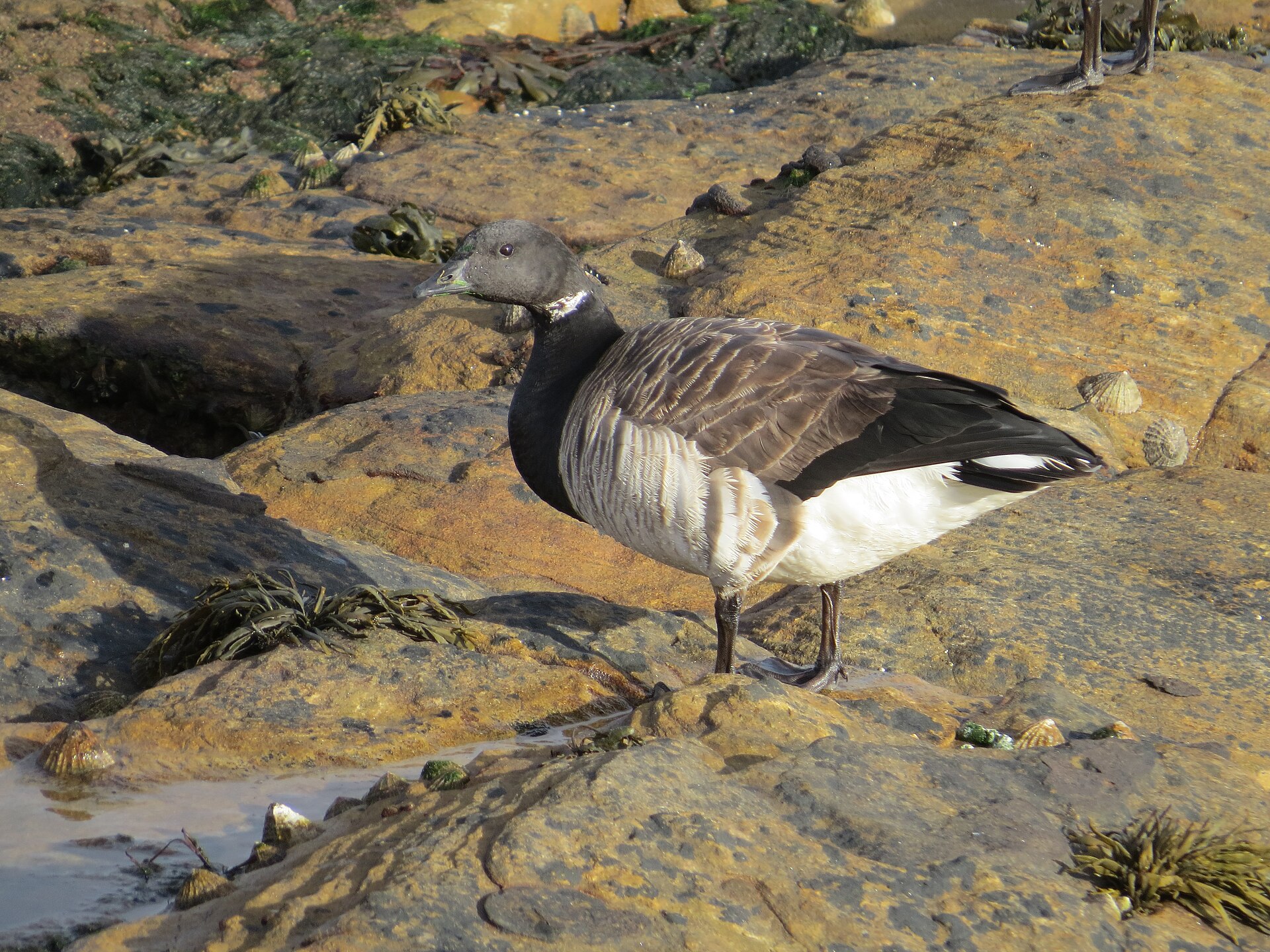
Small and dark. 55 to 62 centimetres, wingspan 110 to 120 centimetres — distinctly smaller than the geese most visitors picture. Black head, neck and breast, with only a small white streak on the side of the neck. Conspicuous white under the tail, which is often the first thing you notice on a flock walking away from you. Which goose is it? Three dark geese get mixed up here, and the face settles it. The Brant goose has a black head and neck with just a small white neck streak, and no white on the face. The Barnacle Goose has a bold white face cutting sharply against a black neck, and a pale grey barred back. The Canada Goose is much bigger and brown, with a white chin patch that runs up under the cheek. The voice is worth knowing before you go, because it is not what people expect from geese. There is no loud honking. The call is a low, rolling rrò… rrò — a soft throat sound, and a large feeding flock ends up sounding like distant surf. Standing near a few thousand Brant geese, the murmuring is the thing you remember.
What does a Brant sound like?
Recording: British Library, CC BY 4.0, via Wikimedia Commons
Where do you see this species in the Netherlands?
The Wadden region and the Zeeland Delta: the tidal flats, the salt marshes and the grassland just behind the dyke. The Netherlands holds 51,600 to 60,800 wintering birds.
📍 Nationaal Park Oosterschelde
Good chance in season chance per source📍 Nationaal Park Lauwersmeer
presence reported📍 Nationaal Park Duinen van Texel
presence reported📍 Wadden Sea
Good chance in season chance per source📍 Noordhollands Duinreservaat
presence reported📍 Ilperveld
presence reported📍 Meijendel & Berkheide
presence reported📍 Schoorlse Duinen
presence reported📍 Haringvlietsluizen
presence reported📍 De Putten bij Camperduin
presence reportedThese links come straight from our database, with the chance, the source and the evidence level for each area.
When is the best time?
Green = present · orange = peak period. The bar is generated from our database.
Best period: October to late May. April and May give the biggest flocks, right before departure, when the birds are fuelling for the flight to Siberia. That makes late spring the best time for this species and the worst for most of the others on this coast — useful to know if you are planning a trip outside the autumn.
Best time of day: The tide moves them, so plan for it. Around low water they are out on the flats, feeding; as the water rises they withdraw to the salt marshes and the grassland behind the dyke, which is where most people get their best views, from a car or a dyke road.
Recent sightings
👁️ Where has this species been seen recently?
Check the current sightings on Waarneming.nl. A useful addition to our own verified information.
How to improve your chances
- Learn the calls first. You will hear most birds before you see them.
- Go in the first hour after sunrise, when the song is at its peak and the wind is still down.
- Use a hide or natural cover. Sitting still gets you more than walking closer.
- Keep the sun behind you. Against the light you see a silhouette and no colour.
🎒 What you need for this
Binoculars; a telescope for scanning a big flock.
🌿 Watching responsibly
Keep your distance, stay on the paths, and never lure animals with food or sound. Leave as soon as an animal becomes uneasy.
Status: Verified · Last checked: 2026-08-08
The goose with the lemming story
The Brant goose (Branta bernicla) is the small dark goose of the tidal flats, and it is the one with the best story behind it: whether a good number of young birds reach the Netherlands in autumn depends on how many lemmings there were in Siberia that summer. Not metaphorically. Directly.
A note on the name: British readers will know this bird as the brent goose. Same species, same bird.
What it eats, and why it is now in ordinary polders
Originally eelgrass, plus sea lettuce and other algae on the flats.
But eelgrass has largely disappeared from the Dutch Wadden Sea, and the Brant goose has shifted increasingly to grass — on salt marshes and on grassland inside the dyke. That switch is the reason you now find them grazing in ordinary polders, well away from any flat, which surprises people who expect a sea goose to stay at sea.
It is also a reminder of what that means: a species adapting to the loss of its original food is coping, not thriving.
The lemming connection
This is the part worth telling someone over dinner.
Brant geese breed on the Siberian tundra, where arctic foxes are the main nest predators. In years with plenty of lemmings, the foxes concentrate on lemmings and largely leave the goose nests alone. In lemming-poor years they turn to eggs instead.
That used to produce a tidy three-year cycle, and you could more or less predict from the lemming year how many young birds would arrive in the Netherlands.
Climate change has disrupted the lemming cycle, and with it the predictability. The number of young Brant geese reaching this coast each autumn is now a good deal less foreseeable than it was — which is a problem for anyone trying to work out how the population is actually doing.
Watching it responsibly
Geese on grassland are feeding, and a flock pushed off a field loses the energy it was storing for a flight of several thousand kilometres. Stay in or beside the car on a dyke road rather than walking into the field, and keep dogs on a lead. A flock that lifts has already cost you the view anyway.
Sources
Our sources for this species are in Dutch.
- Vogelbescherming Nederland (bird guide), consulted 2 November 2026 (in Dutch): identification, measurements, voice, diet and the lemming cycle.
- Sovon Vogelonderzoek Nederland (in Dutch): the wintering total and the seasonal pattern.
- Area-level occurrence on our Dutch pages is based on NDFF Flora & Fauna Verkenner open data alongside statements from the site managers. NDFF counts say something about presence, not about density or your chance of seeing a bird.
- The Wadden Sea — the area page, including how the tide shapes the day.
- Common Shelduck and Common Eider — the other two waterfowl of this coast.
- Red Knot — and the full explanation of the high-tide roost.
- How we work — where our facts come from and what we leave out.
Frequently asked questions
Where and when do you see brant geese?
From October to late May in the Wadden region and the Zeeland Delta. At low water they feed on the flats; as the tide rises they move to salt marshes and the grassland behind the dyke. The largest numbers are in April and May, just before departure. The Netherlands holds 51,600 to 60,800 wintering birds.
What is the difference from a barnacle goose?
Colour and size. The brant goose is smaller and much darker: head, neck and breast black, with only a small white streak on the side of the neck. The barnacle goose has a striking white face set sharply against a black neck, and a pale grey barred back. The Canada goose is considerably bigger and brown, with a white chin patch running up under the cheek.
How do you recognise it by sound?
A low, rolling rrrò… rrrò — not loud honking but a soft throat call, so that a big flock ends up sounding like distant surf. The murmuring is what strikes people standing near feeding brant geese for the first time.
What does it eat?
Originally eelgrass, along with sea lettuce and other algae on the flats. Because eelgrass has largely disappeared from the Wadden Sea, it has shifted increasingly to grass on salt marshes and on grassland inside the dyke. That switch is why you now also see them grazing in ordinary polders.
Why does its breeding success depend on lemmings?
It breeds on the Siberian tundra, where arctic foxes are the main nest predators. In years with many lemmings the foxes focus on those and leave the goose nests alone; in lemming-poor years they take the eggs. That used to produce a neat three-year cycle. Climate change has disrupted the lemming cycle, so the number of young birds is now less predictable.