
Where to see the Common Eider in the Netherlands
Easy 🦅 Bird
Where and when do you see a Common Eider? This species is easy to see, all year round.
How do you recognise a Common Eider?
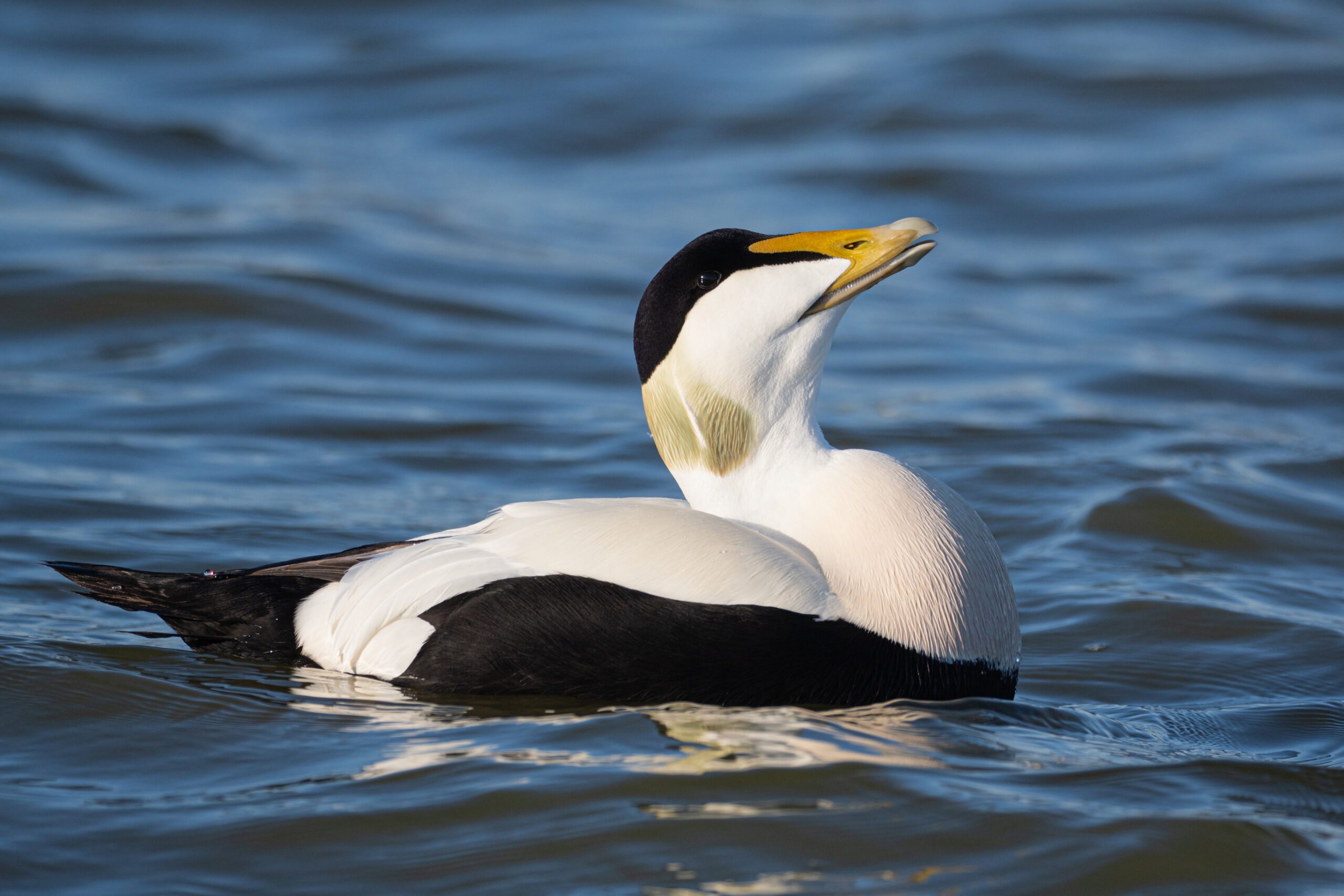
Go by the head. The eider has a heavy, triangular head in which the forehead runs almost in a straight line into the bill — a profile no other Dutch duck has. At any distance where you can see the shape, that is your identification. The male in breeding plumage is boldly white above and black below, with an olive-green patch on the nape and a pink flush on the breast. The female is brown and finely barred, and much easier to overlook. 50 to 71 centimetres, wingspan 95 to 105 centimetres: a big, heavy bird on the water. The display call of the male surprises almost everyone — a low, almost human ooh. The female is low and harsh. On a quiet spring morning the males carry a long way.
What does a Common Eider sound like?
Recording: British Library, CC BY-SA 4.0, via Wikimedia Commons
Where do you see this species in the Netherlands?
Coastal waters only, with the Wadden region as the stronghold. The birds are out on the mussel and cockle beds, which are often well offshore — one reason a telescope helps. The ferries to the Wadden islands cross the right water, and from the deck you are looking down rather than across. Easily the best free option.
📍 Wadden Sea
Good chance chance per source📍 Nationaal Park Oosterschelde
Good chance chance per source📍 Noordhollands Duinreservaat
presence reported📍 Meijendel & Berkheide
presence reported📍 Voornes Duin
presence reported📍 Schoorlse Duinen
presence reported📍 Vismigratierivier Afsluitdijk
presence reported📍 De Putten bij Camperduin
presence reportedThese links come straight from our database, with the chance, the source and the evidence level for each area.
When is the best time?
Green = present · orange = peak period. The bar is generated from our database.
Best period: All year in the Wadden Sea. The largest numbers are in winter, when northern birds join the local population; egg-laying runs from early April to early June.
Best time of day: Go at low water and scan the mussel and cockle beds, or take a ferry to one of the islands.
Recent sightings
👁️ Where has this species been seen recently?
Check the current sightings on Waarneming.nl. A useful addition to our own verified information.
How to improve your chances
- Learn the calls first. You will hear most birds before you see them.
- Go in the first hour after sunrise, when the song is at its peak and the wind is still down.
- Use a hide or natural cover. Sitting still gets you more than walking closer.
- Keep the sun behind you. Against the light you see a silhouette and no colour.
🎒 What you need for this
Binoculars or a telescope. Eiders often sit a long way out on the mussel beds.
Photography
At low water, stand on a dyke or a pier and scan the mussel beds. On the ferries to the Wadden islands eiders often pass close by, and that is the easiest way to photograph them at eye level.
🌿 Watching responsibly
Keep your distance, stay on the paths, and never lure animals with food or sound. Leave as soon as an animal becomes uneasy.
Status: Verified · Last checked: 2026-08-08
A duck that lives on shellfish
The Common Eider (Somateria mollissima) is a sea duck that lives almost entirely on shellfish, and the Dutch Wadden Sea is the southern edge of its breeding range. That one fact explains most of what follows — including why everything that happens to the mussel and cockle beds here shows up in this bird within a season.
The tooth in the bill
The eider is specialised for shellfish in a way that is worth knowing: there is a horny tooth at the tip of the bill, used to work open the adductor muscle of a mussel. Shells are then swallowed whole and ground up in the gizzard.
Its diet is shellfish, crabs and crustaceans, and that is more or less all. Which is exactly why the exploitation of mussel and cockle beds in the Wadden Sea bears so directly on this species: take away the beds and you have taken away the food, with no alternative for the bird to switch to.
The numbers
- 3,300 to 3,800 breeding pairs in 2024. The Netherlands is a scarce breeder, sitting at the southern limit of the range.
- 28,100 to 99,000 in winter counts.
That winter range is wide, and the width is real rather than sloppy: it depends on the year, on how far south the northern birds come, and on where the shellfish are.
Crèches
Eiders run a collective nursery. Females pool their own ducklings with their neighbours’ into a single group, escorted by a few adult females. The result is dozens of downy young swimming behind a handful of grown birds — one of the better things to come across on a Wadden crossing in June.
The young fledge after 65 to 75 days and are independent at around fifty.
How it is doing
The eider is on the Orange List of Dutch breeding birds, and the pressures on it come almost entirely from the sea:
- oil pollution
- overfishing
- exploitation of shellfish beds
- drowning in fishing nets
- disturbance by recreation
Because the bird lives on shellfish and little else, any intervention in the mussel and cockle beds of the Wadden Sea feeds straight through into its condition and its breeding success. It is a species with no dietary fallback, which makes it a reasonable barometer of what is happening below the waterline.
Watching it responsibly
Two of the listed pressures are things a visitor can affect. Disturbance by recreation is one: eiders nest on the ground on the islands, so stay on the paths in the dunes between April and June and keep dogs on a lead. And a bird on the water that keeps swimming away from you is paying for it in energy — watch from the dyke or the deck rather than following it along the shore.
Sources
Our sources for this species are in Dutch.
- Vogelbescherming Nederland (bird guide) (in Dutch): identification, the bill tooth, diet, crèches and voice.
- Sovon Vogelonderzoek Nederland (in Dutch): breeding pairs in 2024, winter counts, and the Orange List status.
- Area-level occurrence on our Dutch pages is based on NDFF Flora & Fauna Verkenner open data, consulted 8 August 2026, alongside statements from the site managers. NDFF counts say something about presence, not about density or your chance of seeing a bird.
- The Wadden Sea — the area page, including the ferries as a viewpoint.
- Common Shelduck — the other duck of this coast, and the one that nests underground.
- Eurasian Oystercatcher — the other shellfish specialist, with the same vulnerability.
- How we work — where our facts come from and what we leave out.
Frequently asked questions
How do you recognise an eider?
By the head. It has a heavy, triangular head in which the forehead runs almost in one line into the bill — a profile no other Dutch duck has. The male in breeding plumage is strikingly white and black with an olive-green patch on the nape and a pink flush on the breast; the female is brown and finely barred. Length 50 to 71 centimetres.
What does an eider eat?
Shellfish, crabs and crustaceans. It is specially equipped for it: a horny tooth at the tip of the bill works open the adductor muscle of a mussel. It swallows shells whole and grinds them in its gizzard. That also explains why the exploitation of mussel and cockle beds in the Wadden Sea bears so directly on this species.
Where and when do you see it?
In the Wadden Sea, all year round. The Netherlands is at the southern limit of the breeding range, with 3,300 to 3,800 pairs in 2024. In winter large numbers of northern birds join them: winter counts come out between 28,100 and 99,000. Look at low water over the mussel and cockle beds, or watch from the ferry.
What is a crèche in eiders?
A collective nursery. Female eiders pool their own ducklings with their neighbours’ into one group, escorted by a few females, so dozens of downy young swim along behind a handful of adults. The young fledge after 65 to 75 days and are independent at around fifty days.
How is the eider doing?
It is on the Orange List of Dutch breeding birds. The threats come almost entirely from the sea: oil pollution, overfishing, exploitation of shellfish beds, drowning in fishing nets and disturbance by recreation. Because the eider lives almost entirely on shellfish, every intervention in the Wadden mussel and cockle beds works directly through into its condition and breeding success.
What does an eider sound like?
In display the male makes a low, almost human-sounding ooh — a noise that surprises many people. The female is low and harsh.