
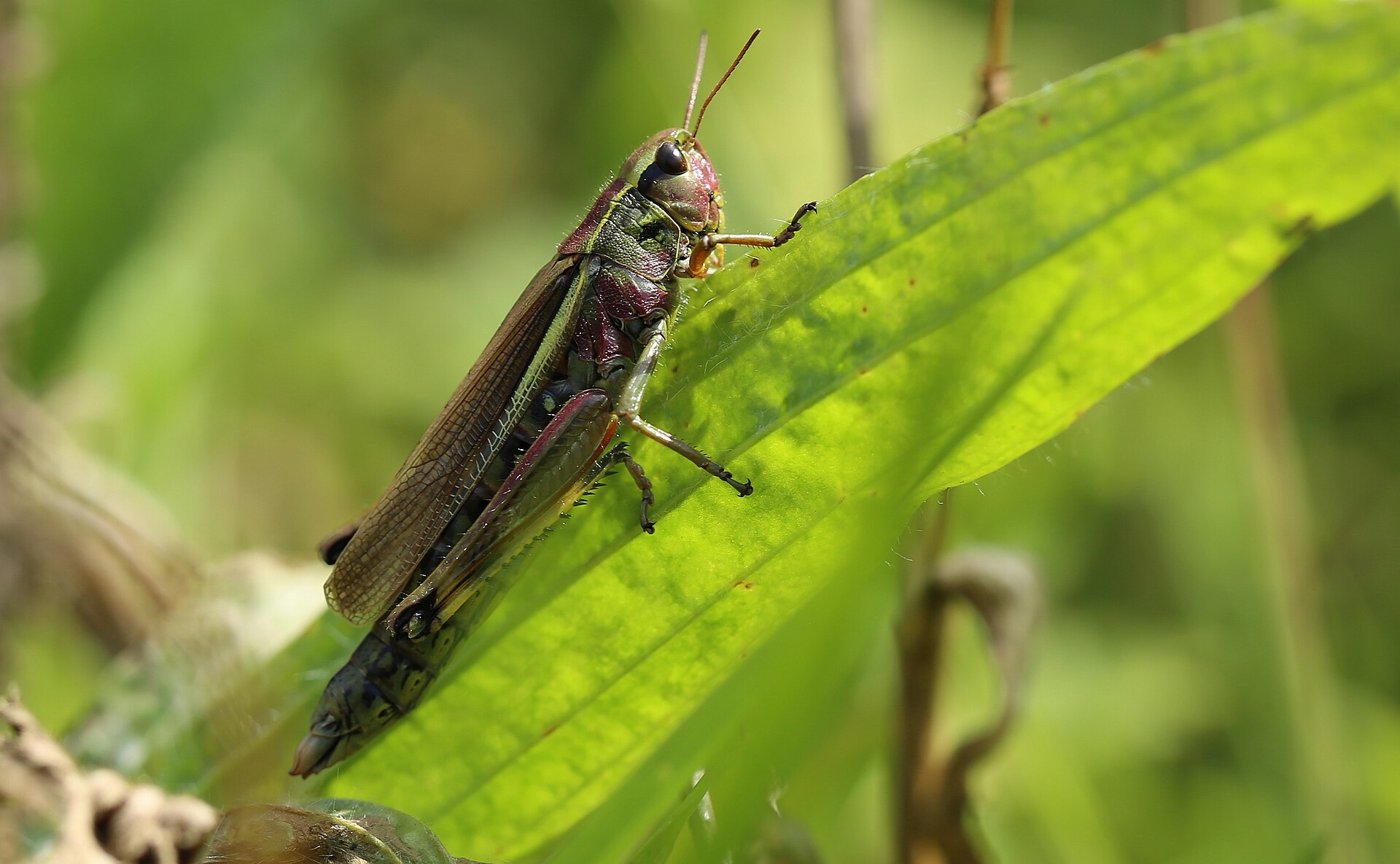
Where to see the Large Marsh Grasshopper in the Netherlands
Rare 🦗 Grasshopper
Where and when do you see a Large Marsh Grasshopper? This species is rarely seen, from July to October.
How do you recognise a Large Marsh Grasshopper?
Our largest grasshopper: 12 to 39 millimetres, with females far bulkier than males. Yellow-green to olive green, often with a mottled pattern. The wings are streaked yellow and the underside of the hind shanks is a striking red, which is the best feature once you see the animal close up.
What does a Large Marsh Grasshopper sound like?
Recording: Baudewijn Odé, CC BY-SA 4.0, via Wikimedia Commons
Where do you see this species in the Netherlands?
Fairly rare and strongly declined everywhere in the Netherlands because of drainage. What remains is in raised bog remnants, wet heath and unfertilised fen meadows. In Wallonia the species is still present in many places.
Habitat: Very wet terrain and marshland: peat marsh, wet heath, quaking fen and unfertilised, seepage-fed grassland that stays damp all year. The species tolerates no drainage and disappears as soon as a site dries out.
This is a common, widespread species: you can come across it in far more places than the areas listed below. Treat that list as a starting point rather than a full survey.
📍 Nationaal Park Weerribben-Wieden
presence reported📍 Fochteloërveen
presence reported📍 Nationaal Park De Alde Feanen
presence reported📍 Nationaal Park De Groote Peel
presence reported📍 Nationaal Park Dwingelderveld
presence reported📍 Naardermeer
presence reported📍 Nationaal Park Drents-Friese Wold
presence reported📍 Onlanden & Leekstermeer
presence reported📍 Deelerwoude
presence reported📍 Nationaal Park Utrechtse Heuvelrug
presence reported📍 Nationaal Park De Meinweg
presence reported📍 Nationaal Park Zuid-Limburg (in formation)
presence reported📍 Nationaal Park Sallandse Heuvelrug
presence reported📍 Kroondomein Het Loo
presence reported📍 Gelderse Poort & Millingerwaard
presence reported📍 Nationaal Park De Hoge Veluwe
presence reported📍 Nationaal Park De Maasduinen
presence reported📍 Sint-Pietersberg & Zuid-Limburg
presence reported📍 Planken Wambuis
presence reported📍 IJssel-uiterwaarden
presence reported📍 Grensmaas
presence reported📍 IJsselmeer
presence reported📍 Eemland
presence reported📍 Leuvenumse Bossen
presence reported📍 Blauwe Kamer
presence reported📍 Zouweboezem
presence reported📍 Oostelijke Vechtplassen
presence reported📍 Wormer- en Jisperveld
presence reported📍 Ilperveld
presence reported📍 Zuidlaardermeergebied en Hunzedal
presence reported📍 Kampina & Oisterwijkse Vennen
presence reported📍 De Maashorst
presence reported📍 Strabrechtse Heide & Beuven
presence reported📍 Loonse en Drunense Duinen
presence reportedThese links come straight from our database, with the chance, the source and the evidence level for each area.
When is the best time?
Green = present · orange = peak period. The bar is generated from our database.
Best period: Adults from July to October.
Best time of day: Warm, sunny afternoons; the clicking sound carries far across open marsh.
Recent sightings
👁️ Where has this species been seen recently?
Check the current sightings on Waarneming.nl. A useful addition to our own verified information.
How to improve your chances
- Listen first. Almost every species gives itself away by singing before you spot it.
- Go on a warm, windless afternoon. In cold or wind they fall silent.
- Walk slowly and note where the sound stops. That is where it sits, usually low in the vegetation.
- A bat detector makes audible the species that sing too high for human ears.
🎒 What you need for this
Boots and ears. The sound is not a song but a series of separate clicks, and it gives the species away before you see it.
Photography
Stay on boardwalks and duckboards: the peat this species lives in is irreparably damaged by trampling, and that is exactly why the species has become rare. Photograph with a macro lens from the path and make sure the red hind shanks are visible.
🌿 Watching responsibly
Keep your distance, stay on the paths, and never lure animals with food or sound. Leave as soon as an animal becomes uneasy.
Status: Verified · Last checked: 2026-08-08