
Where to see the Sickle-bearing Bush-cricket in the Netherlands
With luck 🦗 Grasshopper
Where and when do you see a Sickle-bearing Bush-cricket? With some luck you can see this species, from August to October.
How do you recognise a Sickle-bearing Bush-cricket?
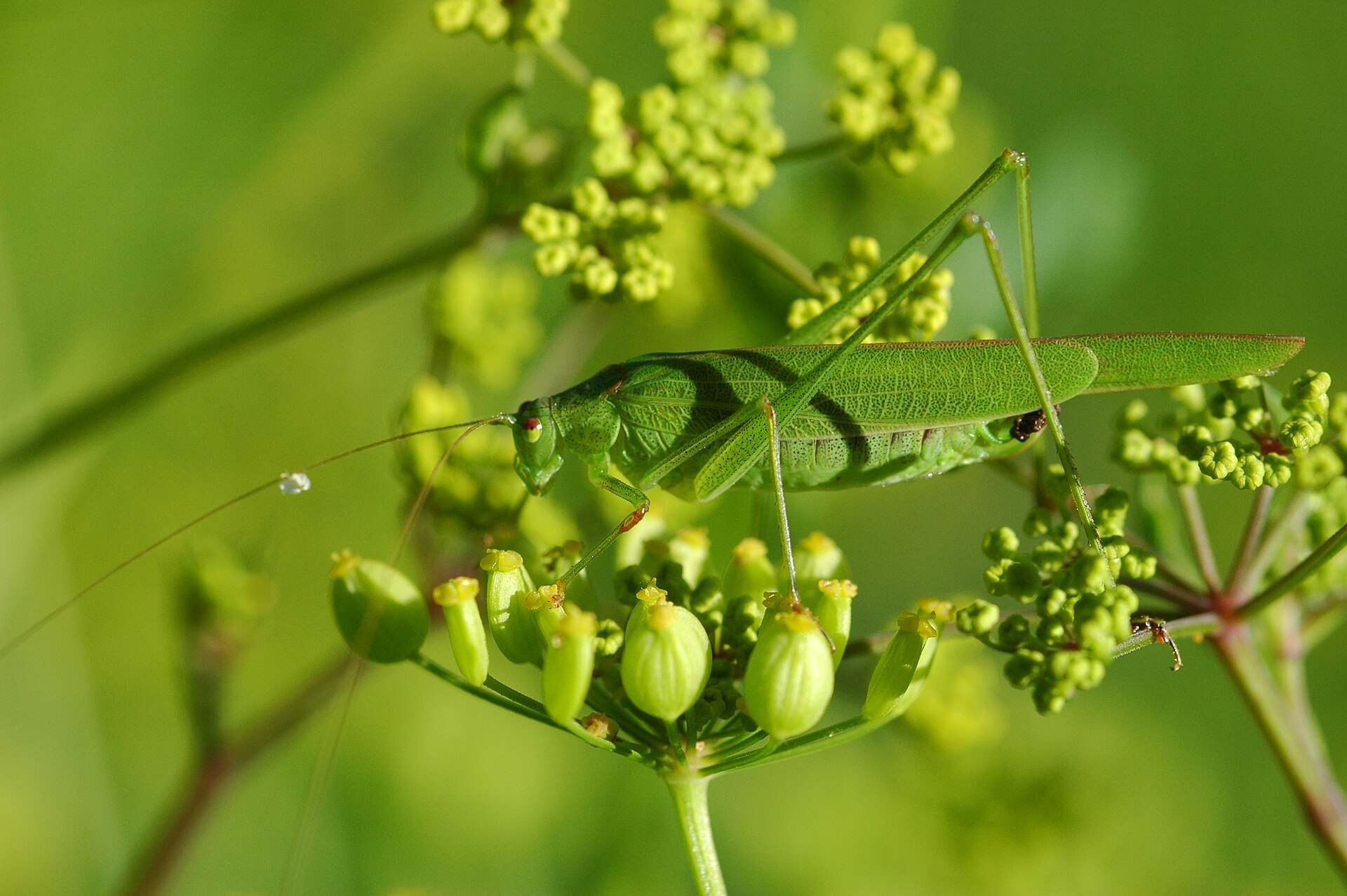
A slender, pale green bush-cricket of 12 to 18 millimetres with strikingly long wings: the hindwings project well beyond the forewings. The decisive feature is the female ovipositor: short, broad and curved upwards at an almost right angle, like a sickle. That is where the species gets its name.
What does a Sickle-bearing Bush-cricket sound like?
Recording: http://bio.acousti.ca/node/9826, CC BY 3.0, via Wikimedia Commons
Where do you see this species in the Netherlands?
Originally a southern species that has established itself in the south of the Netherlands and in Belgium and is expanding northwards. Locally fairly common; as a good flier it can spread quickly.
Habitat: Sunny, densely vegetated slopes, terraces and rank vegetation in wooded surroundings, and also scrub, woodland edges and overgrown verges. It looks for warmth and structure.
This is a common, widespread species: you can come across it in far more places than the areas listed below. Treat that list as a starting point rather than a full survey.
📍 Nationaal Park Veluwezoom
presence reported📍 Nationaal Park De Hoge Veluwe
presence reported📍 Deelerwoude
presence reported📍 Nationaal Park Sallandse Heuvelrug
presence reported📍 Nationaal Park De Meinweg
presence reported📍 Nationaal Park De Groote Peel
presence reported📍 Sint-Pietersberg & Zuid-Limburg
presence reported📍 Nationaal Park Utrechtse Heuvelrug
presence reported📍 Nationaal Park Zuid-Kennemerland
presence reported📍 Planken Wambuis
presence reported📍 Grensmaas
presence reported📍 Eemland
presence reported📍 Leuvenumse Bossen
presence reported📍 Oostelijke Vechtplassen
presence reported📍 Noordhollands Duinreservaat
presence reported📍 Wormer- en Jisperveld
presence reported📍 Meijendel & Berkheide
presence reported📍 Kampina & Oisterwijkse Vennen
presence reported📍 De Maashorst
presence reported📍 Strabrechtse Heide & Beuven
presence reported📍 Loonse en Drunense Duinen
presence reported📍 Schoorlse Duinen
presence reportedThese links come straight from our database, with the chance, the source and the evidence level for each area.
When is the best time?
Green = present · orange = peak period. The bar is generated from our database.
Best period: Adults from August to October, later than most species.
Best time of day: Late afternoon and evening, when the very high, short ticks sound.
Recent sightings
👁️ Where has this species been seen recently?
Check the current sightings on Waarneming.nl. A useful addition to our own verified information.
How to improve your chances
- Listen first. Almost every species gives itself away by singing before you spot it.
- Go on a warm, windless afternoon. In cold or wind they fall silent.
- Walk slowly and note where the sound stops. That is where it sits, usually low in the vegetation.
- A bat detector makes audible the species that sing too high for human ears.
🎒 What you need for this
A bat detector. The song is so high in the spectrum that many people can no longer hear it with the naked ear.
Photography
Search at evening dusk with a torch along overgrown woodland edges; the animals then sit high on leaves. Photograph with a macro lens and a diffused flash, and with a female try to get the curved ovipositor in profile: that is the photograph that explains the species.
🌿 Watching responsibly
Keep your distance, stay on the paths, and never lure animals with food or sound. Leave as soon as an animal becomes uneasy.
Status: Verified · Last checked: 2026-08-08