
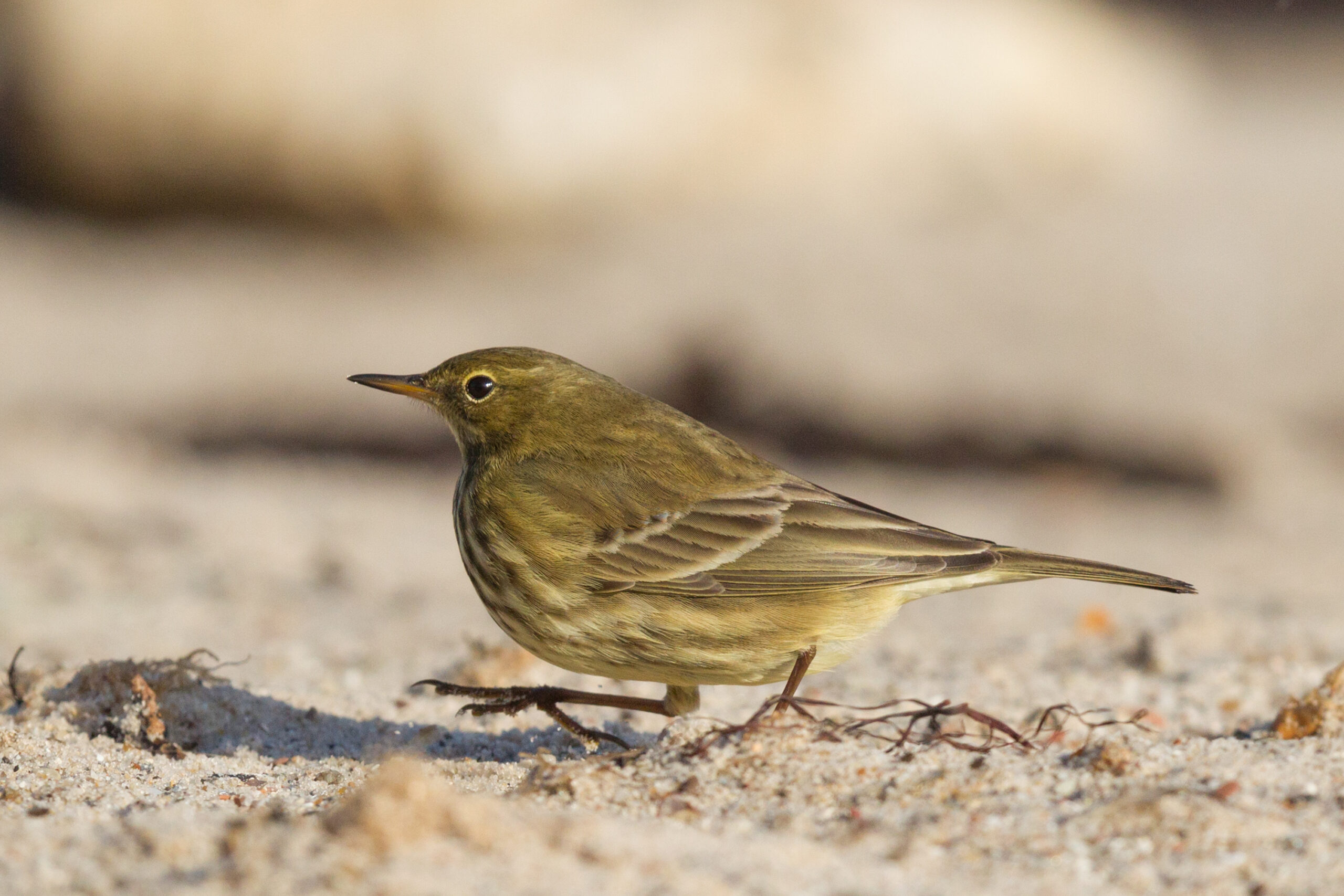
Where to see the Rock Pipit in the Netherlands
With luck 🦅 Bird
Where and when do you see a Rock Pipit? With some luck you can see this species, from September to April.
How do you recognise a Rock Pipit?
A relatively hefty pipit of 16.5 to 17 cm with dark legs and a fairly long, dark bill. The upperparts are brownish grey with a faint olive tinge and vague dark streaking; the underparts are off-white with dark streaking. The outer tail feathers are greyish white rather than pure white. The eyebrow stripe is short and inconspicuous. The whole bird looks darker and more coarsely streaked than a Meadow Pipit.
Wingspan: 25 cm an indication from Wikidata; it varies by individual, sex and subspecies · compare all birds (in Dutch)
What does a Rock Pipit sound like?
Recording: British Library, CC BY-SA 4.0, via Wikimedia Commons
Where do you see this species in the Netherlands?
A winter visitor and passage migrant along the coast; not a breeding bird in the Netherlands. In the winters of 2012/13 to 2014/15 it involved 5,000 to 10,000 birds, with another 2,000 to 10,000 passage migrants. Almost all of them belong to the Scandinavian subspecies littoralis.
📍 Wadden Sea
Good chance in season chance per source📍 Nationaal Park Oosterschelde
Good chance in season chance per source📍 Noordhollands Duinreservaat
presence reported📍 De Dollard
presence reported📍 Meijendel & Berkheide
presence reported📍 Schoorlse Duinen
presence reported📍 Haringvlietsluizen
presence reported📍 De Putten bij Camperduin
presence reportedThese links come straight from our database, with the chance, the source and the evidence level for each area.
When is the best time?
Green = present · orange = peak period. The bar is generated from our database.
Best period: Autumn passage from September to November, wintering into March, return passage in March and April.
Best time of day: Around high tide, when the birds forage on the topmost stones.
Recent sightings
👁️ Where has this species been seen recently?
Check the current sightings on Waarneming.nl. A useful addition to our own verified information.
How to improve your chances
- Learn the calls first. You will hear most birds before you see them.
- Go in the first hour after sunrise, when the song is at its peak and the wind is still down.
- Use a hide or natural cover. Sitting still gets you more than walking closer.
- Keep the sun behind you. Against the light you see a silhouette and no colour.
🎒 What you need for this
Binoculars and shoes with grip. The birds usually let you approach closely on the stones.
Photography
Sit down on the dyke and let the bird come to you; rock pipits have a fixed foraging route along the waterline. Photograph low, with the wet basalt blocks as a dark background against which the streaked breast stands out.
🌿 Watching responsibly
Keep your distance, stay on the paths, and never lure animals with food or sound. Leave as soon as an animal becomes uneasy.
Status: Verified · Last checked: 2026-08-08