
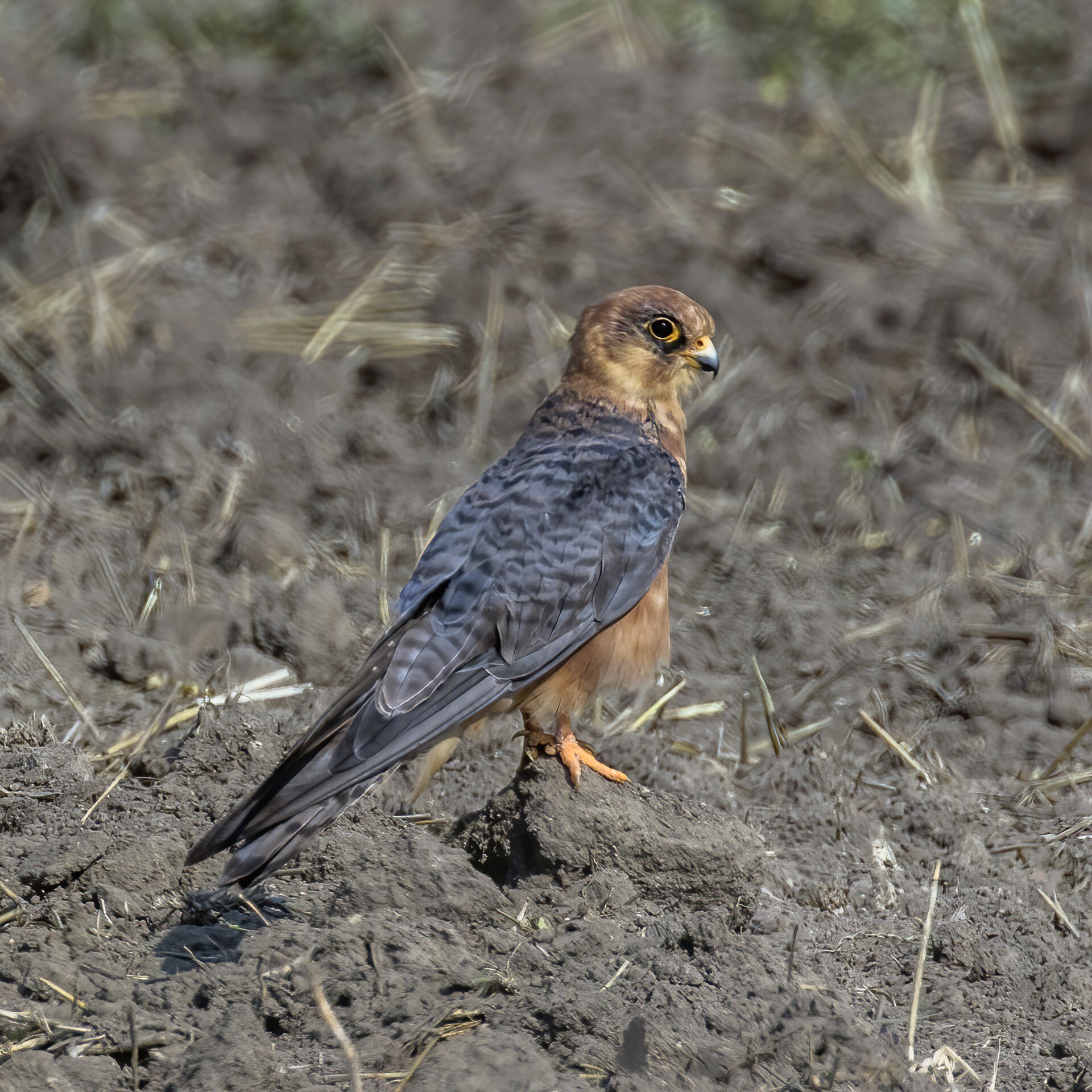
Where to see the Red-footed Falcon in the Netherlands
Very rare 🦅 Bird Sensitive species · R3
🛡️ No exact locations, on purpose
This is a sensitive species. We deliberately show no nest sites, and during the breeding season (March to July) we are extra careful about exact spots. Why we do that.
Where and when do you see a Red-footed Falcon? This species is very rarely seen, in April, May, June, August, September and October.
How do you recognise a Red-footed Falcon?
A small falcon of 28 to 34 centimetres with a wingspan of 65 to 76 centimetres. The male is entirely slate grey with rusty red trousers and undertail and orange-red legs and bill base. The female has a rusty brown underside and head with a blue-grey, black-barred upperside and a dark face mask. Young birds, most often seen here, resemble young hobbies but have white cheeks and a rusty brown crown.
What does a Red-footed Falcon sound like?
Recording: Bubulcus, CC BY 3.0, via Wikimedia Commons
Where do you see this species in the Netherlands?
No fixed distribution; during influxes above all in the east, with the Fochteloerveen as a well-known spot.
📍 Amsterdamse Waterleidingduinen
presence reported📍 Fochteloërveen
presence reported📍 Nationaal Park Dwingelderveld
presence reported📍 Planken Wambuis
presence reported📍 Noordhollands Duinreservaat
presence reported📍 Meijendel & Berkheide
presence reported📍 De Maashorst
presence reported📍 Strabrechtse Heide & Beuven
presence reportedThese links come straight from our database, with the chance, the source and the evidence level for each area.
When is the best time?
Green = present · orange = peak period. The bar is generated from our database.
Best period: Spring migration from late April to early June with the peak in May; autumn migration August to mid-October.
Best time of day: During the day, above all late afternoon and evening.
Recent sightings
👁️ Where has this species been seen recently?
Check the current sightings on Waarneming.nl. A useful addition to our own verified information.
Current sightings on Waarneming.nl →
Note: for sensitive species the source already blurs or withholds sightings. We do not reproduce exact locations.
How to improve your chances
- Learn the calls first. You will hear most birds before you see them.
- Go in the first hour after sunrise, when the song is at its peak and the wind is still down.
- Use a hide or natural cover. Sitting still gets you more than walking closer.
- Keep the sun behind you. Against the light you see a silhouette and no colour.
🎒 What you need for this
Binoculars; a telescope when it sits on a post far out in the field
Photography
It hunts by hovering and from posts and wires, often in the late afternoon above insect-rich grassland. That makes it predictable: pick a post it returns to and wait, rather than following it in flight
🌿 Watching responsibly
Keep your distance, stay on the paths, and never lure animals with food or sound. Leave as soon as an animal becomes uneasy. This is a sensitive species. We deliberately show no nest sites, and during the breeding season (March to July) we are extra careful about exact spots.
Status: Verified · Last checked: 2026-08-07