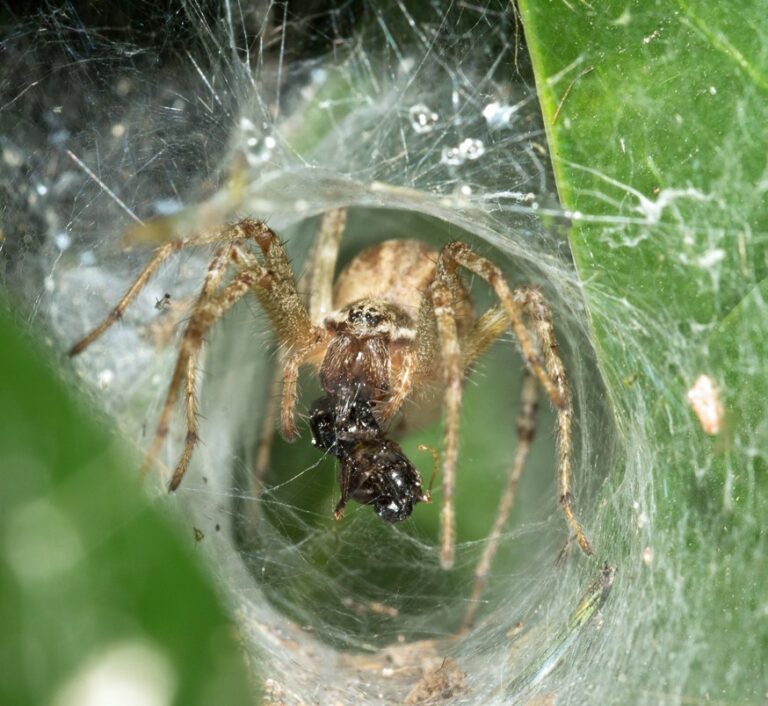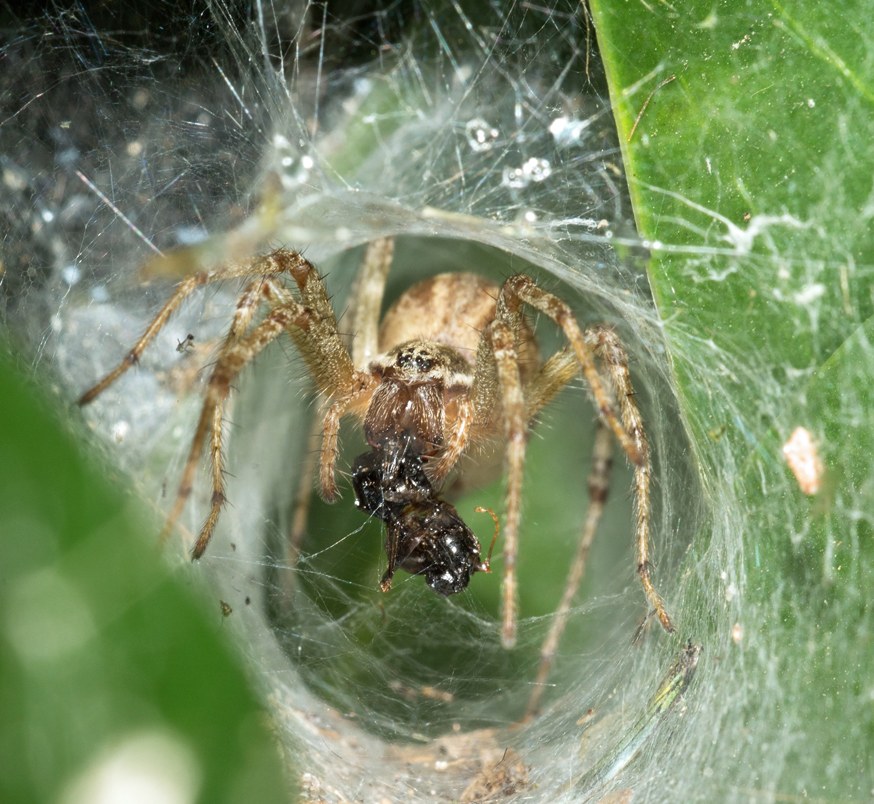
Where to see the labyrinth spider in the Netherlands
Easy 🕷️ Spider
Where and when do you see a labyrinth spider? This species is easy to see, from June to October.
How do you recognise a labyrinth spider?
The abdomen has a pale brown central stripe with a darker, greyish band on either side; within those dark bands stand small white dashes or chevrons (NatureSpot). Females 10.0 to 16.5 mm, males 8.0 to 14.0 mm. The body lengths come from Spiders of Europe (Nentwig et al., araneae.nmbe.ch); those are European ranges, not Dutch measurements.
What can you confuse a labyrinth spider with?
Looks like: Giant house spider
- NatureSpot names no similar species. In practice the horizontal sheet with its long funnel is the strongest feature, although none of the sources consulted states that explicitly as an identification feature.
- House spider (Eratigena): also builds a funnel web, but indoors and in dark corners, not low in sunny grass.
Where do you see this species in the Netherlands?
Common in rough, sunny vegetation throughout the country. Dutch trend figures are lacking.
📍 Leuvenumse Bossen
presence reported📍 Nationaal Park De Biesbosch
presence reported📍 Nationaal Park Veluwezoom
presence reported📍 Nationaal Park De Hoge Veluwe
presence reported📍 Noordhollands Duinreservaat
presence reported📍 Meijendel & Berkheide
presence reported📍 Kampina & Oisterwijkse Vennen
presence reported📍 Strabrechtse Heide & Beuven
presence reported📍 Loonse en Drunense Duinen
presence reported📍 Schoorlse Duinen
presence reportedThese links come straight from our database, with the chance, the source and the evidence level for each area.
When is the best time?
Green = present · orange = peak period. The bar is generated from our database.
Best period: NatureSpot gives June to October, with a peak in July and August. Note: the months come from British sources (the British Arachnological Society and NatureSpot), but this is not a Dutch measurement.
Best time of day: Early morning. There is dew on the sheet web then and you can see it from metres away. Later in the day it dries off and you look straight past it.
Recent sightings
👁️ Where has this species been seen recently?
Check the current sightings on Waarneming.nl. A useful addition to our own verified information.
How to improve your chances
- Go early, pick one spot, and let the animal come to you.
- Wear muted colours, skip the scent, and put your phone on silent.
- Look first for where one habitat turns into another. That is where most of the movement is.
- Be patient. Expect to come back more than once before it works.
🎒 What you need for this
A macro lens; a kneeling pad helps, because the web sits low.
Photography
Photograph the web, not just the spider. Lie down on the ground and take in the depth of the funnel, with the spider waiting in its throat. Early morning dew makes the structure of the sheet visible; without dew you are photographing air.
🌿 Watching responsibly
Keep your distance, stay on the paths, and never lure animals with food or sound. Leave as soon as an animal becomes uneasy.
Status: Verified · Last checked: 2026-10-28
More photos