
Where to see the whiskered bat in the Netherlands
Rare 🦇 Mammal (bat) Sensitive species · R2
🛡️ No exact locations, on purpose
This is a sensitive species. We deliberately show no resting places such as setts, burrows or winter roosts, and no photographs in which such a place is recognisable. Why we do that.
Where and when do you see a whiskered bat? This species is rarely seen, from April to October.
How do you recognise a whiskered bat?
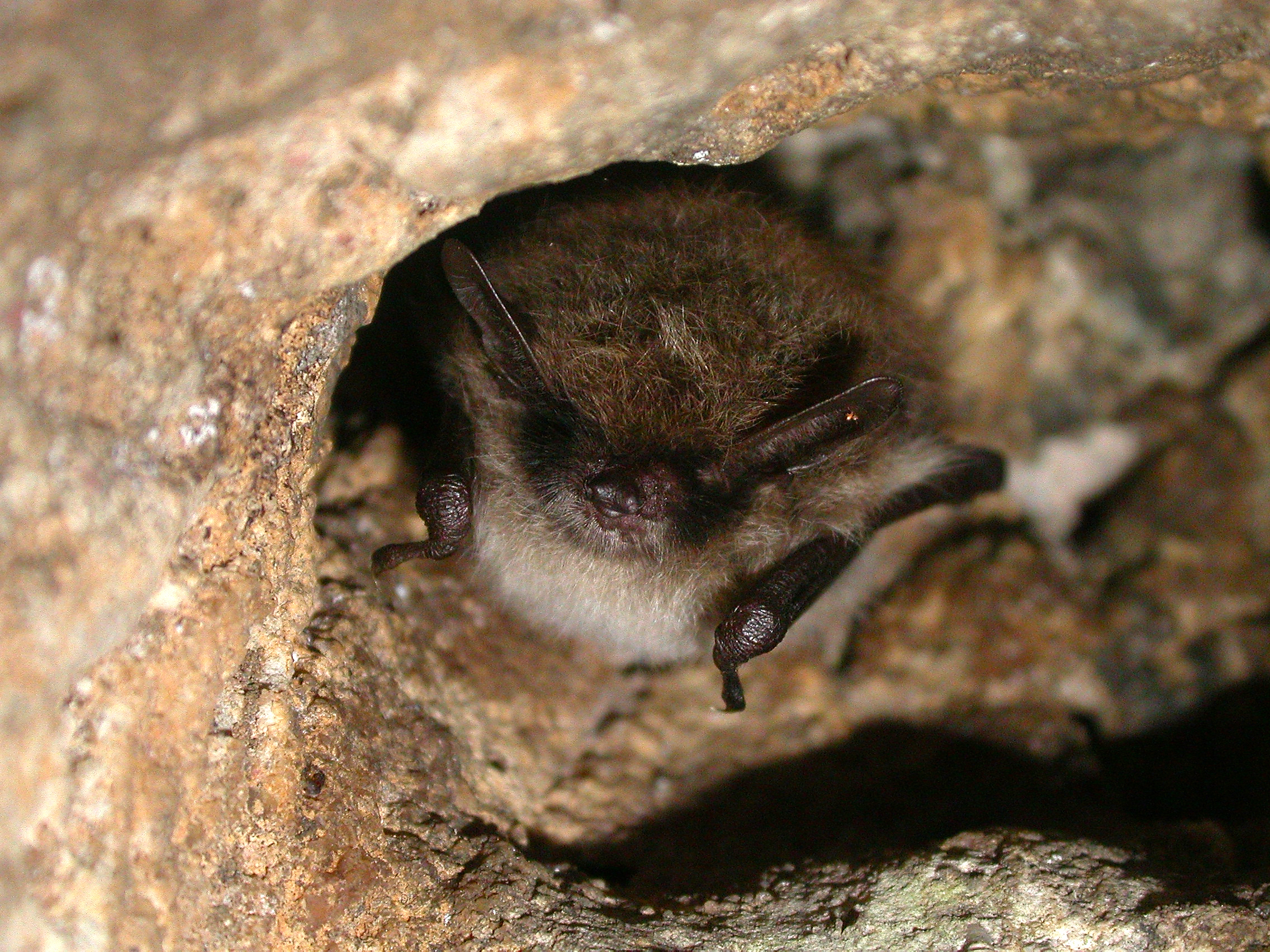
A small bat with a pale, greyish belly and a dark brown to yellowish brown back. The short, dark brown ears taper to a point; the tragus reaches about halfway up the ear. Head and body up to 48 millimetres, 4 to 8 grams, wingspan 19 to 22.5 centimetres, forearm 32 to 36.5 millimetres.
What tracks does a whiskered bat leave?
Droppings: diameter up to just over 2 mm, length 5 to 10 mm, about the same size as those of the Common pipistrelle and Nathusius' pipistrelle. In practice this is the only trace a bat leaves, and they cannot be assigned to species: Zodion calls bat droppings very hard to identify. Because bats eat nothing but insects, the droppings consist entirely of insect remains and not of plant material, and that is how you tell them from mouse droppings of the same size. Anyone wanting to know which species is flying will get further with sound than with traces.
Where do you see this species in the Netherlands?
It occurs throughout the Netherlands but is generally rare in summer. In winter it has been found almost everywhere, in fairly large numbers. There is local decline: at one winter site the numbers fell from over a thousand in 2012 to a few dozen.
📍 Nationaal Park Utrechtse Heuvelrug
presence reported📍 Sint-Pietersberg & Zuid-Limburg
presence reported📍 Onlanden & Leekstermeer
presence reported📍 Zwin & Zeeuws-Vlaanderen
presence reported📍 Wormer- en Jisperveld
presence reported📍 Meijendel & Berkheide
presence reported📍 Strabrechtse Heide & Beuven
presence reportedThese links come straight from our database, with the chance, the source and the evidence level for each area.
When is the best time?
Green = present · orange = peak period. The bar is generated from our database.
Best period: Active from April to October; hibernating in underground spaces from October to March.
Best time of day: About half an hour after sunset.
Recent sightings
👁️ Where has this species been seen recently?
Check the current sightings on Waarneming.nl. A useful addition to our own verified information.
Current sightings on Waarneming.nl →
Note: for sensitive species the source already blurs or withholds sightings. We do not reproduce exact locations.
How to improve your chances
- Keep the wind in your face. Most mammals will smell you long before they see you.
- Arrive before sunrise and then stay put. Sitting still beats walking about.
- Wear muted colours, skip the scent, and put your phone on silent.
- Be patient. Expect to come back more than once before it works.
🎒 What you need for this
A bat detector. Sight alone is not enough for this species, and even the detector gives no certainty.
Photography
Never disturb a hibernating animal. A whiskered bat hanging in hibernation in a quarry or cellar is woken by light and warmth and then burns reserves it cannot spare. Photograph only from a distance and without flash.
🌿 Watching responsibly
Keep your distance, stay on the paths, and never lure animals with food or sound. Leave as soon as an animal becomes uneasy. This is a sensitive species. We deliberately show no resting places such as setts, burrows or winter roosts, and no photographs in which such a place is recognisable.
Status: Verified · Last checked: 2026-08-08