
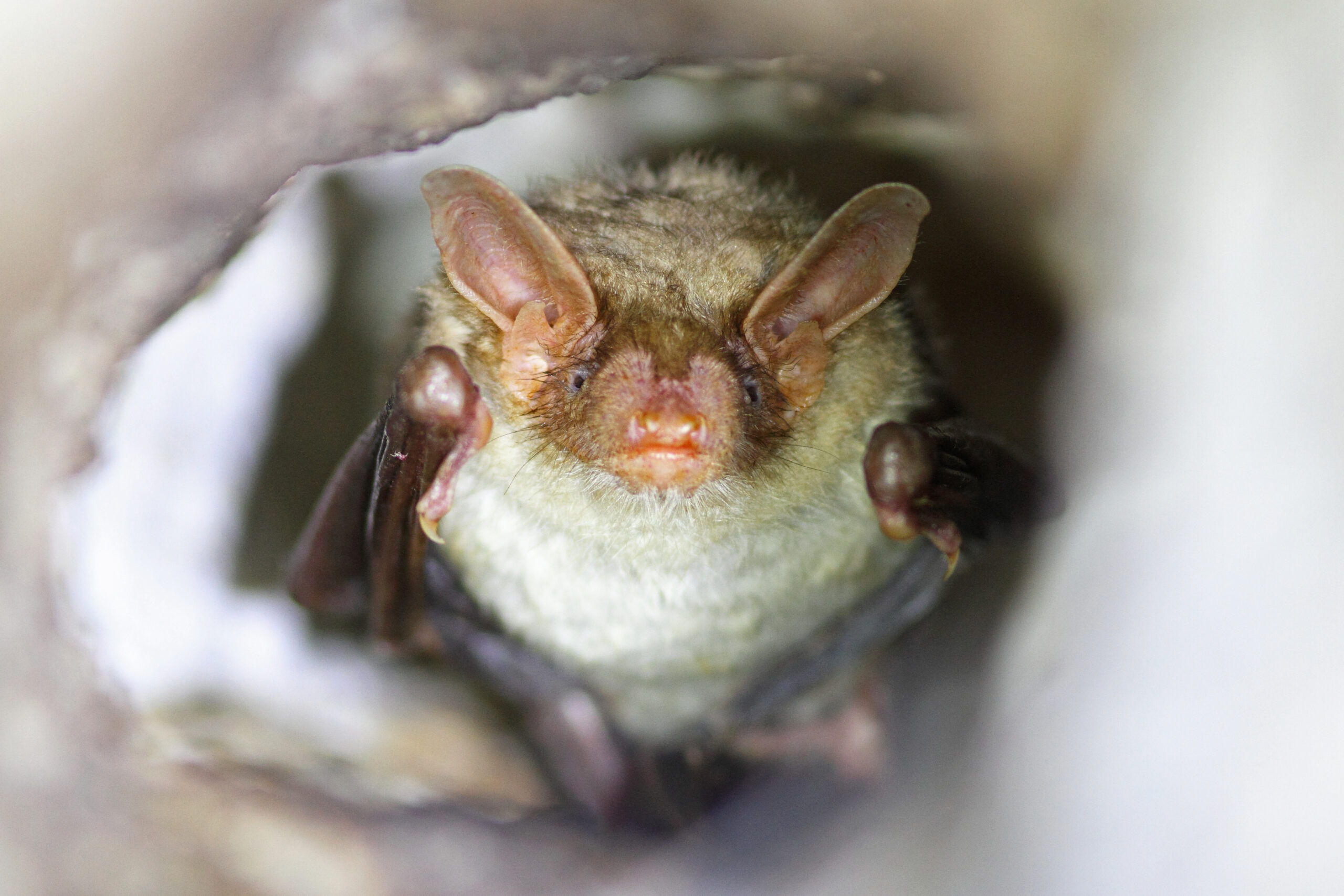
Where to see the greater mouse-eared bat in the Netherlands
Very rare 🦇 Mammal (bat) Sensitive species · R2
🛡️ No exact locations, on purpose
This is a sensitive species. We deliberately show no resting places such as setts, burrows or winter roosts, and no photographs in which such a place is recognisable. Why we do that.
Where and when do you see a greater mouse-eared bat? This species is very rarely seen, from April to October.
How do you recognise a greater mouse-eared bat?
One of the largest bats in the Netherlands. The fur is thick and short, yellowish brown to reddish brown on the back and whitish grey to beige on the belly; young animals are darker. The snout is long and broad, the ears fairly long and broad with seven to eight transverse folds, and the tragus broadly built. Head and body 67 to 84 millimetres, 28 to 40 grams, wingspan 35 to 43 centimetres, forearm 55 to 67 millimetres.
What tracks does a greater mouse-eared bat leave?
Droppings: diameter 3 to 4 mm, length 8 to 15 mm or more. In practice this is the only trace a bat leaves, and they cannot be assigned to species: Zodion calls bat droppings very hard to identify. Because bats eat nothing but insects, the droppings consist entirely of insect remains and not of plant material, and that is how you tell them from mouse droppings of the same size. Anyone wanting to know which species is flying will get further with sound than with traces.
Where do you see this species in the Netherlands?
Found mainly as a hibernating animal in South Limburg, with occasional reports from Gelderland and Utrecht. The only recent maternity colony is in the Geul valley and was discovered in 2018.
📍 Nationaal Park Zuid-Limburg (in formation)
presence reported📍 Sint-Pietersberg & Zuid-Limburg
presence reported📍 Planken Wambuis
presence reported📍 Blauwe Kamer
presence reported📍 Meijendel & Berkheide
presence reportedThese links come straight from our database, with the chance, the source and the evidence level for each area.
When is the best time?
Green = present · orange = peak period. The bar is generated from our database.
Best period: Active from spring to autumn; in winter in the marl quarries of South Limburg.
Best time of day: Twenty to thirty minutes after sunset.
Recent sightings
👁️ Where has this species been seen recently?
Check the current sightings on Waarneming.nl. A useful addition to our own verified information.
Current sightings on Waarneming.nl →
Note: for sensitive species the source already blurs or withholds sightings. We do not reproduce exact locations.
How to improve your chances
- Keep the wind in your face. Most mammals will smell you long before they see you.
- Arrive before sunrise and then stay put. Sitting still beats walking about.
- Wear muted colours, skip the scent, and put your phone on silent.
- Be patient. Expect to come back more than once before it works.
🎒 What you need for this
Binoculars and a bat detector. Size alone identifies it: no other Myotis in the Netherlands reaches these dimensions.
Photography
Look for it low over short vegetation: it hunts at one to two metres with its head pointing down and lands to seize its prey. That is quite different behaviour from most bats and makes it recognisable in the field.
🌿 Watching responsibly
Keep your distance, stay on the paths, and never lure animals with food or sound. Leave as soon as an animal becomes uneasy. This is a sensitive species. We deliberately show no resting places such as setts, burrows or winter roosts, and no photographs in which such a place is recognisable.
Status: Verified · Last checked: 2026-08-08