
Where to see the Small Red-eyed Damselfly in the Netherlands
Easy 🪰 Dragonfly
Where and when do you see a Small Red-eyed Damselfly? This species is easy to see, from June to September.
How do you recognise a Small Red-eyed Damselfly?
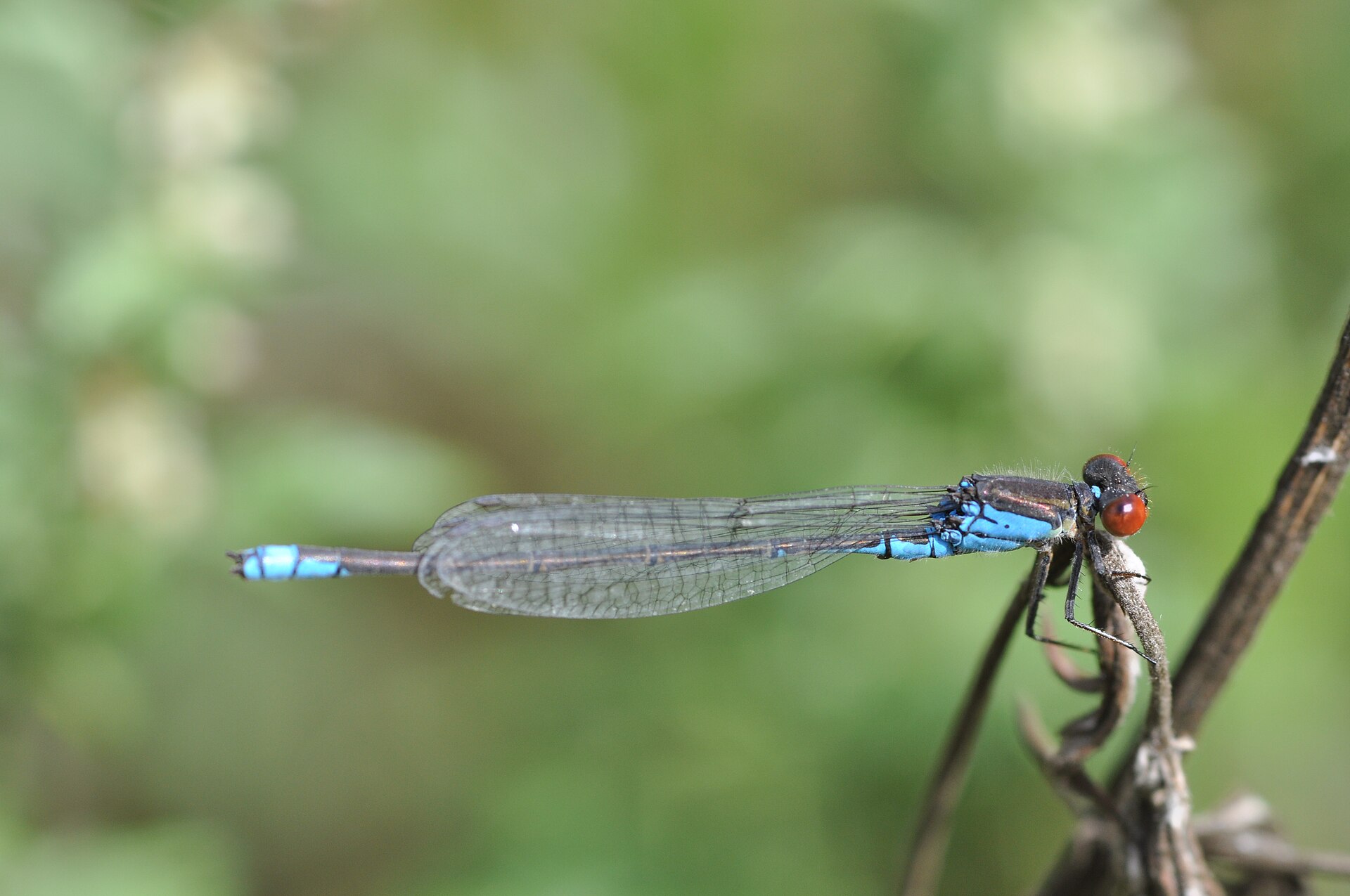
A small damselfly of 26 to 32 millimetres, smaller and slimmer than the large red-eyed damselfly. The male has bright red eyes, a black thorax with blue sides and complete shoulder stripes, and, the decisive feature, a black X shape in the blue of segment 9 seen from above. Females have brown eyes and are yellow or green below.
Where do you see this species in the Netherlands?
Throughout the country, most numerous in South Holland, Utrecht and the river area; also on the Wadden Islands.
Habitat: All kinds of still and slow-flowing waters with plenty of floating water plants, preferably fine-leaved species.
This is a common, widespread species: you can come across it in far more places than the areas listed below. Treat that list as a starting point rather than a full survey.
📍 Sint-Pietersberg & Zuid-Limburg
presence reported📍 Gelderse Poort & Millingerwaard
presence reported📍 Nationaal Park De Biesbosch
presence reported📍 Nationaal Park Weerribben-Wieden
presence reported📍 Nationaal Park Zuid-Kennemerland
presence reported📍 Amsterdamse Waterleidingduinen
presence reported📍 Nationaal Park De Groote Peel
presence reported📍 Oostvaardersplassen
presence reported📍 Nationaal Park Utrechtse Heuvelrug
presence reported📍 Naardermeer
presence reported📍 Deelerwoude
presence reported📍 Nationaal Park De Hoge Veluwe
presence reported📍 Onlanden & Leekstermeer
presence reported📍 Oostelijke Vechtplassen
presence reported📍 Noordhollands Duinreservaat
presence reported📍 Wormer- en Jisperveld
presence reported📍 Ilperveld
presence reported📍 Zuidlaardermeergebied en Hunzedal
presence reported📍 Meijendel & Berkheide
presence reported📍 Kampina & Oisterwijkse Vennen
presence reported📍 Loonse en Drunense Duinen
presence reported📍 Schoorlse Duinen
presence reportedThese links come straight from our database, with the chance, the source and the evidence level for each area.
When is the best time?
Green = present · orange = peak period. The bar is generated from our database.
Best period: Mid-June to the end of September, with the peak from late July to mid-August.
Best time of day: The warm hours in the middle of the day.
Recent sightings
👁️ Where has this species been seen recently?
Check the current sightings on Waarneming.nl. A useful addition to our own verified information.
How to improve your chances
- Go on a warm, windless day between about ten and four, when they are active.
- Look for the place rather than the animal: flowery edges for butterflies, banks and open water for dragonflies.
- Move slowly and keep your shadow off the animal. It notices that before it notices you.
- Early in the morning they are still cold and motionless on a leaf. That is when you can get closest.
🎒 What you need for this
Binoculars with a short focusing distance; they often sit beyond macro range
Photography
They sit on floating plants out in the middle of the water, so a macro lens will not reach. Work with a telephoto lens from the bank, or find a jetty. You want the X shape on segment 9 from above
🌿 Watching responsibly
Keep your distance, stay on the paths, and never lure animals with food or sound. Leave as soon as an animal becomes uneasy.
Status: Verified · Last checked: 2026-08-07